
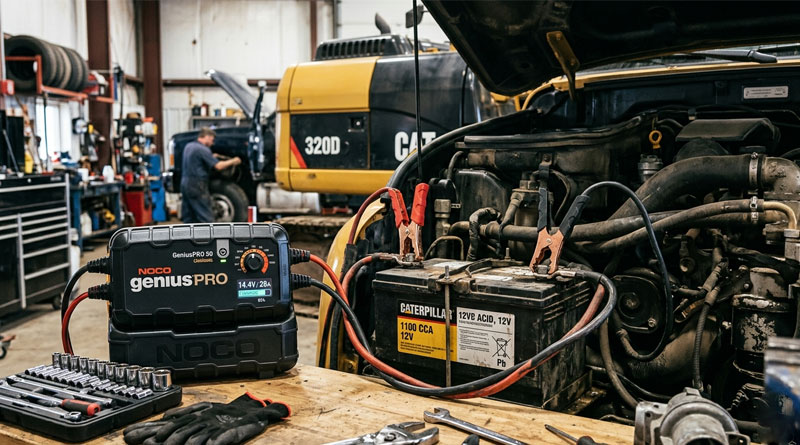
Maintaining high-capacity batteries requires specialized equipment that can handle significant power loads without compromising safety. Heavy-duty chargers provide the high amperage and advanced recovery modes necessary for trucks, boats, and commercial fleets. This guide highlights top-tier chargers engineered for durability, rapid recovery, and long-term maintenance in demanding environments and extreme weather conditions.
1. NOCO Genius GENPRO10X4 4-Bank Onboard Charger

- Total Output: 40 Amps (10A per bank)
- Compatibility: 12V Lead-Acid and Lithium-ion
- Protection Rating: IP68 Waterproof
- Special Mode: Force Mode for 0V batteries
The GENPRO10X4 is a premier heavy-duty solution for marine and multi-battery systems. This four-bank powerhouse delivers a dedicated 10 amps to each battery, allowing for independent charging of starter and deep-cycle systems simultaneously. Its compact, fully-sealed housing is rated IP68, ensuring it survives thousands of hours in the most brutal underwater and saltwater environments while maintaining peak performance.
Precision is a hallmark of this unit, featuring integrated thermal sensors that adjust the charging profile based on ambient temperatures. This prevents undercharging in freezing conditions and overcharging in the summer heat. The refined mounting system is designed to handle high-vibration environments, making it ideal for permanent installation in boats or heavy equipment where shock and noise isolation are critical.
- Pros:
- Independently charges four separate batteries
- Fully waterproof and shock-resistant design
- Recovers deeply discharged batteries from 0V
- Cons:
- Permanent mounting required for best use
- Higher price point for multi-bank tech
2. YONHAN 20A Fully Automatic Battery Maintainer

- Output: 12V 20A / 24V 10A
- Charging Stages: 7-stage automatic quick charge
- Display: Extra-large visualized LCD screen
- Technology: High/Low-frequency pulse repair
The YONHAN 20A is a versatile heavy-duty charger capable of handling both 12V and 24V systems. It is significantly faster than standard maintainers, making it a “must-have” for trucks, SUVs, and tractors. The 7-stage charging process intelligently manages battery health, while the advanced pulse repair mode works to recover old or idle batteries by eliminating sulfation, effectively extending their operational lifespan during long storage periods.
This unit shines in seasonal maintenance, offering dedicated winter and summer modes that adapt the charging rate to ambient temperature changes. The bright, extra-large LCD screen provides clear real-time data on voltage, current, and charging percentage, even under direct sunlight. It includes multiple safety protections against overcharging and short circuits, ensuring a worry-free experience for long-term holiday battery maintenance.
- Pros:
- Dual voltage 12V/24V versatility
- Fast charging for large-capacity batteries
- Visualized data on a bright LCD
- Cons:
- Not a standalone jump starter
- Cannot repair physically damaged cells
3. E-FAST 25A Smart Car Battery Charger

- Max Output: 25A for 12V / 15A for 24V
- Booster Mode: 200-second emergency start assist
- Housing: Rugged Aluminum Alloy shell
- Adjustability: 5-level selectable current
The E-FAST 25A is engineered specifically for heavy-duty automotive and commercial tasks. Its rugged aluminum housing provides superior heat dissipation compared to plastic units, supported by active fan cooling for high-amperage sessions. The standout feature is the 200-second “Booster” mode, which provides a concentrated surge of power to help jump-start a depleted 12V battery, making it an essential garage tool for emergencies.
Unlike “one-size-fits-all” chargers, this device allows for manual current adjustment from a 2A trickle for small motorcycles up to 25A for massive truck batteries. It features an 8-stage charging process and a dedicated 16-hour repair mode to desulfate plates. With its intelligent all-weather sensors, the unit automatically switches between winter and summer modes to guarantee a full, safe charge regardless of the climate.
- Pros:
- Unique 200s Booster jump-start assist
- Durable aluminum alloy construction
- Customizable amperage for different sizes
- Cons:
- Booster mode limited to 12V only
- Fans can be loud at 25A output
4. WAVLINK 280W Smart Battery Charger

- Voltage Support: 6V, 12V, and 24V
- Peak Amperage: 20A maximum
- Charging Modes: Charge, Maintain, Desulfate, Force
- Display: Real-time LCD status monitor
The WAVLINK 280W is a comprehensive diagnostic and charging station for a wide variety of battery chemistries, including LiFePO4 and traditional Lead-Acid. It features four distinct operation modes, with a “Force” mode that allows users to initiate charging on batteries that have dropped to zero volts. This makes it an invaluable tool for recovering neglected deep-cycle batteries in golf carts, tractors, and boats.
Safety is integrated into every stage of the WAVLINK’s multi-stage process, from soft-start functions to spark-proof and fireproof protections. The intuitive LCD screen keeps the user informed by displaying current, voltage, and temperature in real-time, allowing for precise monitoring of the desulfation process. Its wide operating temperature range ensures consistent and safe power delivery from freezing winters to scorching summer afternoons.
- Pros:
- Supports 6V, 12V, and 24V batteries
- Recovers zero-volt “dead” batteries
- Comprehensive safety protection system
- Cons:
- Cables could be longer for tractors
- Force mode requires careful monitoring
5. NOCO GENIUS10 Smart Battery Charger

- Amperage: 10 Amps output
- Modes: 6V, 12V, Lithium, and Repair
- Design: 17% smaller than previous models
- Warranty: 3-year limited warranty
The NOCO GENIUS10 is a highly efficient, all-in-one charging solution that delivers 115% more power than its predecessors in a significantly more compact frame. It serves as a charger, maintainer, and desulfator for a massive range of vehicles, from lawn mowers to heavy-duty trucks. Its advanced thermal sensor dynamically adjusts the charge based on the ambient temperature, ensuring your battery never overcharges in the heat.
A key advantage of the GENIUS10 is its ability to recover deeply discharged batteries down to 1 volt, with a “Force Mode” available for batteries at zero volts. Unlike traditional trickle chargers, it provides constant monitoring and precision pulse charging to reverse sulfation and acid stratification. This allows users to leave the charger connected indefinitely, providing safe, worry-free maintenance for classic cars or off-season equipment.
- Pros:
- Extremely compact and powerful for 10A
- Safe for long-term indefinite connection
- Advanced precision pulse reconditioning
- Cons:
- Higher cost per amp than budget units
- No 24V support in this model
6. E-FAST 20A Universal Smart Battery Charger
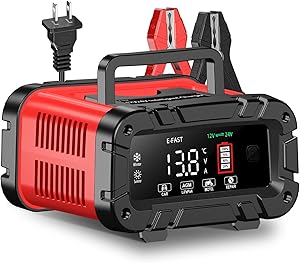
- Versatility: 12V 20A / 24V 10A
- Cycle: 7-stage automatic smart charging
- Repair: High-power pulse technology
- Visuals: Real-time status display
The E-FAST 20A is a robust, universal charging solution tailored for large RV, deep-cycle, and farm vehicle batteries. It employs a sophisticated 7-stage process that includes desulfurization, constant current charging, and floating charge modes, automatically adjusting based on the battery’s real-time internal resistance. This ensures that every battery, from a small motorcycle to a heavy truck, receives an optimized charge that prolongs its lifespan.
This model utilizes high-power pulse technology to rejuvenate old or idle batteries, stripping away vulcanization to restore lost performance. The visualization screen is a major plus, clearly showing each charging stage along with real-time voltage and temperature. Once the battery reaches 100%, the unit automatically stops to prevent overcharging, making it a safe and efficient choice for boaters and commercial vehicle operators.
- Pros:
- Comprehensive 7-stage smart algorithm
- Effective pulse repair for idle batteries
- Intuitive display with automatic stop
- Cons:
- Cannot activate a completely dead cell
- Not designed as a jump starter
7. Schumacher Electric SC1445 Wheeled Manual Charger
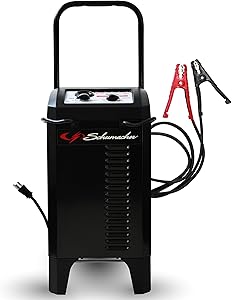
- Engine Start: 250A peak power
- Boost Mode: 50A rapid charge
- Timer: 135-minute manual control
- Construction: Steel case with solid wheels
The Schumacher SC1445 is the ultimate heavy-duty workhorse for commercial garages and fleet maintenance. Delivering a massive 250-amp engine start, it can instantly revive completely dead batteries in trucks and high-performance vehicles. Unlike smart chargers, this manual wheeled unit gives mechanics total control with a 135-minute timer, allowing for customized high-amp sessions tailored to specific battery recovery needs.
Built for the rigors of a shop environment, the SC1445 features a durable steel case, solid wheels, and a retractable handle for easy mobility. It supports 6V and 12V standard, AGM, and deep-cycle batteries, offering a 50-amp boost mode that brings deeply discharged units back to life quickly. It is a time-tested, rugged solution designed for those who need reliable power and manual oversight in a professional setting.
- Pros:
- Incredible 250A engine starting power
- Manual timer for precision charge control
- Rugged, wheeled steel case for mobility
- Cons:
- Manual operation requires constant monitoring
- Too heavy for standard home storage
How to Choose Heavy Duty Battery Chargers
When you are dealing with large-capacity batteries in trucks, commercial boats, or industrial machinery, a standard home-use charger simply won’t suffice. Heavy-duty charging requires high amperage, robust heat dissipation, and advanced diagnostic features to handle the increased internal resistance and storage capacity of these massive cells. Choosing the wrong charger can result in days of downtime or, worse, a permanently damaged battery bank. This guide explores the critical factors you must consider when selecting a heavy-duty charger for your fleet or workshop.
Understanding Amperage and Charging Speed
The primary difference between a standard and a heavy-duty charger is the amperage output. Amperage is essentially the “flow rate” of electricity. For heavy-duty applications, you generally need to look at three distinct levels of power delivery:
High-Amperage Charging (20A to 50A)
Large batteries found in RVs and semi-trucks typically have a high Amp-Hour (Ah) rating. To charge these in a reasonable timeframe, you need at least 20 to 25 amps. A 10-amp charger might take 24 hours to fill a large deep-cycle battery, whereas a 25-amp heavy-duty unit can do it in 8 to 10 hours. High-amperage units are essential for minimizing downtime in commercial settings.
Boost and Engine Start Modes
True heavy-duty chargers often include a “Boost” mode (typically 50A) for rapid energy infusion and an “Engine Start” mode (250A+). Engine start modes provide a massive, short-duration surge that mimics a jump-start from another vehicle, allowing you to crank over heavy engines even when the battery is critically low. This is a vital feature for fleet managers and professional garages.
Voltage Versatility: 12V vs. 24V Systems
While almost all cars use a 12V system, heavy-duty applications often utilize 24V configurations for better electrical efficiency in large engines and marine setups. Many professional chargers are “Dual Voltage,” allowing you to switch between 12V and 24V modes. Using a 12V-only charger on a 24V system will simply not work, while a 24V charger on a 12V battery can lead to a dangerous overcharge situation. Always verify the voltage requirements of your specific fleet.
Smart vs. Manual Chargers
In the heavy-duty world, there is still a debate between fully automatic “Smart” chargers and manual “Wheeled” chargers.
The Benefits of Smart Chargers
Smart chargers use microprocessors to monitor the battery’s state of charge. They adjust the amperage and voltage in real-time, moving through stages like Bulk, Absorption, and Float. They are safer for long-term maintenance and prevent overcharging. Most modern smart chargers also include “Repair” modes to break down sulfation on the lead plates.
The Benefits of Manual Chargers
Professional mechanics often prefer manual chargers, like wheeled Schumacher units, because they allow for total control. If a battery is so dead that a smart charger’s safety sensor won’t detect it, a manual charger can be used to “force” a high-amperage charge into the battery for a set period. However, manual chargers require constant supervision to ensure the battery doesn’t overheat or gas.
Battery Chemistry Compatibility
Heavy-duty equipment no longer relies solely on standard flooded lead-acid batteries. You must ensure your charger supports the specific chemistry of your battery bank:
- AGM (Absorbent Glass Mat): Requires a specific voltage profile to prevent internal pressure buildup.
- Gel Batteries: Extremely sensitive to overcharging; they require a lower charging voltage.
- LiFePO4 (Lithium): Requires a dedicated lithium charging algorithm to protect the Battery Management System (BMS). Charging lithium on a lead-acid setting can permanently damage the cells.
Construction and Durability for the Shop
A heavy-duty charger is an investment that should withstand a shop environment. Look for rugged materials like aluminum alloy or steel casings rather than thin plastic. Aluminum is particularly effective for heavy-duty units because it acts as a heat sink, dissipating the high heat generated during 25A+ charging sessions. Additionally, check for features like heavy-duty copper clamps, high-gauge wiring, and solid wheels for mobile units.
Environmental Resilience: Waterproofing and Temperature Compensation
If you are charging batteries for marine applications or in outdoor construction sites, environmental protection is critical. Onboard marine chargers should carry an IP68 waterproof rating to survive humidity and direct water contact. Furthermore, “Temperature Compensation” is a must-have. High temperatures require lower charging voltages, while freezing temperatures require higher voltages to penetrate the chemical resistance of the battery. A charger with a thermal sensor ensures the battery is charged correctly regardless of the weather.
Diagnostic and Recovery Features
Heavy-duty batteries are expensive, so recovery features can save you thousands in replacement costs. Look for chargers that offer “Pulse Repair” or “Desulfation” modes. These use high-frequency pulses to break down the lead sulfate crystals that accumulate on the plates of neglected batteries. A “Force Mode” is also helpful for batteries that have dropped to 0V, allowing the charger to bypass its safety checks and begin the recovery process.
Conclusion
Choosing a heavy-duty charger is about matching the scale of the tool to the scale of the task. For multi-battery marine setups, a waterproof multi-bank onboard charger is the standard. For commercial garages, a wheeled manual charger with high engine-start amperage provides the most versatility. By prioritizing high amperage, aluminum heat dissipation, and chemistry-specific charging modes, you can ensure that your heavy equipment stays powered and your expensive batteries last as long as possible.