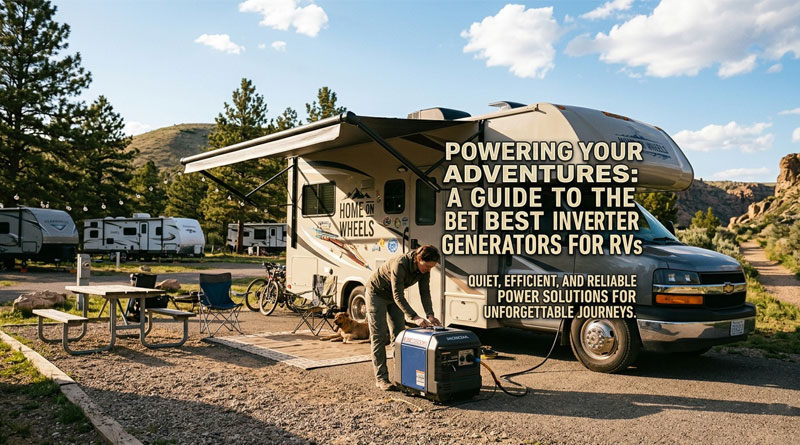
Ditch the deafening roar of old-school metal boxes. Today’s RV road trips demand whisper-quiet, fuel-sipping energy that won’t fry your delicate iPad or camera gear. Modern inverter generators serve up ultra-stable, “clean” electricity, turning off-grid boondocking into a luxury stay. Whether you need to run a heavy-duty air conditioner during a summer heatwave or simply keep the campsite lights glowing, we’ve rounded up the absolute best mobile power stations currently fueling the modern wanderlust lifestyle.
1. PowerSmart Portable Inverter Generator for RV

- Power Output: 3600 starting watts, 3200 running watts (<3% THD)
- Portability: 50 pounds, with built-in handle
- Noise Level: 59 dBA at 23 feet (25% load)
- Outlets: (2) 120V 20A, (1) 120V 30A RV, (1) 12V DC, (2) 5V USB
If you hate breaking a sweat before the campfire is even lit, this featherweight champion is your ticket to easy power. Tipping the scales at a mere 50 pounds, the PowerSmart 3600 packs an unexpected punch, kicking out 3200 continuous watts of pure sine wave energy. It effortlessly runs power-hungry RV essentials like your microwave or air conditioning unit without breaking a sweat, all while keeping the electric current safe and stable for your high-tech gadgets.
Operating at an ultra-quiet 59 decibels, it hums along in the background without drowning out evening conversations. Setting up is effortless thanks to a native 30-amp RV outlet built right into the control board, eliminating the hunt for annoying adapters. When you factor in the fuel-saving Eco Mode and an automatic low-oil shutdown feature, you get a highly reliable, camper-friendly machine that punches well above its weight class.
- Pros:
- Excellent power output for its size
- Very quiet operation
- Lightweight and highly portable
- Cons:
- Moderate run time at half load
- No dual-fuel option
2. WEN Portable Inverter Generator 56360i
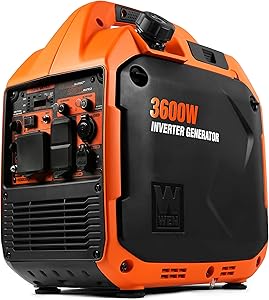
- Engine: 149cc, up to 3600 surge watts, 2900 rated watts
- Power Quality: Clean power (<1.2% THD) for sensitive electronics
- Weight: Ultralight 46 pounds
- Outlets: (2) 120V, (1) TT-30R RV, (1) 12V DC, (2) 5V USB
Minimalists, rejoice. The WEN 56360i shaves away unnecessary bulk to deliver an incredibly compact 46-pound power station that is exceptionally easy to lift. Despite its small profile, the 149cc engine cranks out a solid 2900 rated watts. Crucially, it manages an incredibly low Total Harmonic Distortion of under 1.2%, offering some of the safest, cleanest power you can buy to charge sensitive gear like laptops and cameras.
WEN also built in a clever fuel-shutoff valve that burns through any remaining gas left in the carburetor before the engine stops. This prevents stale fuel build-up and keeps you out of the small-engine repair shop. Combined with a plug-and-play RV outlet and a reassuring three-year warranty, this unit is a brilliant, fuss-free companion for campers who value cargo space and long-term mechanical reliability.
- Pros:
- Extremely lightweight for easy transport
- Generates very clean power (low THD)
- Fuel shutoff feature extends lifespan
- Cons:
- Slightly lower running watts than competitors
- No parallel capability mentioned
3. Pulsar Inverter Generator NE40BiSRCO
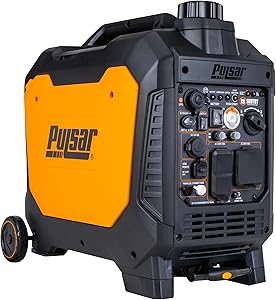
- Fuel Type: Dual Fuel (Gasoline & Propane)
- Power Output: 4000 peak/3200 running watts (gas), 3600 peak/2800 running watts (propane)
- Starting Options: Remote, Push-button, Recoil Start
- Safety Features: Low Oil Shutdown, CO Sentry sensor
Why limit yourself to one fuel source when you can have options? The Pulsar NE40BiSRCO gives you the freedom to run on standard gasoline or clean-burning liquid propane. If you choose gas, you get a powerful 4000 starting watts; switch to propane, and you still enjoy a highly capable 3600 starting watts. This dual-fuel setup is perfect for off-grid trips where finding a gas station might require a long trek.
Starting the generator is incredibly convenient. You can use the wireless remote key fob, press the electric push-button, or fall back on the classic pull-cord. Safety is heavily emphasized here, featuring a CO Sentry sensor that automatically shuts down the system if toxic carbon monoxide builds up. With parallel compatibility to link a second unit, it is a highly adaptable power solution for growing setups.
- Pros:
- Versatile dual-fuel operation
- Multiple convenient starting options
- Enhanced safety with CO Sentry
- Cons:
- Battery for push/remote start not included
- Propane output slightly lower
4. Champion RV Ready Inverter Generator

- Fuel Type: Dual Fuel (Gasoline & Propane)
- Power Output: 4000 starting watts, 3000 running watts (gas)
- Noise Level: Ultra-quiet 64 dBA from 23 feet
- Run Time: Up to 10 hours on gasoline (25 hours on propane)
Champion has earned a stellar reputation in the camping community, and this dual-fuel brute shows exactly why. Ready to go right out of the box, this machine runs for up to 10 hours on a single tank of gas. However, the real magic happens when you hook it up to propane, stretching your continuous runtime to an incredible 25 hours—perfect for sleeping through the night without needing to refuel.
Safety is the priority here, led by Champion’s built-in CO Shield, which detects dangerous carbon monoxide buildup and instantly shuts down the motor. While it relies on a manual pull-start, its dependable, cold-weather-friendly engine turns over easily. Backed by lifetime technical support and a solid three-year warranty, this generator acts as a highly reliable safety net for your off-grid RV excursions.
- Pros:
- Exceptional dual-fuel versatility
- Very long run times, especially on propane
- Ultra-quiet operation
- Cons:
- Parallel kit sold separately
- Manual start only (no electric/remote)
5. Westinghouse Inverter Generator

- Power Output: 4000 peak watts, 3300 rated watts (<3% THD)
- Fuel Type: Dual Fuel (Gasoline & Propane)
- Starting Options: Remote, Electric, Recoil Start
- Noise Level: As low as 52 dBA
For those who love data and seamless control, the Westinghouse dual-fuel inverter is a dream come true. Operating at a remarkably quiet 52 dBA, it is barely louder than a modern refrigerator. Its standout feature is the bright LED Data Center, which gives you real-time updates on fuel levels, remaining runtime, voltage output, and lifetime hours so you are never left guessing in the dark.
Moving this unit around is incredibly easy thanks to its built-in telescoping handle, which pulls along like a rolling suitcase. It comes fully equipped with a remote start key fob, a highly responsive push-button electric start, and robust carbon monoxide monitoring. If you want a premium, high-tech experience that keeps you informed of your power usage, this is a top-tier choice.
- Pros:
- Exceptionally quiet operation (52 dBA)
- Convenient remote and electric start
- Comprehensive LED data center
- Cons:
- Slightly larger footprint due to handle
- Residual oil/fuel odor from factory testing
6. WEN Quiet Inverter Generator DF680iX

- Engine: 224cc dual-fuel
- Power Output: 6800 surge watts (gas), 6000 surge watts (propane)
- Safety Feature: WEN Watchdog CO Shutdown Sensor
- Unique Feature: Bonded-neutral 240V for Level 2 EV charging
If you are driving a luxury Class A motorhome or carrying heavy-duty gear, minor power outputs simply won’t cut it. The massive WEN DF680iX steps up to the plate with a powerful 224cc engine, yielding a whopping 6800 starting watts on gasoline. It is built to comfortably handle multiple high-draw appliances simultaneously, easily running two RV air conditioners while keeping your microwave running at the same time.
In addition to its high capacity, this forward-thinking machine features a bonded-neutral 240V configuration. This allows you to perform Level 2 emergency charging for electric vehicles right from the generator. Complete with a CO Watchdog sensor, an integrated wheel kit, and a telescoping handle, it serves as a highly capable portable power station for demanding power needs.
- Pros:
- High power output for demanding tasks
- Dual-fuel for versatile operation
- EV charging capability is unique
- Cons:
- Larger and heavier than lower-wattage models
- Might be overkill for basic RV needs
7. Generac Portable Inverter Generator

- Power Output: 3300-watt, with PowerRush Advance Technology
- Power Quality: TruePower Technology for clean, stable power
- Fuel Efficiency: Economy Mode for reduced consumption
- Safety Feature: COsense Technology
The Generac GP3300i is a masterclass in handling sudden, high-demand electrical spikes. Utilizing its smart PowerRush Technology, this generator delivers over 50% extra starting capacity when your appliances kick on. This prevents the generator from stalling or tripping its breakers when motor-driven appliances, like your RV’s air conditioning compressor, cycle on and off during the night.
It also features Generac’s TruePower design, which keeps power output clean and steady to protect sensitive charging ports. When your power demands drop, the built-in Economy Mode automatically lowers the engine’s RPMs, saving you fuel and dampening the motor’s sound. Backed by integrated COsense carbon monoxide monitoring, this generator is a smart, highly efficient insurance policy for any outdoor adventure.
- Pros:
- Excellent clean and stable power output
- PowerRush Technology for high starting capacity
- Fuel-efficient Economy Mode
- Cons:
- Gasoline-only operation
- Parallel kit sold separately
How to Purchase Your Ideal Inverter Generator
Investing in a high-quality inverter generator is one of the most important decisions you will make for your RV setup. The right choice ensures seamless comfort on the road, while a poor decision can lead to dead batteries, tripped breakers, or fried electronics. Navigating the specs, marketing buzzwords, and technical details can feel overwhelming. To make the purchasing process as straightforward as possible, we have broken down the vital steps to choosing your perfect portable power match.
Step 1: Perform an Honest Electrical Audit
Before entering your credit card details, you must calculate exactly how much electricity your RV actually consumes. Think of generator power like a financial budget: you cannot spend more watts than your machine produces. To get an accurate estimate, you must understand the difference between starting (surge) watts and running (rated) watts.
Every appliance in your RV has a label listing its power requirements. Simple resistive loads, like incandescent light bulbs or electric kettles, draw the same amount of power from the moment you turn them on. However, inductive loads—anything with a compressor or motor, such as air conditioners, refrigerators, and water pumps—require a massive, brief burst of extra electricity to start up before settling into their normal running cycle.
| Appliance | Typical Running Watts | Typical Starting Watts |
|---|---|---|
| RV Air Conditioner (15,000 BTU) | 1,500 – 1,800 | 2,800 – 3,500 |
| Microwave Oven | 1,000 | 1,500 |
| RV Refrigerator | 400 | 600 |
| Laptop Charger | 60 | 60 |
| LED Lights (total) | 50 | 50 |
To calculate your target generator size, identify the appliance with the highest starting wattage (usually your air conditioner). Write that number down. Next, add the running wattages of all other appliances you want to run at the same time. Let’s look at a typical scenario:
Scenario calculation:
• RV Air Conditioner (highest starting load): 3,000 starting watts
• RV Refrigerator (running load): 400 watts
• Laptop Charger (running load): 60 watts
• LED Lights (running load): 50 watts
Total Power Required: 3,510 Watts
In this scenario, a generator rated for 3,600 starting watts is the bare minimum you need. If you intend to run a microwave or coffee maker while the AC is running, you will need to look at larger units in the 4,000 to 6,800-watt range, or practice careful power management by turning off the AC before starting up high-draw kitchen appliances.
Step 2: Choose Your Fuel Source Wisely
Modern inverter generators offer excellent versatility when it comes to fuel. Deciding between a standard gasoline generator and a dual-fuel unit (gasoline and propane) depends heavily on how and where you prefer to camp.
Standard Gasoline: Gas is highly accessible and can be purchased at any gas station. Gasoline generators generally offer slightly higher starting and running wattages than propane. However, gasoline is highly flammable, has a strong odor, and can gum up your generator’s carburetor if left sitting idle for more than a few weeks without fuel stabilizer.
Propane (LPG): Propane is an incredibly clean-burning fuel that won’t degrade over time, meaning you will never have to worry about a clogged carburetor. Because most RVs already carry onboard propane tanks for heating and cooking, choosing a dual-fuel generator allows you to easily tap into your existing fuel supply. Keep in mind that propane has a lower energy density than gasoline, resulting in a roughly 10% drop in total wattage output and slightly higher fuel consumption.
For most RVers, purchasing a dual-fuel generator is well worth the slight price premium, offering excellent peace of mind and flexibility during extended off-grid stays.
Step 3: Analyze the Decibel Levels
There is nothing worse than arriving at a beautiful, quiet campsite only to have your peace shattered by a loud, rattling generator. Many national parks and managed campgrounds enforce strict noise limits, often capping noise levels at 60 dBA measured at a distance of 50 feet. Because the decibel scale is logarithmic, a generator rated at 60 dBA is actually twice as loud as one rated at 50 dBA.
When shopping for a generator, look for units that feature an automatic Eco Mode. This system allows the engine to automatically throttle down and run quieter when your RV’s power demands are low, saving you fuel and keeping your campsite peaceful. If you frequently camp near others, prioritize high-end, super-quiet units that run at 55 dBA or lower under normal loads.
Step 4: Assess Physical Size and Portability
A generator’s weight and footprint are critical details that are easy to overlook. A powerful 6,800-watt generator is incredibly useful, but if it weighs over 100 pounds and lacks wheels, loading it into your truck bed or RV storage compartment can quickly become a difficult, two-person chore.
If you prefer solo travel, look for lightweight units in the 40 to 50-pound range. These smaller models can easily be lifted with one hand. If you need a larger, heavier unit to run your air conditioner, ensure the model you purchase includes a built-in wheel kit and a telescoping handle to make moving it around your campsite effortless.
Step 5: Inspect the Safety and Outlet Panel
Your generator should connect directly to your RV with minimal hassle. Look for a control panel that features a dedicated TT-30R (Travel Trailer) 30-amp outlet. This allows you to plug your RV’s main power cable directly into the generator without needing to buy extra, unsafe adapters.
Additionally, check for these critical safety features before buying:
- CO Shutoff Sensor: This life-saving safety feature automatically cuts power to the engine if dangerous levels of carbon monoxide pool around your generator.
- Low-Oil Shutdown: Safely turns off the engine if oil drops below safe levels, preventing severe engine damage.
- Parallel Capability: This feature allows you to link two identical, smaller generators together using a simple cable, effectively doubling your power output while keeping your setup lightweight and easy to transport.
Step 6: Balance Your Budget Against Brand Reputation
While bargain-bin generators are tempting, they often lack reliable customer support, replacement parts, and clean, stable electrical outputs. Investing in established, highly rated brands like Westinghouse, WEN, Champion, or Generac ensures you receive a solid warranty (typically 3 years) and easy access to local service centers if you ever need maintenance down the road. Spending a bit more upfront protects your delicate laptops, phones, and appliances from power surges, saving you a lot of money and frustration in the long run.