Ever felt like you’re living in a funhouse because your RV is tilted at a five-degree angle? Achieving a perfectly level rig is about more than just preventing your soup from sliding off the table; it’s vital for your refrigerator’s health and proper plumbing drainage. While the idea of manual leveling might spark a bit of “campsite anxiety,” the right blocks turn this chore into a quick win. Let’s look at the top gear to stabilize your home-on-wheels.
1. Camco FasTen RV Leveling Blocks

- Pack Size: 10 interlocking blocks
- Dimensions: 8.5” x 8.5” x 1” each
- Design: Quad-Grid Extreme Load Bearing
- Storage: Integrated T-handle for securing and carrying
The Camco FasTen system is a staple for a reason. These vibrant yellow polymer blocks utilize a clever interlocking “LEGO-style” design that allows you to customize your height based on the specific mood of the terrain. Whether you are dealing with a minor dip or a significant slope, the Quad-Grid construction provides a rugged foundation that resists crushing under pressure. They are versatile enough for various jack types, though keeping the stack under 4.5 inches is the sweet spot for safety.
What really sets these apart is the “carry-and-go” convenience. The patented T-handle is a stroke of genius; you simply thread it through the center of the stack and twist to lock. No more chasing loose blocks around your storage bay. Made in the USA and built for high visibility, these are a durable, no-nonsense choice for anyone who wants to spend less time setup-drilling and more time roasting marshmallows.
- Pros:
- Highly customizable interlocking system
- Extreme load-bearing Quad-Grid design
- Integrated T-handle makes storage effortless
- Cons:
- Height limit recommended at 4.5 inches
- Large rigs may require a second pack
2. Kohree Heavy Duty RV Leveling Blocks
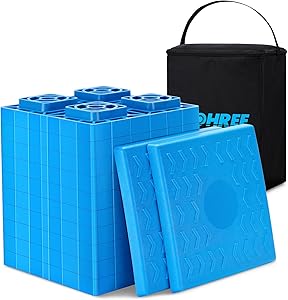
- Pack Size: 12 blocks (2 flat top + 10 stackable)
- Dimensions: 8.54″ x 8.54″ x 1.45″ each
- Material: High-density reinforced polymer
- Storage: Included black carrying bag
Kohree steps up the game by offering a 12-pack that includes two specialized flat-top blocks. This is a game-changer for tire health, as it provides a smooth, even surface rather than the “knobby” texture of standard interlocking blocks. Constructed from high-density reinforced polymer, these are designed to outlast and outperform traditional wood planks, which tend to rot or crack. The pyramid stacking method is straightforward, providing a wide, stable base for single or dual wheels.
The extra thickness of 1.45 inches per block means you get more lift with fewer pieces, which is great for tackling aggressive inclines. They play well with tongue jacks and stabilizers too, making them a “jack-of-all-trades” accessory. When it’s time to hit the road, the whole set tucks away into a zippered carrying bag. If you’re looking for a combination of brute strength and a tire-friendly surface, this reinforced kit is a heavy-duty contender.
- Pros:
- Includes flat-top blocks for better tire contact
- Increased thickness per block for faster leveling
- Generous 12-pack covers more ground
- Cons:
- Fewer height increments due to block thickness
- Loose flat tops can be easy to leave behind
3. OULEME 12 Pack RV Leveling Blocks
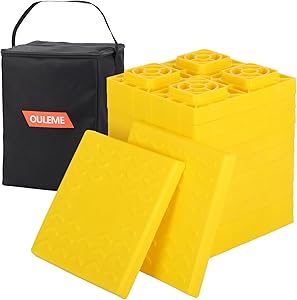
- Pack Size: 12 (10 interlocking blocks, 2 top blocks)
- Single Block Dimensions: 8.5″ x 8.5″ x 1.5″
- Material: Polypropylene with anti-UV aging additives
- Storage: Includes a carrying bag
OULEME focuses on the long-term survival of your gear. Their blocks are infused with anti-UV aging additives, which is critical because leveling blocks spend 100% of their working life exposed to the elements. Without this protection, plastic becomes brittle and cracks under the weight of a 10,000-pound trailer. The kit features a mix of 1.5-inch standard blocks and 0.7-inch thin top blocks, allowing for “micro-adjustments” that help you get that bubble level perfectly centered.
The increased density of the polypropylene used here is noticeable; these feel substantial and don’t flex easily. Their multi-functional design means you can use them under the tongue jack or as pads for your stabilizers to stop them from sinking into the dirt. While they might feel a bit bulkier in your storage bay, the trade-off is a set of levelers that won’t fade or fail after a single season in the desert sun.
- Pros:
- Anti-UV additives prevent sun-related brittleness
- Thin top blocks allow for precise fine-tuning
- High-density build handles heavy loads
- Cons:
- Can be bulky to store compared to thinner blocks
- Top blocks offer minimal lift on their own
- Cons:
4. VEVOR Trailer Jack Block

- Capacity: 6000 lbs per block
- Pack Size: 4 blocks
- Material: Polypropylene
- Features: Integrated drainage hole design
If you are tired of stacking ten thin blocks just to get your tongue jack high enough, VEVOR offers a beefier alternative. These blocks are designed with a massive 6,000-lb capacity per unit, prioritizing vertical stability over thin increments. They feature a significantly larger footprint than standard levelers, which effectively distributes weight and prevents the dreaded “sinking jack” syndrome when camping on soft grass or sand.
The design logic here is all about speed and durability. These blocks are resistant to oil, tar, and harsh soil chemicals, making them ideal for long-term stays. A particularly smart touch is the integrated drainage hole, which ensures water doesn’t pool inside the block, reducing the risk of mold or rust on your jack’s metal foot. While they aren’t the best choice for driving wheels over, they are arguably the sturdiest platform available for your RV’s primary support posts.
- Pros:
- Exceptional weight capacity for heavy tongue loads
- Large footprint prevents sinking in mud or sand
- Drainage holes prevent water/debris buildup
- Cons:
- Not ideal for full-wheel leveling
- Small pack size (4 blocks) lacks versatility
5. Tri-Lynx Lynx Levelers RV Leveling Blocks

- Pack Size: 10 interlocking blocks
- Dimensions: 8.5″ x 8.5″ x 1.5″
- Load Capacity: Up to 40,000 lbs
- Origin: Made in USA (since 1992)
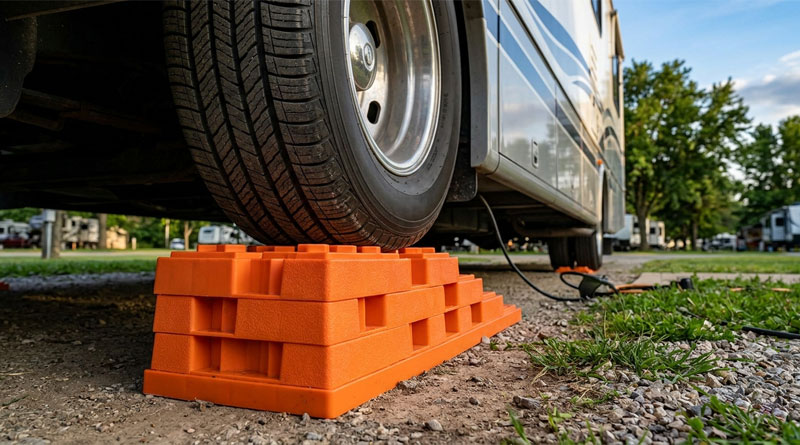
The Tri-Lynx Lynx Levelers are essentially the “OG” of the RV world. They have been manufactured in the USA since 1992, and that longevity shows in their design. With a staggering load capacity of 40,000 lbs, these orange blocks can handle anything from a lightweight pop-up to a massive Class A motorhome. The interlocking system is incredibly secure; when these blocks click together, they act as a solid, monolithic unit that won’t shift as you crawl your rig up the stack.
Reliability is the name of the game here. Tri-Lynx backs their product with an impressive 10-year warranty, which is almost unheard of for a plastic product that gets driven over by multi-ton vehicles. They provide a full inch of lift when interlocked, giving you a predictable and steady way to level your home. The signature blue nylon bag makes them easy to spot in a crowded storage bay. For those who value a proven track record and domestic manufacturing, these are the gold standard.
- Pros:
- Massive 40,000 lb weight rating
- Proven design with a 10-year warranty
- High-visibility orange for safety
- Cons:
- Color shows grease and dirt easily
- Standard height may require multiple sets for steep slopes
6. RVMATE 12 Pack RV Leveling Blocks

- Pack Size: 12 (10 standard, 2 top blocks)
- Dimensions: Standard 1.5″ H, Top 0.75″ H
- Material: High-density, reinforced polymer
- Storage: Includes a carrying bag
RVMATE offers a sophisticated take on the 12-pack leveling kit. Like some of its competitors, it includes specialized top blocks, but these are specifically engineered to reduce tire tread compression. By providing a flat interface, the RVMATE system prevents your tire rubber from being forced into the “waffle” pattern of the lower blocks, which can be an issue during long-term storage. This thoughtful detail helps preserve your expensive RV tires while ensuring the rig remains rock-solid.
The high-density reinforced material is designed for versatility, working equally well under hydraulic jacks or dual axle wheels. The interlocking teeth are deep and secure, minimizing the risk of the stack “spitting out” when you apply torque. This set is particularly useful for those who travel in varied climates, as the material resists the thermal expansion and contraction that can cause cheaper blocks to warp. It’s a complete system that prioritizes both vehicle stability and tire longevity.
- Pros:
- Top blocks protect tire tread from “waffle” marks
- Total of 12 blocks for significant height potential
- Strong, deep interlocking mechanism
- Cons:
- Top blocks are thin and provide minimal lift
- Must be stacked precisely to engage the interlocking teeth
7. Homeon Wheels 10 Pack RV Leveling Blocks

- Pack Size: 10 blocks
- Features: Anti-slip pads design
- Construction: High-quality, solid bottom structure
- Storage: Zippered carrying bag with handle
The Homeon Wheels leveling blocks solve one of the most annoying problems in RVing: blocks sliding away as you try to drive onto them. These blocks feature integrated anti-slip pads that grip the asphalt or gravel, ensuring the stack stays exactly where you put it. This makes solo leveling significantly easier, as you won’t have to keep getting out of the cab to reposition a block that’s been kicked forward by the tire.
Furthermore, these blocks utilize a solid bottom structure. Unlike some grid-style blocks that can act like “cookie cutters” on soft grass, these distribute weight evenly across their entire base. This prevents the blocks from sinking into the turf, maintaining your level even if the ground gets soggy after a rainstorm. With a heavy-duty zippered bag included, this 10-pack is a reliable, user-friendly solution for anyone who frequently camps on “less-than-ideal” surfaces.
- Pros:
- Anti-slip pads make solo setup much easier
- Solid bottom prevents sinking on soft ground
- Durable, heavy-duty construction
- Cons:
- Only 10 blocks per pack
- Bright yellow color gets dirty very quickly
How to Choose the Best RV Leveling Blocks
Navigating the world of RV accessories can feel like a full-time job. When you’re ready to move beyond using random scraps of 2×4 wood found in your garage, selecting the right leveling blocks is the first step toward a stress-free camping experience. It isn’t just about picking the brightest color; it’s about physics, safety, and protecting your expensive investment.
Step 1: Know Your RV’s Weight and Axle Configuration
Before you even click “add to cart,” you must know your Gross Vehicle Weight Rating (GVWR). Leveling blocks are rated by weight capacity, and exceeding that limit is a recipe for a plastic explosion.
- Single Axle vs. Dual Axle: If you have a dual axle trailer, you need to ensure the blocks are narrow enough to fit between the tires, yet wide enough to support the tread. Often, you’ll need two sets of blocks to level both wheels on one side simultaneously.
- Weight Distribution: Remember that the weight isn’t always distributed evenly. A block rated for 6,000 lbs might seem like enough for a 10,000 lb trailer, but if one side is significantly heavier due to a slide-out or a full water tank, you’re pushing the limits. Always aim for a capacity that far exceeds your needs.
Step 2: Material Matters – Polypropylene vs. HDPE
Not all plastics are created equal. Most high-quality blocks use high-density polyethylene (HDPE) or reinforced polypropylene.
- UV Resistance: This is non-negotiable. Blocks sit in the sun for weeks at a time. Without UV inhibitors, the plastic will become brittle, change color, and eventually shatter under the weight of your RV.
- Environmental Resilience: Look for materials that won’t degrade when exposed to engine oil, gasoline, or road tar. High-quality polymers are “non-reactive,” meaning they won’t soften or melt when they come into contact with common campsite chemicals.
Step 3: The “Grid” vs. “Solid” Bottom Debate
The underside of the block determines how it interacts with the ground.
- Grid Bottoms: These are lighter and often “bite” into the ground, providing good traction on gravel or dirt. However, on soft grass or sand, they can sink like a hot knife through butter.
- Solid Bottoms: These offer a much larger surface area, preventing the blocks from sinking into soft turf. If you frequently camp in meadows or beachfront spots, a solid bottom is usually the superior choice.
Step 4: Interlocking Reliability
If you are stacking blocks three or four inches high, you are essentially building a small tower. If those blocks don’t lock together securely, the lateral force of the tire can cause the stack to shift or “kick out.” Look for deep, “LEGO-style” nubs that provide a positive mechanical lock. If the blocks just sit on top of each other with friction alone, keep looking.
Step 5: Portability and Organization
RV storage is a game of Tetris. Ten loose blocks will rattle, get dirty, and eventually get lost.
- Carrying Bags: A heavy-duty nylon bag keeps the dirt off your other gear and keeps the set together.
- Handle Systems: Some brands, like Camco, use a threaded rod system. This is often faster than a bag but leaves the blocks exposed to the air. Choose the one that fits your storage bay’s layout.
Step 6: Fine-Tuning with Top Blocks
Sometimes a one-inch lift is too little, and a two-inch lift is too much. This is where “top blocks” or “cap blocks” come in. These are usually half the thickness of a standard block and provide a smooth surface.
- Precision: They allow you to get that leveling bubble exactly in the center.
- Tire Protection: Standard interlocking blocks have nubs that can press into your tire tread over time. A flat top block provides a smooth surface that protects the rubber from deformation.
Step 7: Safety Features to Look For
Leveling can be dangerous if the vehicle moves unexpectedly.
- Anti-Slip Pads: Some blocks come with rubber inserts or textured surfaces on the bottom to prevent them from sliding on wet pavement.
- Visibility: Bright yellow, orange, or even red blocks are easier to see. This helps you line up the tire correctly and ensures you don’t accidentally leave them behind when you break camp.
Step 8: Versatility for Jacks and Stabilizers
Don’t just think about tires. Your tongue jack and stabilizer jacks also need a firm footing. Using leveling blocks under your stabilizers means the jacks don’t have to extend as far, which significantly reduces the “wobble” inside the RV. A shorter jack is a stiffer jack. Ensure the blocks you buy are wide enough to accommodate the foot of your jacks.
Conclusion: The Long-Term Value
While it’s tempting to grab the cheapest set of blocks available, remember that these pieces of plastic are the only thing standing between your RV and the dirt. Investing in a high-capacity, UV-protected, and interlocking set—like the Tri-Lynx or Camco options—saves you money in the long run. Cheap blocks crack, and when they do, you’re left scrambling to level your rig with rocks and branches at 9:00 PM in the rain. Buy right, buy once, and enjoy the peace of mind that comes with a perfectly stable home.