A compromised RV roof doesn’t announce itself until water is dripping onto your sleeping bag at 2 a.m. somewhere outside Amarillo. Lap sealant is the unsung guardian standing between your rig and that nightmare — but not every tube on the shelf deserves a spot on your roof. We tested and evaluated the most popular options available, breaking down what actually works on EPDM, TPO, and metal surfaces when the weather turns ugly and the miles pile up.
1. Kohree Self-Leveling RV Roof Sealant 4 Pack

- Leveling Speed: Levels within 30 seconds
- Temp Range: -40° F to 200° F
- Compatibility: EPDM, TPO, PVC, Metal, Wood
- Safety: Low-odor, non-hazardous formula
Most lap sealants give you a narrow window before they start setting up — Kohree’s formula flips that script. Squeeze it out along a roof seam and watch it dissolve into a flat, glassy sheet within half a minute, no putty knife required. That self-leveling speed is genuinely useful when you’re working on a hot afternoon and every other product is already skinning over before you cap the tube. The temperature range is equally impressive, staying pliable from deep winter lows through triple-digit summer highs without any seasonal formula swap.
Adhesion spans an unusually broad material list — rubber membranes, aluminum flashing, glass skylights, and even wood decking all bond reliably without a primer step. The low-odor, non-toxic composition means you can work in enclosed spaces or around kids and animals without clearing the area first. The one real gotcha is that once the tube is open, you’re committed; partial use and storage isn’t realistic. It also won’t stick on a vertical sidewall, so keep a non-leveling tube in your kit for those spots.
- Pros:
- Exceptional self-leveling within 30 seconds
- Broad temperature tolerance for all seasons
- Safe for indoor and outdoor application
- Cons:
- Must be used immediately once opened
- Not suitable for vertical sidewalls
- Slower cure time in high humidity
2. Liquid Rubber Self-Leveling RV Lap Sealant

- Coverage: 22 linear feet per 10 oz tube
- Application: Standard 5/16 inch bead
- Adhesion: Fiberglass, Metal, PVC, EPDM, TPO
- System: Compatible with seam tape and coatings
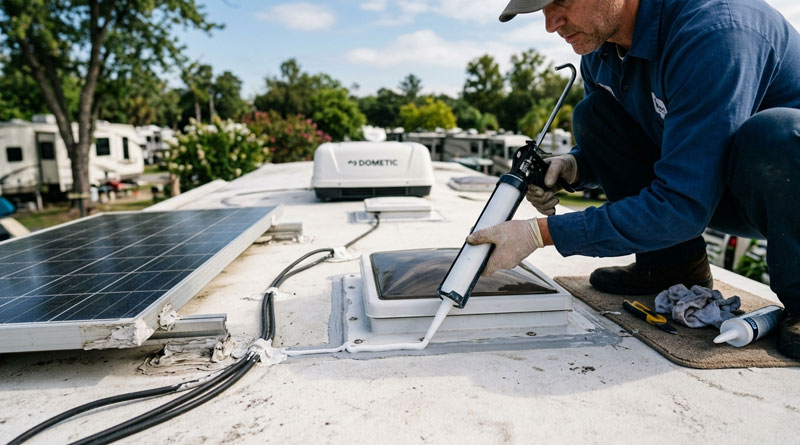
Liquid Rubber built this formula around the specific pain points of horizontal RV roof maintenance — the AC curb seal that never quite stays tight, the vent flange that weeps every spring, the antenna base that started leaving brown stains on the headliner. Applied at a standard 5/16″ bead, it flows naturally into those trouble spots and settles into a membrane rather than a cord of caulk. At 22 linear feet per tube, the coverage rate is better than most competitors, which matters when you’re doing a full-roof inspection on a 35-footer.
Where this product earns extra points is system compatibility — it’s designed to work alongside Liquid Rubber seam tapes on larger cracks, giving you a layered approach rather than relying on sealant alone for structural repairs. The flip side of that design philosophy is surface pickiness: any silicone residue left by a previous repair will cause adhesion failure, and the prep work to get there is legitimately tedious. Clean surfaces get a tenacious, flexible waterproof bond; contaminated surfaces get delamination down the road.
- Pros:
- Reliable flow for horizontal roof seams
- High coverage rate per individual tube
- Forms a highly flexible waterproof barrier
- Cons:
- Strictly prohibited for vertical surfaces
- Will not bond to existing silicone
- Requires extensive surface preparation
3. PAULINN Self-Leveling RV Roof Sealant

- Cure Time: 30 min set, 24 hr full cure
- Application Temp: 40° F to 104° F
- Resistance: UV, Water, and Yellowing
- Materials: EPDM, Metal, Wood, Concrete
PAULINN’s entry targets the weekend warrior crowd — people who discover a suspicious damp spot on a Friday evening and need to be road-ready by Saturday morning. The 30-minute initial set is legitimately fast, and the odorless formula means you can work in the interior too, tackling bathroom caulk or kitchen seals without fumigating the camper. UV inhibitors baked into the formula prevent that telltale yellowing that makes even a recent repair look aged and neglected, keeping the roof looking clean through multiple seasons.
Fluidity is a genuine strength here; the material flows into tight spots around window frames and door seals more readily than thicker competitors. The catch is that EPDM surfaces need a dedicated primer before application — skip that step and adhesion becomes unreliable in a matter of months. The application temperature window is also narrower than rivals, which can complicate spring and fall repairs in colder climates. In high heat, the formula gets runny enough that you’ll need to work quickly and possibly tape off adjacent surfaces.
- Pros:
- Odorless and non-toxic for indoor use
- Resists yellowing and UV degradation
- Fast initial set time of 30 minutes
- Cons:
- Requires primer for EPDM surfaces
- Optimal application range is narrow
- Can be very runny in high heat
4. Dicor 501LSW-1 Self-Leveling Lap Sealant

- Shelf Life: 2 years from stamped date
- Primary Use: Secondary seal for edges/vents
- Adhesion: Aluminum, Vinyl, Fiberglass, Concrete
- Compatibility: EPDM and TPO Sheeting
Ask any RV technician what they reach for when a rig comes in with a leaking roof seam and the answer is almost always Dicor 501. It has held that default position in the industry for decades — not because it’s flashy, but because it consistently does exactly what a lap sealant needs to do. The formula flows into screw penetrations and seam edges, levels cleanly, and cures to a flexible bond that handles road shock without pulling away from the substrate. Its dual compatibility with both EPDM and TPO makes it genuinely universal across the modern RV fleet.
The product shines in professional and DIY maintenance applications alike — the 4-pack provides ample material to address a full roof’s worth of vents, skylights, and solar panel mounts in a single session. Long-term elasticity is where it separates itself from cheaper alternatives; years after application, properly maintained Dicor seals still move with the roof rather than cracking away from it. The two-year shelf life requires attention when buying in bulk, and the material does attract road grime over time, resulting in grey streaks that are cosmetically annoying but structurally harmless.
- Pros:
- Recognized industry-standard reliability
- Excellent adhesion to EPDM and TPO
- Stays flexible to resist road vibration
- Cons:
- Strict two-year expiration window
- Known to attract dirt over time
- Requires careful cleaning of old sealant
5. WELLUCK 4PC Self-Leveling RV Roof Sealant

- Working Time: 10 minutes initial grab
- Weather Range: 0° F to 104° F
- Hybrid Tech: Bonds nearly any surface
- VOC Level: Low odor, Low VOC
WELLUCK’s hybrid polymer technology gives this sealant a chemical profile that sits between standard silicone and polyurethane — and that hybrid nature translates to real-world versatility. It grabs quickly and bonds to an unusually diverse surface list without needing a primer step on most substrates, including PVC, brass fittings, and metal flashings that give other sealants trouble. The 0°F lower application limit also makes it a practical choice for cold-weather repairs that would leave other products refusing to cure properly.
The 10-minute initial grab is a deliberate design choice that cuts both ways. On a windy repair day, that fast tack prevents wind from lifting a fresh bead off a seam — a real problem with slower-setting products. But it also means your working time is compressed, so plan your application path before squeezing any material out of the tube. Full cure lands at 24 hours, color options are limited to white, and applications right at the 0°F threshold require extra patience. For most three-season campers, though, it’s an excellent all-around performer.
- Pros:
- Advanced hybrid bonding technology
- Fast initial grab and 24-hour cure
- No primer required for most surfaces
- Cons:
- Short 10-minute working time
- Limited color options available
- Can be tricky to apply at 0° F
6. SURVOL All-Weather RV Lap Sealant

- Temp Range: -40° F to 200° F
- Quantity: 2-Pack for smaller repairs
- Safety: Non-hazardous, low-odor
- Properties: Waterproof and UV-resistant
SURVOL’s temperature range claim — -40°F to 200°F — isn’t just a marketing number. That spread covers everything from an Alberta winter to a Nevada summer with margin to spare, and the formula maintains its elasticity across that entire spectrum without going brittle in the cold or gummy in the heat. The self-leveling action handles vent pipes and drip edges cleanly, and the non-hazardous composition means it’s safe to use in the confined spaces around rooftop AC units or interior skylight frames without special ventilation.
The 2-pack sizing makes SURVOL an appealing targeted repair option rather than a full-roof maintenance solution. If you’re chasing a single suspicious seam or resealing one skylight, you won’t end up with four half-used tubes rattling around your storage bay. EPDM, TPO, aluminum, and steel all bond well, and the low surface tension of the leveled product discourages water pooling around penetrations. One honest note: the initial smell is present despite “low-odor” labeling, and surfaces must be bone dry before application — moisture under a fresh bead causes bubbling and adhesion loss.
- Pros:
- Exceptional flexibility in extreme cold
- Low-odor and pet-safe formulation
- Smooth finish prevents water pooling
- Cons:
- Small 2-pack might not cover full roofs
- Requires clean, dry surfaces for best results
- Initial smell takes time to dissipate
7. Dicor 551LSW-1 Non-Leveling Lap Sealant

- Type: Non-Leveling (High Viscosity)
- Material Base: HAPS-Free formula
- Compatibility: EPDM, PVC, TPO, DiFlex II
- Application: Vertical and slanted surfaces
The 551 exists to solve the problem the 501 can’t: vertical surfaces. Squeeze a self-leveling product onto a sidewall vent or a slanted drip rail and it simply runs — you get a mess and zero protection. The 551’s high-viscosity formula holds its bead shape on contact, letting you build a proper seal around slide-out seals, door frames, and vertical roof-to-wall transitions where gravity is working against you. The HAPS-free designation (no Hazardous Air Pollutants) makes it a meaningfully cleaner product for regular users doing frequent maintenance work.
UV stabilization keeps the white color honest over multiple seasons, avoiding the grey-beige degradation that signals chemical breakdown in cheaper products. Wood, vinyl, and galvanized metal all accept the bond readily, and the long-term flexibility means it stays sealed through thousands of miles of road shock. The trade-off for all that viscosity is application effort — this product requires a good caulk gun and steady hand pressure. For large flat seams, grab the 501 instead; the 551 is purpose-built for the vertical work that other sealants simply aren’t designed to handle.
- Pros:
- Stays in place on vertical surfaces
- Environmentally friendly HAPS-free formula
- UV-stabilized to prevent yellowing
- Cons:
- Requires tooling for a smooth look
- Cannot be used for large flat seams
- Thicker texture is harder to squeeze
How to Choose the Right RV Lap Sealant
Walk into any RV supply store and you’ll find an entire wall of lap sealant tubes. They all claim to be waterproof. They all claim to be flexible. A fair number of them will fail within a season if applied incorrectly or matched to the wrong surface. Knowing what separates a product that lasts from one that peels up after the first hard freeze requires understanding a handful of technical concepts that manufacturers often bury in fine print. This section breaks those concepts down so you can make a confident decision before your next roof inspection.
Self-Leveling vs. Non-Leveling: Get This Wrong and Nothing Else Matters
This is the single most consequential decision in the entire purchase. Self-leveling sealants are low-viscosity liquids; they flow like cold honey and settle flat under gravity. That property makes them ideal — and exclusively suitable — for horizontal applications like the top deck of your roof. Applied to a flat surface, they fill screw penetrations, micro-gaps in seam tape edges, and the irregular space around a vent base with zero need for a smoothing tool.
Non-leveling sealants are the opposite in every meaningful way. Their high viscosity means they stay exactly where the caulk gun puts them. That sounds like a disadvantage until you’re standing on a ladder trying to seal a slideout frame or a vertical sidewall vent — at which point a self-leveling product is useless. It will immediately begin migrating south by gravity, leaving an unprotected gap at the top and a messy drip at the bottom. Keep both types in your maintenance kit. They are not interchangeable, and no single formula handles both application scenarios well.
Roofing Material Compatibility: Read the Fine Print Before You Buy
Modern recreational vehicles predominantly use two types of roof membrane: EPDM (Ethylene Propylene Diene Monomer) rubber and TPO (Thermoplastic Polyolefin). Older rigs, particularly those built before the mid-1990s, often have aluminum or fiberglass roofs. Each material has distinct chemical properties that affect how sealants bond — and in some cases, react — with the surface.
EPDM is particularly sensitive. Certain petroleum-based sealants cause the rubber to swell, blister, and delaminate, which creates a far worse problem than the leak you were trying to fix. Any sealant going onto an EPDM roof must be explicitly labeled as EPDM-compatible or EPDM-safe; don’t assume compatibility based on the product category alone. TPO is generally more forgiving but still requires verification. For aluminum roofs, look for sealants that specify adhesion to metal without galvanic corrosion risk, particularly around dissimilar metal fasteners.
One near-universal rule: lap sealants do not bond to silicone. If a previous repair was made with silicone caulk — a common and unfortunate DIY mistake — every trace of it must be mechanically removed before a new lap sealant application. Silicone creates an invisible release layer that prevents adhesion regardless of brand or formula. Use a plastic scraper and a solvent specifically approved for your roofing material to strip the area completely before proceeding.
Elasticity Is Not Optional on a Vehicle That Never Stops Moving
A house sits on a foundation. An RV hurtles down the interstate at 65 mph, twisting, vibrating, and thermally expanding and contracting all day. A sealant that cures to a rigid state is essentially a rigid object bonded between two surfaces that are in constant relative motion — it will crack, and it will do so faster than you expect. True elasticity, sometimes called “memory” in the industry, means the cured sealant can stretch and compress repeatedly without losing its bond or developing microfractures.
Look for products that specify an elongation percentage in their technical data. Higher elongation values indicate greater ability to accommodate structural movement. As a practical benchmark, any lap sealant marketed for the RV industry should remain flexible for at least five years under normal conditions. If a product’s technical sheet describes it as “rigid” or “semi-rigid” after cure, it belongs on a stationary structure — not on a vehicle.
UV Resistance: The Invisible Threat Your Roof Faces Every Day
An RV roof receives unobstructed sun exposure for as long as you’re not parked under trees — which is most of the time, since campsite shade is never guaranteed. Ultraviolet radiation attacks polymer chains in sealant materials, causing oxidation that manifests as chalking, brittleness, and the characteristic grey-to-tan discoloration that signals a seal nearing failure. A sealant that looked pristine when applied can become cracked and porous within two seasons if it lacks proper UV stabilization.
Quality products incorporate UV absorbers and light stabilizers (often HALS — Hindered Amine Light Stabilizers) that extend the service life significantly. When evaluating products, check for specific UV resistance claims rather than generic “weather resistant” language. Products that list sun-ray stabilization or HALS chemistry in their formulation are meaningfully superior to those that don’t for rooftop applications. This matters more in high-UV environments like the Southwest than in the Pacific Northwest, but it matters everywhere.
Application Temperature Windows: Timing Your Repair Correctly
The temperature at the moment of application, not the temperature during the vehicle’s travels, determines how well a sealant cures. Most standard lap sealants require ambient and surface temperatures above 40°F to achieve a proper chemical cure. Below that threshold, the curing reaction slows dramatically, and the sealant may remain tacky, fail to bond at full strength, or remain permeable to water even after it appears set.
Hybrid polymer sealants generally offer the widest application windows, often starting as low as 0°F, which makes them the only practical option for emergency winter repairs. At the other extreme, applying any sealant on a sun-baked roof on a 95°F afternoon creates different problems — the surface can be too hot for the material to flow correctly, and “skinning” (surface curing before the interior has cured) can trap moisture and prevent the self-leveling action from completing. The ideal application window is a dry day with temperatures between 50°F and 80°F, which gives most products the conditions needed to cure evenly and bond fully.
Surface Preparation: The Step That Determines How Long Your Repair Actually Lasts
No lap sealant overcomes a poorly prepared surface. Adhesion is a chemical and mechanical event that requires intimate contact between the sealant and a clean, stable substrate. Contaminants — roof oxidation, road grime, old caulk residue, mold, or traces of previous cleaning agents — all create barriers that prevent that contact from occurring. A sealant applied over contamination may appear to bond initially but will begin delaminating within months.
Start by removing all old sealant completely. Don’t apply over existing material; the new layer will only be as secure as whatever it’s sticking to. Use a plastic scraper to avoid scratching the roof membrane, followed by a cleaner appropriate for your surface type. For EPDM, use a purpose-formulated EPDM cleaner or isopropyl alcohol — avoid petroleum-based solvents that can degrade the rubber. For metal or fiberglass, denatured alcohol or acetone works well. Allow the surface to dry completely before proceeding.
Some sealants advertise primer-free application, which is true on most surfaces but not all. EPDM in particular sometimes benefits from a dedicated adhesion primer, especially on older, oxidized membranes where the surface chemistry has changed. If you’re working on a roof that’s more than five years old and has never been treated, a primer step is cheap insurance against a repeat repair six months later.
Cure Time vs. Set Time: Two Different Numbers That Both Matter
“Set time” or “tack-free time” refers to how long until the surface of the sealant firms up enough to resist light contact or rain. For most quality lap sealants, this is 30 to 60 minutes. “Full cure time” — when the product reaches its rated bond strength, elasticity, and waterproofing capability — is a different number entirely, typically 24 to 48 hours. The distinction matters because a sealant that is tack-free is not yet waterproof at full capacity.
If you’re performing a repair and need to drive within the hour, choose a product with a fast initial grab (10 to 15 minutes) to prevent wind lift, but understand that you’re accepting some risk by driving before full cure is complete. For any repair that isn’t an emergency, plan to give the sealant 24 dry hours before exposing it to sustained rain or highway wind pressure. Applying sealant the evening before a travel day and driving out early the next morning is generally acceptable for most products — consult the specific product’s technical sheet to confirm.
Quantity Planning: Buying the Right Amount Before You’re Mid-Job
A standard 10-ounce lap sealant tube, applied at a 5/16-inch bead, covers approximately 20 to 25 linear feet. That sounds like a lot until you start mapping out how many linear feet of seams, vent flanges, screw heads, and appliance mounts exist on a typical 30-foot Class A motorhome. A comprehensive roof inspection and resealing of all penetrations on a rig that size routinely requires four to six tubes — and that’s before accounting for any problem areas that need heavier application.
The practical advice: always buy more than your estimate. Running out of sealant halfway through a skylight resealing is worse than having a spare tube left over. Buying in 4-packs or 6-packs reduces per-tube cost significantly compared to single purchases, and unopened tubes store well within their shelf life. Date-stamp your spares when you put them away. With products like the Dicor 501, the two-year shelf life is meaningful — a tube bought in 2024 should be used by 2026, so don’t over-buy to the point where you’re throwing out expired product. Match your purchase quantity to your planned maintenance schedule and keep one or two backup tubes in the rig for roadside repairs.