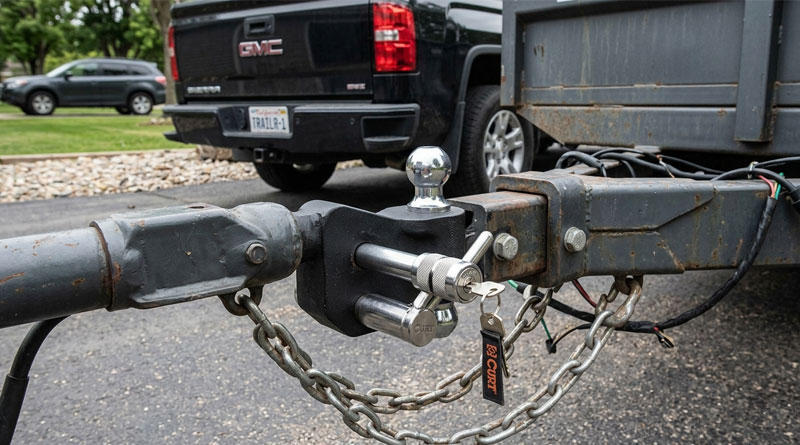
Protecting your haul shouldn’t be an afterthought. A high-quality hitch lock pin serves as the ultimate gatekeeper, preventing both opportunistic theft and the nightmare of a highway disconnect. While the market is flooded with generic hardware, true security lies in the details of metallurgy and weatherproofing. This guide bypasses the fluff to examine top-tier locks engineered for resilience. Whether you’re pulling a weekend boat or a heavy-duty flatbed, these picks ensure your trailer stays exactly where it belongs.
1. CZC AUTO Hitch Receiver Pin Lock

- Pin Dimensions: 5/8″ diameter; 3-1/2″ effective length
- Compatibility: Class III/IV 2″ and 2-1/2″ receivers
- Material: Carbon steel with electrophoretic finish
- Weather Protection: 360-degree swivel head and rubber cap
The CZC AUTO receiver lock is a formidable “dogbone” style barrier designed for heavy-duty applications. By utilizing high-strength carbon steel, the manufacturers have created a pin that is notoriously difficult to shear or bend under pressure. The 5/8-inch diameter is precision-engineered for Class III and IV hitches, providing a tight fit that eliminates the excessive play often found in cheaper alternatives. Its black electrophoretic coating serves a dual purpose: it provides a sleek, tactical aesthetic while offering a deep layer of corrosion resistance against road salts and humidity.
User experience is clearly at the forefront of this design, evidenced by the 360-degree rotating head. This feature allows you to orient the keyhole at any angle, which is a lifesaver when working in the cramped spaces typical of modern truck bumpers. Internally, the zinc alloy core is shielded by an updated tubular keyway that resists traditional picking methods. A rugged rubber cap completes the package, sealing out the grime and grit of the open road to ensure the locking mechanism remains smooth and functional for years of reliable service.
- Pros:
- Hardened carbon steel resists heavy-duty tampering
- Swivel head simplifies locking in narrow bumper gaps
- Cons:
- Tubular keys are unique and harder to duplicate locally
- Coating may show wear after years of heavy friction
2. Rhino USA 2” Trailer Hitch Pin

- Material: Solid Steel
- Compatibility: Class III & IV (2″ x 2″) Hitches
- Key Feature: Patented slide cap
- Warranty: Lifetime replacement
Rhino USA brings “lab-tested” intensity to the hitch world with this solid steel locking pin. Engineered to be a “set-and-forget” security solution, this pin is specifically tailored for 2-inch receivers common on most SUVs and pickup trucks. The focus here is on pure material strength; the solid steel construction acts as a massive deterrent against bolt cutters and power tools. It transforms your hitch into a vault-like connection, ensuring that your expensive bike racks, cargo carriers, or trailers don’t go missing while you’re away from the vehicle.
The innovation that sets Rhino USA apart is the patented slide cap mechanism. Unlike flimsy rubber tethers that can snap off, this integrated sliding barrier provides a permanent shield against mud and debris. It is a critical feature for off-roaders or those living in snowy climates where road salt usually destroys lock internals. Backed by a legitimate lifetime replacement warranty and the support of an American-owned family business, this lock is designed for those who want a premium, “overbuilt” product that guarantees long-term performance and unmatched brand accountability.
- Pros:
- Solid steel construction for maximum anti-theft protection
- Patented slide cap is more durable than standard rubber
- Lifetime replacement warranty offers immense value
- Cons:
- Limited strictly to 2-inch receiver sizes
- Higher price point than basic generic models
3. Master Lock Receiver Lock

- Pin Diameters: 1/2 inch and 5/8 inch (Dual Pack)
- Usable Length: 2-3/4 inches
- Weight Rating: 10,000 lbs (on 5/8″ pin)
- Locking Mechanism: 4-pin cylinder, push-to-lock
The Master Lock 2866DAT is the “Swiss Army Knife” of hitch security, providing a clever dual-pin system that covers almost every towing scenario. By including both 1/2-inch and 5/8-inch pins, Master Lock allows you to transition between a light-duty Class I receiver on a sedan and a heavy-duty Class IV receiver on a truck without buying separate hardware. The 5/8-inch pin is rated for a staggering 10,000 lbs, making it more than capable of handling large RVs or commercial trailers with ease, while the smaller pin is perfect for light utility trailers.
Operationally, this lock uses a convenient “push-to-lock” mechanism that engages without the key, saving you time and frustration during hitching. The swivel head provides 360 degrees of rotation, ensuring you can always find the right angle to insert the key regardless of the vehicle’s bumper design. To prevent the internal 4-pin cylinder from seizing, Master Lock includes a tight-fitting snap-on cover. While the chrome finish provides a classic look, the real value lies in the brand’s decades of security expertise, offering a reliable barrier against picking and unauthorized tampering in any environment.
- Pros:
- Exceptional versatility with included dual pin sizes
- Push-to-lock feature allows for rapid, keyless securing
- Highly recognizable brand with proven reliability
- Cons:
- Chrome finish can flake if subjected to heavy impacts
- 2-3/4″ length might be tight on some wider receivers
4. RETRUE Trailer Hitch Locks

- Pin Versatility: Adjustable 3″ to 3.5″ length
- Locking Mechanism: One-handed push-to-lock
- Security Hardware: Pick-resistant tubular keys
- Extras: Anti-rattle silencer O-rings
The RETRUE Hitch Lock addresses the one thing that drives every driver crazy: hitch rattle. By incorporating four adjustable O-rings, this lock allows you to customize the fit to your specific receiver tube. This creates a pressurized, snug connection that eliminates the metallic “clanking” sounds during travel, providing a much quieter ride on long hauls. Beyond acoustics, the adjustable length ensures the lock sits perfectly flush against the receiver, reducing the exposed pin area that a thief could potentially leverage with a crowbar or saw, thereby increasing overall security.
Functionality is handled by a sophisticated “Push-to-Lock” system, which is arguably the most user-friendly interface in this category. You simply slide the locking head onto the pin until it clicks home—no key required for engagement. For removal, the set includes high-security tubular keys that are significantly more difficult to pick than standard flat keys. The inclusion of a heavy-duty rubber weather cap and anti-rust coatings ensures that despite being exposed to the “blast zone” behind your tires, the internal mechanism remains debris-free and ready to unlock whenever you are.
- Pros:
- O-rings effectively eliminate annoying hitch noise
- Adjustable effective length ensures a custom, flush fit
- Tubular keys offer superior resistance to lock picking
- Cons:
- Initial setup requires fumbling with O-rings for sizing
- The extra pin length can be bulky on smaller vehicles
5. METOWARE Trailer Tongue Coupler Lock
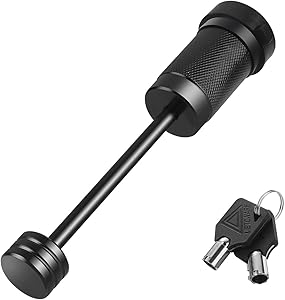
- Pin Diameter: 1/4 inch
- Effective Length: 3-1/2 inch
- Material: Heavy-duty steel; electrophoretic paint
- Locking Type: Push-to-lock, tubular key
The METOWARE Coupler Lock focuses on the “other” end of the hitching process: the trailer tongue. This 1/4-inch pin is specifically designed to fit through the latch of your trailer coupler, ensuring that even if someone manages to bypass your receiver lock, they cannot physically unlatch the trailer from your ball. It is an essential secondary layer of defense. Built from heavy-duty steel and finished with electrophoretic paint, it is remarkably resilient against the rust that typically plagues small hardware exposed to the elements during boat launching or rainy-day towing.
What makes the METOWARE stand out is its “overbuilt” approach to a small-format lock. While many coupler locks feel like toys, this unit uses a reinforced zinc alloy tubular core and robust keys to resist drilling and picking attempts. The 3.5-inch effective length makes it highly versatile, fitting a wide variety of latch styles across boats, RVs, and utility trailers. The push-to-lock design means you can secure your trailer in seconds, and the watertight rubber cap ensures that the mechanism won’t freeze or seize up when you’re ready to head home after a long trip.
- Pros:
- Provides essential security for the coupler latch
- Exceptional rust resistance for marine environments
- Extra-long 3.5″ pin fits almost any trailer tongue
- Cons:
- Only useful for latch-style couplers
- 1/4″ pin is inherently thinner than receiver pins
6. CZC AUTO Black Trailer Hitch Coupler Lock

- Pin Diameter: 1/4 inch
- Effective Length: 3/4 inch
- Material: High-strength steel
- Operation: Flat key, spin-to-lock
For those who value minimalism without sacrificing protection, this CZC AUTO coupler lock is the perfect pocket-sized solution. With a concise 3/4-inch span, it is designed specifically for tight-fitting tongue latches where a longer pin would simply get in the way or rattle excessively. Despite its small stature, it is crafted from high-strength steel and treated with a black electrophoretic finish to fight off corrosion. It serves as a discreet but effective deterrent that fits easily into a glove box or even a pocket when the trailer is in use.
The operation is a bit more traditional, utilizing a flat key and a spin-to-lock mechanism. It requires about 5 to 7 full rotations to fully engage or disengage the lock, which provides a very secure, mechanical feel. While it lacks the “instant” click of push-to-lock models, this threaded engagement style is less prone to mechanical failure over time. Backed by CZC AUTO’s 12-month warranty, this is an excellent choice for owners of small boat trailers or utility haulers who need a reliable, compact lock that won’t interfere with the trailer’s aerodynamics or aesthetics.
- Pros:
- Extremely compact and easy to store
- Threaded locking mechanism is very secure
- Inexpensive but highly effective theft deterrent
- Cons:
- The 3/4″ span is too narrow for some larger couplers
- Flat keys are generally easier to pick than tubular ones
7. CURT 23518 Black Trailer Hitch Lock

- Pin Diameter: 5/8 inch
- Usable Length: 2.85 inches
- Material: High-strength steel; powder coat
- Locking Mechanism: 1/4-turn activation
CURT is a titan in the towing industry, and the 23518 hitch lock lives up to that reputation with a “barbell” design that prioritizes strength and simplicity. Built from high-strength steel, this lock is designed to be a permanent fixture on your tow vehicle. The 5/8-inch pin diameter is standard for most 2-inch receivers, and the 2.85 inches of usable length provides a generous fit for most hitch setups. The entire unit is wrapped in a durable black powder coat finish, which is significantly more resistant to chipping and scratching than standard paint, ensuring it looks good even after years of abuse.
The standout feature here is the 1/4-turn activation. Unlike some locks that require multiple rotations or heavy pressure, the CURT lock engages with a simple, crisp turn of the key. It’s an incredibly efficient design that reduces the time you spend kneeling on the ground behind your truck. A watertight dust cap protects the internal keyway from the elements, ensuring that even after a winter of road salt and slush, the lock won’t leave you stranded. It’s a straightforward, professional-grade tool for those who want a name-brand security solution they can trust implicitly.
- Pros:
- Professional-grade steel construction from a top brand
- 1/4-turn lock activation is exceptionally fast and easy
- Durable powder coating resists rust and physical wear
- Cons:
- Will not fit double-walled receiver tubes
- Heavier and bulkier than some “dogbone” styles
The Master Guide to Securing Your Towing Setup
Purchasing a trailer hitch lock pin might seem like a minor task, but it is the single most important decision you can make to protect thousands of dollars in equipment. When you’re traveling, your trailer is vulnerable at every gas station, hotel parking lot, and trailhead. A standard hitch pin with a cotter clip can be removed in three seconds by anyone. A locking pin, however, changes the math for a thief, forcing them to use loud power tools and risk detection. This guide provides the deep-dive technical knowledge needed to navigate the nuances of hitch security, ensuring you don’t just buy a lock, but the right lock for your specific rig.
Decoding Hitch Classes and Pin Diameters
The first rule of hitch security is that size isn’t just a preference—it’s a mechanical requirement. Hitch receivers are categorized into “Classes” based on their towing capacity, and these classes dictate the size of the pin hole. If you use a pin that is too small, it will rattle and eventually shear under the stress of a heavy load. If it’s too large, it simply won’t fit.
- Class I and II: These are common on sedans and small crossovers. They typically have a 1-1/4″ receiver tube and require a 1/2-inch diameter pin. These are rated for lighter loads, usually up to 3,500 lbs.
- Class III, IV, and V: These are the standard for pickup trucks and large SUVs. They feature 2-inch, 2-1/2 inch, or even 3-inch receiver tubes. These require a 5/8-inch diameter pin. These pins are engineered to handle 10,000 lbs to 20,000 lbs or more.
Before buying, always check the sticker on your hitch receiver or measure the hole with a caliper. Never “guess” between 1/2″ and 5/8″—the safety of your trailer depends on this precise fit.
Measuring “Usable Length”: The Hidden Critical Spec
Many buyers make the mistake of only looking at the pin diameter and forgetting about the usable length. This is the distance between the pin’s head and the locking mechanism. If your hitch receiver has particularly thick walls, or if you are using an accessory with a wide mounting bracket (like some heavy-duty bike racks), a “standard” pin might be too short to allow the lock to click into place. Conversely, a pin that is too long will stick out, creating a “leverage point” that a thief could hit with a hammer to snap the lock. Measure the total width of your receiver plus any accessories to ensure the pin has at least a 1/4-inch of clearance beyond the metal for the lock to engage safely.
Metallurgy 101: What Is Your Lock Actually Made Of?
A lock is only as strong as its weakest point. When browsing, you will encounter several material types:
- Hardened Steel: This is the gold standard. It has been heat-treated to increase surface hardness, making it extremely resistant to hacksaws and bolt cutters.
- Stainless Steel: While slightly softer than hardened steel, it offers the best natural resistance to rust. This is ideal for boat owners who frequently submerge their hitches in salt water.
- Chrome-Plated Steel: This looks great but is purely a surface treatment. Once the chrome scratches, the steel underneath will rust.
- Zinc Alloy Cores: Most lock *internals* are made of this. Look for units that specify “reinforced” zinc alloy to ensure the lock cylinder itself can’t be easily shattered.
Weatherproofing: The Difference Between Security and a Jammed Lock
Because hitch locks live in the “spray zone” behind your vehicle, they are bombarded by water, mud, and road salt. A lock that won’t open when you’re 500 miles from home is just as bad as no lock at all. Look for three specific weather features:
- Rubber Dust Caps: An absolute must. This prevents grit from entering the keyway.
- Internal Seals: Some high-end locks have O-rings inside the mechanism to keep moisture out of the tumblers.
- Electrophoretic Coating: This is a high-tech “e-coat” that bonds to the metal more effectively than paint, providing superior long-term rust protection.
Key Types and Security Levels
Not all keys are created equal. The type of key often dictates how “pick-resistant” a lock is:
- Flat Keys: These are common and easy to use, but they are also the easiest for experienced thieves to pick or bump.
- Tubular (Ace) Keys: These circular keys are much harder to pick with standard tools. They are the preferred choice for high-security applications.
- Disc Detainer Keys: Usually found on high-end locks, these are nearly impossible to pick without highly specialized tools and significant time.
The “Silent Killers”: Rattle and Vibration
If your hitch pin fits loosely, the constant vibration of the road acts like a slow-motion hammer, wearing down the metal components of both the pin and your receiver. This is why “anti-rattle” features are so valuable. Systems that use O-rings or threaded pins to pull the hitch tight against the receiver wall don’t just make your ride quieter—they extend the life of your towing equipment by reducing kinetic wear.
Installation and Maintenance Best Practices
Once you’ve purchased the right lock, follow these steps to ensure it lasts a decade:
- The “Tug Test”: Every time you lock your pin, grab the hitch and give it a violent shake. Make sure the locking head is truly clicked in. Sometimes dirt can prevent a “push-to-lock” mechanism from fully engaging.
- Dry Lubricants Only: Never use WD-40 or heavy grease inside the lock cylinder. These attract dirt and will eventually turn into a thick paste that jams the lock. Use a dry graphite spray or silicone-based lubricant twice a year.
- Orient the Keyhole: Always point the keyhole away from the direction of travel (facing the rear or the side) to minimize the amount of road spray forced into the mechanism.
Common Traps: What to Avoid
Avoid “all-in-one” kits from unbranded manufacturers. While the price is tempting, these often use “pot metal” that can be snapped with a simple pipe wrench. Also, be wary of locks that don’t come with at least two keys. Losing the only key to a high-quality hardened steel lock often means you’ll have to hire a locksmith with an angle grinder to cut your hitch off—an expensive mistake that far outweighs the cost of a better lock.
Final Recommendation
Your choice should ultimately be driven by your environment. If you live in the “salt belt” or near the ocean, prioritize stainless steel or e-coated locks like the CZC AUTO. If you tow heavy loads through high-crime areas, prioritize hardened steel and tubular keys like the Rhino USA. By matching the technical specifications of the lock to your specific vehicle and trailer class, you ensure that your journey ends with your gear exactly where it started: safely attached to your truck.