RV living demands smart gear choices — and your fan situation is no exception. Whether you’re chasing summer sunsets across national parks or hiding from the heat at a quiet desert campsite, the right portable fan can transform your rolling home from a sweat box into a comfortable sanctuary. We’ve rounded up seven top-performing models that balance airflow power, battery life, and packable convenience for life on the open road.
1. PANERGY Portable Solar Fan with LED Light
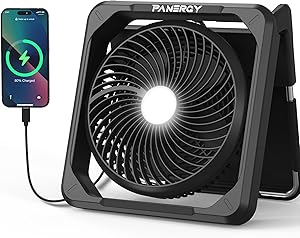
- Power: 10,000mAh Battery & 10W Solar Panel
- Runtime: 5 to 67 Hours per charge
- Speed: High-speed brushless motor (1500 RPM)
- Lighting: 3-Level LED with 67-hour duration
Boondockers and off-grid adventurers have a new best friend. The PANERGY Solar Fan doesn’t just run on battery — it actively replenishes itself through a detachable 10W solar panel, making it a genuinely self-sustaining cooling solution for week-long wilderness stays. The 10,000mAh battery doubles as a power bank, so your phone stays alive even when civilization feels very far away. A brushless motor pushes air at 13ft/s while staying remarkably hushed throughout.
Practicality is baked into every detail. The pivoting head and adjustable stand let you redirect airflow without repositioning the whole unit — a real bonus in cramped RV layouts where every inch counts. Three LED brightness levels give it a secondary life as a bedside lamp, and the built-in timer means it won’t run all night burning through reserves. If solar charging feels slow compared to USB top-ups, that’s the only real trade-off you’ll notice.
- Pros:
- Detachable solar panel for true off-grid use
- 10,000mAh doubles as a device power bank
- Whisper-quiet brushless motor with strong output
- Cons:
- Solar charging is noticeably slower than USB
- Slightly oversized for narrow window mounting
2. SKYRI Portable USB Mini RV Ceiling Fan

- Size: 16.5-Inch diameter blade span
- Interface: USB-A cord powered (5V-2A)
- Weight: Compact and lightweight design
- Blades: 3-Blade efficient airflow system
Overhead circulation is the unsung hero of RV comfort — and the SKYRI delivers it without drilling a single hole or running a single wire. This 16.5-inch ceiling fan hangs from tent poles, canopy frames, or RV roof rails via its simple suspension system, then draws power straight from a USB-A port. That means your RV’s built-in wall adapters or a standard power bank can keep it spinning indefinitely.
Don’t let the modest size fool you — the three-blade configuration moves air efficiently enough to make a real difference in small sleeping quarters. It runs quietly enough that you’ll forget it’s there, which is exactly what you want at 2 a.m. Setup and breakdown take under two minutes, and it stores flat in almost any gear bag. Just note that without an internal battery, it needs a live power source to function.
- Pros:
- Hangs easily from any overhead anchor point
- Minimal power draw via standard USB
- Gentle airflow well-suited for overnight use
- Cons:
- No internal battery — corded use only
- No remote or wireless control option
3. Geek Aire Oscillating Rechargeable Desk Fan

- Runtime: 4.5 to 12 Hours cordless use
- Oscillation: 120-Degree wide-angle sweep
- Noise: Ultra-quiet operation (under 30dB)
- Design: Foldable with wall-mount holes
The Geek Aire earns its place in any RV by doing something most fans can’t — folding down to one-third of its height for storage. Slide it under the mattress, tuck it in a cabinet, or hang it flat against a wall; it genuinely disappears when you’re done with it. Operating at under 30dB, it’s among the quietest fans in this class, yet its 120-degree oscillation ensures the whole dinette or sleeping area gets covered rather than just the person sitting closest.
The dimmable LED lights are a thoughtful touch that lets it pull double duty as a reading lamp without you needing to fumble for a separate light. A twist-off front grille makes cleaning accumulated campground dust trivially easy — no tools, no frustration. Whether wall-mounted or sitting on a surface, this fan keeps cooling reliably on a single charge, though heavy-speed users may want to keep the cable handy for overnight top-ups.
- Pros:
- Folds flat for genuinely impressive storage efficiency
- Sub-30dB noise — won’t disturb light sleepers
- 120° oscillation covers an entire small room
- Cons:
- Battery drains faster on the highest speed setting
- Lacks Power Delivery for quick recharging
4. Odoland 30,000mAh Oscillating Camping Fan

- Capacity: Massive 30,000mAh Internal Battery
- Movement: 90°/45° Auto-oscillation & 270° swivel
- Control: 25ft Wireless Remote Control included
- Duration: Up to 136 hours on low setting
When a whole week without shore power is your reality, the Odoland’s 30,000mAh battery changes everything. Running up to 136 hours on its lowest setting means a single charge can technically carry you through an entire road trip stretch. The reverse-charging feature transforms it into a high-capacity emergency power bank — handy when your GPS or phone is running on fumes at the end of a long hiking day far from camp.
Functionality stacks up impressively here. Auto-oscillation up to 90 degrees combined with a 270-degree swivel head ensures you can dial in airflow from virtually any angle. The 25-foot remote lets you change speeds or trigger the timer from across the rig without leaving your bunk. A bright integrated LED lantern replaces your camping light entirely. It’s heavier than most fans on this list, and recharging the massive cell takes 7–8 hours, but for extended off-grid stays, those are reasonable trade-offs.
- Pros:
- Industry-leading 30,000mAh battery capacity
- 25ft remote makes adjustments effortless from bed
- Auto-oscillation for thorough, even air distribution
- Cons:
- Heavier than typical portable fan options
- Recharge cycle runs 7–8 hours from empty
5. LIPETY Foldable Oscillating Standing Fan

- Battery: 7200mAh USB-C Rechargeable
- Modes: 4 Wind levels (Breeze to Natural)
- Acoustics: Super silent 30–40dB range
A fan that collapses to a 4-inch disc and extends to a 40-inch standing unit is a remarkable thing to find in any category — in the RV world, it’s borderline revolutionary. The LIPETY handles this transformation through a telescoping pole system, letting it serve as a compact bedside fan at night and a full floor-standing unit during daytime hours. Four wind modes including a natural breeze simulation keep the airflow feeling organic rather than mechanical.
The 70-degree oscillation covers a generous spread, and remote control operation means you never have to physically touch the unit once it’s positioned. Silicone anti-slip pads on the base are a small but significant detail — RV floors vibrate and shift during travel, and a fan that tips and crashes gets retired quickly. The 7200mAh battery is lighter on capacity than some competitors, but for users who primarily want versatile form rather than marathon runtime, that’s a reasonable compromise.
- Pros:
- Transforms from desk fan to floor-standing unit instantly
- Sleep-friendly quiet operation across all modes
- Collapses to an impressively thin profile for travel
- Cons:
- Extension pole can develop minor wobble at full height
- Smaller battery than bulkier off-grid-focused models
6. VENTY Original Wireless Oscillating Fan

- Battery: High-density 16,000mAh capacity
- Port: Upgraded single USB-C (Input/Output)
- Weight: Robust yet light 2.6 lbs
- Range: 120° Oscillation & 180° Rotation
If your RV interior leans toward the refined end of the spectrum, the VENTY is the fan that won’t look out of place next to your good coffee maker and linen throw pillows. Its matte finish and clean geometric lines read more “design boutique” than “camping supply store.” Beneath the good looks, a 16,000mAh battery delivers up to 48 hours of runtime with bidirectional USB-C that keeps your devices charged between your fan’s own top-up cycles.
Where the VENTY genuinely separates itself is mechanical smoothness. The oscillation arc sweeps 120 degrees with almost no audible motor noise, and the 180-degree head tilt allows you to redirect airflow toward the ceiling, across the floor, or anywhere between. A detachable remote and ambient LED lighting round out a package that feels genuinely premium. The included carrying case protects the fan during transit — a thoughtful inclusion that cheaper brands consistently overlook. One USB-C port managing both input and output is the sole workflow inconvenience.
- Pros:
- Premium finish suits higher-end RV interiors
- Protective carrying case included in the bundle
- 48-hour runtime with device-charging capability
- Cons:
- Carries a notably higher price than comparable models
- Single USB-C port requires cable swapping between charging modes
7. Koonie 10,000mAh Sturdy Clip-on Fan

- Mount: Heavy-duty 3-inch industrial clamp
- Battery: 10,000mAh rechargeable (24hr use)
- Charging: 5V-2A Fast charging (6 hours full)
- Flexibility: 360-degree vertical/horizontal rotation
Counter space in an RV is currency — and the Koonie refuses to spend any of it. Its 3-inch industrial clamp latches onto bunk bed rails, cabinet lips, shelving edges, or almost any horizontal surface you can identify, converting overlooked structural features into personal cooling stations. A 10,000mAh battery sustains 24 hours of continuous use, which comfortably covers two full nights without touching a charging cable. Fast Type-C charging then refills it in around six hours.
The 8-inch blade set uses a design optimized for directed, high-velocity airflow — you feel it across the room, not just at arm’s length. Full 360-degree rotation in both axes means you can angle it precisely where the heat collects, whether that’s your upper bunk, a stuffy bathroom corner, or the space above the galley stove. It’s no-frills in the best possible sense: no remote, no LED lights, no unnecessary complexity — just a well-built fan that does exactly what it promises, reliably, for the long haul.
- Pros:
- Clamps to bunk frames, shelves, and cabinet edges with ease
- Strong, tightly directed airflow with full 360° adjustment
- Fast recharge despite the large 10,000mAh cell
- Cons:
- No remote control for hands-free adjustment
- No integrated LED lighting feature
How to Choose the Right Portable Fan for Your RV
Start with Your Actual Travel Style
Before comparing battery specs or oscillation angles, the most important question is: how do you actually travel? A full-hookup camper who parks at KOA resorts every night has completely different requirements than someone who disappears into Bureau of Land Management territory for two weeks at a time. Shore-power travelers can prioritize features like AC-powered output, larger blades, and higher speeds without worrying about battery drain. Boondockers, on the other hand, need to treat every milliamp-hour as a resource to be managed carefully. Knowing which camp you fall into will immediately eliminate half the options on any list and make the remaining choices much clearer.
Map Your RV’s Dead Air Zones
Every RV layout has specific spots where air refuses to move — the rear bedroom, the space under a loft bunk, the area beside the bathroom door. Walk through your rig on a warm day with your AC running and identify exactly where the air feels stale or warm despite the system working. Those are your target zones. A single well-placed oscillating fan with a wide sweep angle will do more for your overall comfort than two fans pointed at the sofa where you’re already comfortable. This exercise also tells you what mounting style you need — if the problem area is overhead, a clip-on or hanging ceiling fan makes more sense than a desk unit.
Decode Battery Capacity Honestly
Manufacturers list maximum battery capacity in milliamp-hours (mAh) and maximum runtime together, but those two numbers rarely align in real-world use. A fan rated for 136 hours at maximum capacity almost always achieves that figure on its lowest, barely-perceptible speed setting. At medium speed — where most people actually run their fans — expect roughly 40 to 50 percent of the advertised maximum. At high speed, cut that number in half again. A practical rule of thumb: if you need 8 hours of solid airflow overnight, look for a battery that delivers at least 20 to 24 hours under the manufacturer’s claimed conditions. This gives you comfortable headroom without having to obsess over power management every evening.
Match Your Power Source to Your Fan
Modern RVs increasingly ship with USB-A and USB-C ports built into the walls, which makes USB-powered fans the logical default for most travelers. They’re efficient, universally compatible, and can be driven by any power bank when the RV’s own outlets are occupied. Twelve-volt DC fans that plug into a cigarette lighter socket work well while you’re actively driving but become inconvenient when parked. Fans requiring 110V AC power depend entirely on either shore power or a power inverter — fine for resort camping, but a significant efficiency loss for off-grid use since inverters waste roughly 10 to 15 percent of the energy they convert. If your rig has a lithium house battery bank, a 12V fan wired directly into the system is actually the most efficient option of all, bypassing conversion losses entirely.
Prioritize Noise Level Based on Sleeping Arrangements
The decibel rating on a fan’s product listing is one of the more trustworthy specifications in this category because it’s relatively easy to measure and verify. Anything under 30dB qualifies as genuinely whisper-quiet and won’t interfere with sleep even in the lightest sleepers. The 30 to 40dB range is noticeable but generally acceptable — comparable to a quiet library or a low conversation. Above 45dB, the fan begins to compete with normal speech and will likely disturb anyone who isn’t already accustomed to sleeping with background noise. One detail reviews rarely emphasize: oscillation mechanisms can add clicking or whirring sounds entirely separate from the motor noise rating. Search specifically for user comments about oscillation sound before purchasing a model you plan to run while sleeping.
Think About Mounting Position Before Buying
Where a fan lives in your RV determines almost everything else about which model works for you. A fan positioned on the floor circulates lower-level air and works well in living areas. A fan on the counter or a nightstand targets the breathing zone directly and is most effective for sleeping comfort. A ceiling-hung or high-mounted fan breaks up the thermal stratification that occurs in any enclosed space — hot air rises and accumulates near the roof, and a fan positioned high can push it back down into the living zone where your AC can recondition it. Clip-on fans excel in bunk arrangements where there’s no nearby surface for a freestanding unit. Think through daily life in your specific rig and buy for that reality rather than for the most impressive spec sheet.
Evaluate Multi-Function Value Honestly
Every additional feature in a fan — LED lights, power bank output, remote control, timers — adds value only if you’ll actually use it. LED lanterns built into fans are genuinely useful for boondocking, where reducing the number of separate devices you need to charge is meaningful. Power bank output is valuable if your fan’s battery capacity is large enough to share without leaving itself depleted. Remote controls shift from nice-to-have to essential the moment you mount the fan somewhere inconvenient to reach physically — overhead, on a high shelf, or clipped to a bunk above your sleeping position. Timers are quietly one of the most practical features available, letting you fall asleep with full airflow and automatically conserving battery through the rest of the night. Weigh each feature against your actual habits rather than abstract desirability.
Factor in Maintenance and Longevity
A fan you buy for your RV will be stored, transported, vibrated, exposed to dust and pet hair, and generally subjected to far more physical stress than a fan sitting on a home office desk. Build quality matters more in this context than in almost any other consumer electronics category. Look for fans with removable front grilles that clean without tools — accumulated dust reduces airflow efficiency measurably and blows allergens through your sleeping space. ABS plastic construction handles vibration and minor impacts far better than cheaper composite materials. Check that hinges, extension poles, and clamp mechanisms feel solid before committing; these are the components most likely to fail after months of weekly setup and breakdown cycles. A fan that lasts three camping seasons is worth paying more for upfront than a bargain model replaced every year.
Read the Warranty Terms Carefully
Portable electronics warranties vary enormously in what they actually cover. A 12-month warranty that covers manufacturing defects but excludes battery degradation is meaningfully different from a 24-month warranty covering the full unit including the cell. Brands that specialize in outdoor and camping gear tend to offer more responsive customer support than general electronics brands selling into the camping category as a secondary market. Before purchasing, search the brand name alongside terms like “customer service” or “warranty claim” to gauge real user experiences. The few extra minutes of research often surfaces patterns — either consistent praise for hassle-free replacements or consistent frustration with unresponsive support — that influence long-term ownership satisfaction more than any single feature on the spec sheet.