
Walking is a wonderful way for seniors to stay active, but it can be tough on your joints and balance. That is where a good set of walking poles comes in. They give you extra stability, reduce strain on your knees, and help you walk farther with more confidence. Whether you are strolling through the park or hiking a gentle trail, the right poles make all the difference. This article will guide you through the best options to keep you moving safely and comfortably.
1. Montem Ultra Strong

- Weight (pair): 1 lb. 3.2 oz.
- Shaft material: 7075 Aluminum
- Grip: Foam
- Locking mechanism: Flick-lock
Don’t let the price tag fool you — the Montem Ultra Strong punches well above its weight class. The 7075 aluminum shaft, borrowed from aerospace engineering, handles everything from rocky switchbacks to muddy descents without complaint. Three collapsible sections fold down to a tidy 24 inches, so stowing them in a car trunk or clipping them to a pack is never an afterthought. The flick-lock levers snap into place with reassuring firmness and hold their position even when you lean into them hard on a steep grade.
The foam grips deserve a mention for how well they absorb hand fatigue across multi-hour outings — a detail often overlooked at this price point. Beginners stepping into trekking poles for the first time will find these forgiving and confidence-inspiring. Yes, they carry a bit more weight than carbon rivals, and the plastic lock components feel like the obvious cost-cutting measure, but neither shortcoming matters much when the poles perform this consistently across varied terrain.
- Pros:
- Aircraft-grade 7075 aluminum construction holds up under real abuse
- Foam grips reduce hand fatigue on long outings
- Collapses to 24 inches for easy transport
- Outstanding value for entry-level hikers
- Cons:
- Noticeably heavier than carbon fiber alternatives
- Plastic locking components feel cheap relative to the shaft quality
2. REI Co-op Trailmade

- Weight (pair): 1 lb. 1 oz.
- Shaft material: 7065 Aluminum
- Grip: EVA Foam
- Locking mechanism: External Lever Lock
The Trailmade is REI’s answer to the question: what if a hiking pole just worked, without ceremony? The oversized lever locks are almost comically easy to operate — gloved hands, cold fingers, mid-rain-squall panic — none of it matters. You flip, you adjust, you move. The EVA foam grips are shaped to accommodate a broad range of hand sizes and stay breathable when temperatures climb. Trail baskets are included for soft soil and light snow, a thoughtful addition that most budget poles skip entirely.
Where the Trailmade reveals its modest ambitions is on rugged, off-trail terrain. The 7065 aluminum is lighter than many rivals but trades some toughness in the process, and the absence of cork handles or extended grip zones will frustrate hikers who like to choke up on the shaft mid-stride. For weekend warriors sticking to maintained paths, though, this is a trustworthy and genuinely lightweight aluminum pole from a brand that stands behind its gear.
- Pros:
- Among the lightest aluminum poles at this price
- Oversized lever locks work effortlessly in any conditions
- Ergonomic EVA foam grips suit a wide range of hand sizes
- Trail baskets included out of the box
- Cons:
- Not built for sustained abuse on rugged or off-trail terrain
- No cork handles or extended grip zones for advanced users
3. Cascade Mountain Tech Carbon Fiber
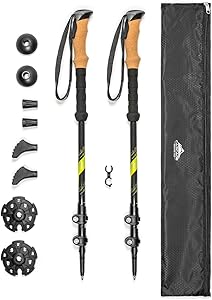
- Weight (pair): 1 lb.
- Shaft material: 100% Carbon fiber
- Grip: Cork or Foam
- Locking mechanism: QuickLock
Carbon fiber poles at this price range should come with a skepticism warning — except these actually earn their keep. Each pole weighs just 8 ounces, which makes a real difference when you’re four hours into a long ascent and your arms are quietly protesting. The QuickLock thumbscrew-and-lever combo keeps sections locked down even when lateral pressure is applied on uneven ground. The option to choose between cork and EVA foam grips is a genuine nod to user preference rather than a marketing gimmick, and both materials perform well.
The kit arrives stocked: carry bag, snow baskets, mud baskets — the kind of accessory haul you’d expect to pay extra for elsewhere. Vibration dampening is noticeably smoother than any aluminum pole at this price. The lever locks are chunkier than what premium labels offer, and joint longevity under sustained heavy use is merely average, but for hikers chasing carbon fiber performance without the brand-name markup, these poles make a genuinely compelling argument.
- Pros:
- Full carbon fiber construction at a budget-friendly price
- Choice between cork and EVA foam grips
- Comprehensive accessory kit included
- Superior vibration dampening versus aluminum alternatives
- Cons:
- Lever locks are noticeably bulkier than those on premium brands
- Joint durability under extended heavy use is only average
See the Cascade Mountain Tech Carbon Fiber
4. Leki Journey Lite

- Weight (pair): 1 lb. 2 oz.
- Shaft material: Aluminum HTS 6.0
- Grip: EVOCON Soft
- Locking mechanism: Speed Lock Plus
German engineering shows up in the details, and the Journey Lite is full of them. The HTS 6.0 aluminum shaft has a rigidity that inspires confidence on technical terrain, and the Speed Lock Plus system lets you dial in height one-handed with winter gloves on — a feature that sounds minor until you’re standing on a cold ridgeline needing a quick tweak. The EVOCON grips are angled slightly forward, which naturally positions the wrist in a neutral stance and noticeably softens the impact during sustained downhill sections.
The wrist straps deserve specific credit: breathable, lightweight, and trimmed to prevent the hot-spot chafing that plagues cheaper versions after hour three. Carbide flex tips bite into rock with precision. The one persistent grumble is that the Speed Lock Plus can occasionally lose its grip under sustained heavy vertical pressure, requiring a quick retighten mid-hike. It’s a minor inconvenience on an otherwise well-executed package — one that reflects Leki’s consistent commitment to ergonomic, long-wearing design.
- Pros:
- Positive-angle EVOCON grips reduce wrist strain on descents
- Speed Lock Plus operates easily even with thick gloves
- Durable HTS 6.0 aluminum handles mixed terrain reliably
- Breathable straps prevent chafing on long days
- Cons:
- Locking mechanism can slip under sustained heavy vertical pressure
5. REI Co-op Traverse

- Weight (pair): 1 lb. 2.5 oz.
- Shaft material: 7075 Aluminum
- Grip: Cork
- Locking mechanism: External Lever Lock
The Traverse doesn’t try to be anything other than what it is: a solid, uncomplicated trekking pole for hikers who want function over fanfare. The three-section 7075 aluminum shaft telescopes smoothly and the external lever locks are simple to operate without consulting a manual. The natural cork grips are the pleasant surprise here — moisture-absorbing, hand-conforming, and noticeably more refined than the rubber or plastic alternatives common at this price. For established trail hiking, they deliver exactly the balance and support they promise.
Push them beyond casual use and the cracks show. The unpadded wrist straps become an irritant on full-day outings, and the locking hardware carries a heaviness that feels out of proportion with the rest of the pole. The shaft also lacks the responsiveness of pricier aluminum builds, so don’t expect the same planted feedback on technical ground. That said, for hikers who visit well-groomed trails a few times per season and want a dependable pole without overcomplicating the purchase, the Traverse is an honest, accessible option.
- Pros:
- Natural cork grips absorb moisture and mold to the hand
- Simple, tool-free lever lock adjustment
- 7075 aluminum is sturdier than most poles at the price
- Affordable entry point from a trusted brand
- Cons:
- Unpadded wrist straps cause discomfort on longer treks
- Locking hardware feels heavy and clunky
6. TrailBuddy Trekking Poles
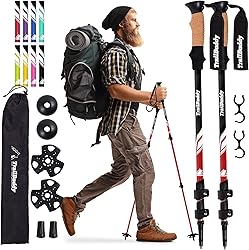
- Weight (pair): 1 lb. 3.2 oz.
- Shaft material: 7075 Aluminum
- Grip: Cork
- Locking mechanism: Lever Lock
TrailBuddy has quietly built something worth paying attention to. The 7075 aluminum shaft adjusts from 24.5 all the way to 54 inches, making these genuinely usable for everyone from younger hikers to tall adults — and when the trip involves air travel, they break down to just 21 inches, small enough to disappear into carry-on luggage. That travel-friendly collapseability is a real differentiator. The one-handed lever locks are a step above what you’d normally find here, allowing adjustments mid-stride without breaking your rhythm.
The cork handles mold over time and pull moisture away from the palm, while the padded wrist straps — often an afterthought in this category — actually buffer the impact of long-distance use. Aluminum will always transmit more ground vibration than carbon, so hikers with sensitive wrists or elbows should factor that in. But for anyone who wants a tough, travel-packable, well-accessorized pole that doesn’t ask you to choose between portability and durability, TrailBuddy makes a case that’s hard to dismiss.
- Pros:
- Collapses to 21 inches — fits in carry-on luggage
- Wide adjustment range accommodates diverse heights
- Padded wrist straps reduce fatigue on extended hikes
- Complete accessory kit included
- Cons:
- Aluminum shaft transmits more trail vibration than carbon fiber models
See the TrailBuddy Trekking Poles
7. LEKI Legacy Lite

- Weight (pair): 1 lb. 2 oz.
- Shaft material: Aluminum
- Grip: COR-TEC (Cork/Latex)
- Locking mechanism: SpeedLock
LEKI’s COR-TEC grip material is genuinely worth your attention — a cork-and-latex blend that manages hand moisture better than pure cork while retaining that natural, confidence-inducing feel against the palm. The handle geometry encourages a relaxed wrist angle that pays dividends on long climbs, and the adjustable security straps sync the pole movement with your arm rather than fighting it. The SpeedLock mechanism includes a built-in tension dial for field adjustments, which means you’re not hunting for tools if it ever needs a quick tune on the trail.
Carbide flex tips give excellent bite on both wet rock and loose dirt, and the included trekking baskets swap out easily for winter versions. These poles are light enough to work for loaded backpacking trips and stiff enough to provide real support during heavy descents. The one real weak point: the lowest pole section can occasionally walk down under heavy pressure if the tension isn’t set precisely right. It’s a fixable quirk rather than a design flaw, but worth knowing before you head out on a demanding route.
- Pros:
- COR-TEC cork/latex grips outperform standard cork in moisture management
- Field-maintainable SpeedLock with built-in tension dial
- Swappable baskets make these viable year-round
- Stable and supportive under loaded backpacking conditions
- Cons:
- Lowest section can gradually slip if tension isn’t set precisely
8. Hiker Hunger Poles

- Weight (pair): 9.95 oz. (short)
- Shaft material: Aluminum
- Grip: Cork or EVA
- Locking mechanism: Quick Flip
At under 10 ounces per pair and a collapsed length of just 15 inches, the Hiker Hunger Poles solve a problem most trekking poles don’t even attempt to address: where do you actually put the poles when you’re not using them? The folding design stows inside a daypack without crowding it, disappears into overhead luggage, and adds almost nothing to carry weight. Designed by a Montana-based outfit that clearly tests gear against actual Rocky Mountain conditions, these aren’t a compromised travel gimmick — the metal flip locks and reinforced joints are built to handle real terrain.
Grip choices between cork and EVA foam let you match material to climate and preference, and both options hold up well over extended use. The trade-off is height adjustment range: the folding architecture limits how much variation you can dial in compared to a traditional telescoping pole, which may frustrate hikers whose height sits at the edges of the adjustment window. For everyone else — especially mountain scramblers and frequent flyers who need maximum portability without sacrificing trail-ready toughness — these poles are an easy recommendation.
- Pros:
- Collapses to 15 inches — fits inside a daypack or carry-on
- Lightest aluminum pair on this list at under 10 oz.
- Durable metal flip locks hold firm on demanding terrain
- Cork or EVA foam grip options available
- Cons:
- Limited height adjustment range compared to telescoping designs
9. Black Diamond Trail Back
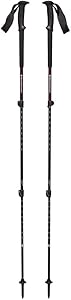
- Weight (pair): 1 lb. 4 oz.
- Shaft material: Aluminum
- Grip: Rubber / Foam Extension
- Locking mechanism: Lever Lock
The Trail Back’s most interesting feature isn’t immediately obvious — it’s the foam extension below the rubber grip. On steeper uphills, most hikers stop to shorten their poles or just muscle through with the wrong length. The Trail Back lets you slide your hand down onto the foam shaft and keep moving without breaking stride. It’s a small ergonomic detail that reveals careful thinking about how poles are actually used on rolling terrain, and it’s something you rarely find at this price point regardless of brand.
Black Diamond includes both standard trekking and snow baskets, and the carbide tips are built for seasons of hard use rather than a single summer. The aluminum construction and rubber primary grip add weight compared to carbon alternatives, and the telescoping design doesn’t pack as tightly as folding poles, but neither issue undermines what this pole does well: absorb punishment, stay functional across all four seasons, and carry the credibility of a brand that has been building serious outdoor gear for decades.
- Pros:
- Extended foam grip below the handle enables on-the-move height adaptation
- Four-season ready with both trekking and snow baskets included
- Built to withstand seasons of sustained hard use
- Trusted Black Diamond construction at an accessible price
- Cons:
- Heavier than most competitors on this list
- Telescoping design is less compact than folding alternatives
See the Black Diamond Trail Back
10. Trekology Trek-Z

- Weight (pair): 1 lb. 10 oz.
- Shaft material: Aluminum
- Grip: Foam
- Locking mechanism: Lever Lock
The Trek-Z earns its spot by solving one specific problem extraordinarily well: it folds to 15 inches and costs almost nothing. For day hikers who need poles that disappear into a bag between uses and don’t want to spend much doing it, that combination is hard to argue with. The foam grips are contoured rather than generic, and the rounded rubber cap at the top of the handle opens up additional hand positions during long flat stretches. The locking mechanism clicks into place with enough authority to feel trustworthy.
The honest trade-off is weight. At 1 lb. 10 oz., the Trek-Z is the heaviest option on this list, and that heft comes from the reinforced metal joints that make the fold-and-lock system durable. On short day hikes the extra ounces are barely noticeable, but on fast-paced, multi-hour outings the poles start to feel unwieldy. Height adjustment range is also narrower than standard telescoping competitors. If you’re after a featherlight setup for big mountain days, look elsewhere — but for occasional use and travel, the Trek-Z delivers real value.
- Pros:
- Collapses to 15 inches for easy daypack or travel storage
- Reinforced joints add durability to the folding mechanism
- Contoured foam grips offer multiple hand positions
- Lowest price point on this list
- Cons:
- Heaviest pair on the list at 1 lb. 10 oz.
- Limited height adjustment range
11. Foxelli Carbon Fiber
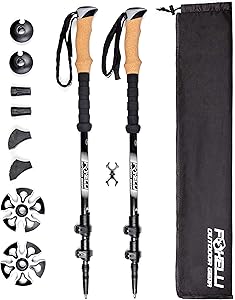
- Weight (pair): 14 oz.
- Shaft material: 100% Carbon fiber
- Grip: Cork
- Locking mechanism: QuickLock
Seven-and-a-half ounces per pole sounds like a marketing number until you actually hike a long ridge with them — then the difference versus aluminum becomes viscerally real, both in carry weight and in how much less vibration reaches your wrists and elbows on hard-packed ground. The Foxelli poles adjust across a generous 24 to 55 inch range, which means hikers at either end of the height spectrum don’t need to compromise. Natural cork grips pull sweat away from the palm during summer outings, preventing the slow-building slipperiness that foam handles develop in the heat.
The value proposition here is genuinely strong, but the QuickLock mechanism is the poles’ one soft spot. It works, but it requires more deliberate setup than premium locking systems — a casual half-turn can leave a section less secure than it appears, which becomes apparent only when you weight the pole hard on descent. For casual hikers and those doing day trips on moderate terrain, this is a minor inconvenience. For extended multi-day expeditions where reliability under load is non-negotiable, the lock warrants careful attention every time you adjust.
- Pros:
- Full carbon fiber at a fraction of typical carbon pricing
- Excellent vibration dampening protects wrists and elbows
- Natural cork grips manage sweat well in warm conditions
- Wide 24–55 inch adjustment range suits almost any height
- Cons:
- QuickLock mechanism requires careful setup to prevent slipping under heavy load
- Not ideal for demanding multi-day expeditions
12. Mountainsmith Dolomite OLS

- Weight (single): 10 oz.
- Shaft material: 7075 Aluminum
- Grip: Cork and Foam
- Locking mechanism: Lever Lock (OLS)
Single-pole hikers are an underserved crowd, and the Dolomite OLS is built specifically with them in mind. The Outer Lock System flicks open with a thumb and adjusts from 44 to 54 inches without drama, which matters when you’re mid-descent and need to lengthen on the fly. The 7075 aluminum shaft provides a rigidity that lets you put genuine downward pressure on it — the kind of trust a staff needs to earn before you rely on it across technical ground. This is not a pole that flexes or wanders under body weight.
The hybrid grip is the clever touch: shaped cork up top for moisture management during flat and descent sections, with an EVA foam extension below for choking up on uphills without adjusting the pole length. A removable rubber boot handles pavement without the grating metal-on-concrete sound, while the carbide tip underneath takes over when dirt and rock demand bite. At 10 ounces it’s on the heavier side for a single pole, and the overall build quality lands at competent rather than refined — but for a purpose-built hiking staff, that’s often precisely what the trail requires.
- Pros:
- Hybrid cork/foam grip serves both flat and uphill hand positions
- 7075 aluminum shaft handles real downward loading without flex
- OLS thumb-flip adjustment is fast and tool-free
- Swappable rubber boot and carbide tip for mixed surfaces
- Cons:
- Heavy for a single pole at 10 ounces
- Build quality is functional but not particularly refined
See the Mountainsmith Dolomite OLS
Stepping Forward with Confidence: How to Choose Walking Poles for Seniors
As we age, maintaining mobility, balance, and physical fitness becomes increasingly vital for health and independence. Engaging in regular walking is one of the most effective and accessible ways for seniors to stay active. However, concerns about joint pain, instability, or a fear of falling can sometimes deter older adults from enjoying the outdoors. This is where walking poles—also known as trekking poles, Nordic walking sticks, or hiking poles—come into play. Far from being a sign of frailty, walking poles are highly effective tools that empower seniors to walk further, faster, and with significantly greater confidence. Choosing the correct set of poles requires an understanding of an individual’s specific physical needs, the intended environment, and the design features of the poles themselves. This comprehensive guide details everything seniors and their caregivers need to know to select the perfect walking poles.
The Benefits of Walking Poles for Older Adults
Before diving into the technical specifications, it is essential to understand why walking poles are so beneficial for seniors. Walking with poles transforms a simple stroll into a full-body workout, but more importantly, it offers distinct mechanical and physiological advantages tailored to aging bodies.
Enhanced Balance and Stability
The most immediate benefit of walking poles is the creation of additional points of contact with the ground. Instead of relying solely on two feet, a senior using poles establishes a shifting base of three or four points of support. This dramatically reduces the likelihood of slips, trips, and falls, particularly on uneven sidewalks, gravel paths, or wet grass. For individuals managing conditions that affect balance, such as Parkinson’s disease, mild vertigo, or inner ear issues, this added stability is life-changing.
Reduced Joint Impact
Walking poles redistribute a portion of the user’s body weight away from the lower extremities and onto the upper body muscles. Studies have shown that using walking poles can reduce the impact on knees, hips, ankles, and the lower back by up to twenty to thirty percent. For seniors suffering from osteoarthritis or recovering from joint replacement surgery, this reduction in stress can mean the difference between a painful, short walk and a comfortable, extended excursion.
Improved Posture and Upper Body Engagement
Many older adults develop a tendency to lean forward or slouch while walking, which compresses the spine and limits lung capacity. Using walking poles naturally encourages an upright posture. To plant the poles correctly, the chest opens up, the shoulders roll back, and the spine aligns. Additionally, the rhythmic swinging motion engages the muscles of the arms, shoulders, core, and back, increasing cardiovascular output without increasing the user’s perception of effort.
Key Types of Walking Poles
Not all walking poles are designed equal. For seniors, the choices generally fall into two main categories, each serving a distinct purpose.
Nordic Walking Poles
Nordic walking is a specific fitness technique developed in Europe, designed to mimic cross-country skiing on dry land. Nordic poles are built specifically for fitness walking on relatively flat terrain, paved paths, or manicured park trails. They feature a unique glove-like strap mechanism that allows the user to release the pole on the backstroke and catch it again on the forward swing. For seniors looking primarily for an efficient, full-body cardiovascular workout in a suburban or urban environment, Nordic walking poles are an exceptional choice.
Trekking and Hiking Poles
Trekking poles are designed for variable terrain, including hiking trails, nature preserves, hills, and uneven ground. They usually feature standard loop straps and are built to withstand heavier vertical loads. If a senior enjoys hiking in nature, birdwatching in state parks, or navigating backcountry paths, trekking poles provide the rugged durability and variable stability required for those settings.
Crucial Features to Evaluate When Choosing
When selecting a specific pair of poles, several design features must be carefully weighed against the physical capabilities and comfort preferences of the senior user.
Locking Mechanisms: Secure and Easy to Use
Adjustable poles must lock securely into place to prevent sudden collapsing when weight is applied. There are two primary locking systems available: twist locks and lever locks (often called flip locks). Twist locks require the user to rotate the pole segments in opposite directions to tighten them. This can be incredibly difficult and painful for seniors with arthritis, weak grip strength, or limited dexterity. Lever locks, on the other hand, utilize an external clamp that snaps shut. They are highly visual, easy to operate with minimal hand strength, and are generally recommended as the safest and most senior-friendly option.
Shaft Material: Weight versus Vibration
The material of the pole shaft dictates its weight, durability, and shock absorption properties. The two dominant materials are aluminum and carbon fiber. Aluminum poles are incredibly durable, economical, and will bend rather than snap under extreme stress. However, they are slightly heavier. Carbon fiber poles are exceptionally lightweight, which significantly reduces arm fatigue during long walks. Furthermore, carbon fiber naturally absorbs vibrations better than aluminum, which protects sensitive wrist and elbow joints from shock. While carbon fiber is more expensive and can fracture under impact, its lightweight nature often makes it a favorite for older adults.
Grip Ergonomics and Materials
The handle of the pole is the primary point of contact and must feel comfortable in the hand. Grips are generally made from cork, foam, or rubber. Cork is highly recommended for seniors because it molds to the shape of the hand over time, resists moisture from sweaty palms, and reduces friction to prevent blisters. Foam is soft, comfortable, and provides excellent shock absorption. Rubber grips are durable and easy to clean, but they can feel cold in the winter, slippery when wet, and may chafe sensitive skin, making them less ideal for older users.
Shock Absorbers: Yes or No?
Some walking poles come equipped with internal anti-shock springs designed to dampen the impact when the pole hits hard ground. While this sounds highly beneficial for arthritic joints, it does come with a trade-off. Anti-shock mechanisms add weight to the poles and can make the poles feel slightly spongy or unstable when a senior is relying heavily on them for balance. If maximum stability is the primary goal, rigid poles without anti-shock features are usually preferred. If joint relief on hard pavement is the main priority, anti-shock can be considered.
Tips and Feet Accessories
The very bottom of the pole determines how it interacts with the walking surface. Most poles feature a sharp carbide or tungsten tip, which is perfect for biting into dirt, ice, or gravel. However, these sharp tips are noisy and slip easily on concrete or asphalt.
For seniors walking on hard surfaces, removable rubber paws or fitness tips are mandatory. These rubber caps slip over the metal tips, providing excellent traction on pavement, dampening noise, and absorbing impact shock. Ensure that the chosen poles come with interchangeable tips, or that compatible rubber tips are readily available for purchase.
Sizing and Adjustability
Proper pole length is critical to ensuring good posture and avoiding shoulder strain. To find the correct height, the senior should stand up straight with their elbows bent at a ninety-degree angle, tucked close to their sides. The distance from the floor to the top of the hand is the ideal pole height. While fixed-length poles exist and are incredibly lightweight, adjustable poles are highly recommended for seniors. Adjustable poles allow for fine-tuning based on footwear, accommodate different family members, and can be shortened when walking uphill or lengthened when walking downhill to maintain optimal biomechanical support.
Conclusion
Investing in a high-quality pair of walking poles is an investment in a senior’s long-term mobility, health, and vitality. By prioritizing features like easy-to-use lever locks, lightweight materials like carbon fiber or high-grade aluminum, comfortable cork or foam grips, and appropriate rubber pavement feet, older adults can safely unlock the joy of walking. With the right pair of poles in hand, the world becomes a more stable, accessible, and inviting place to explore.