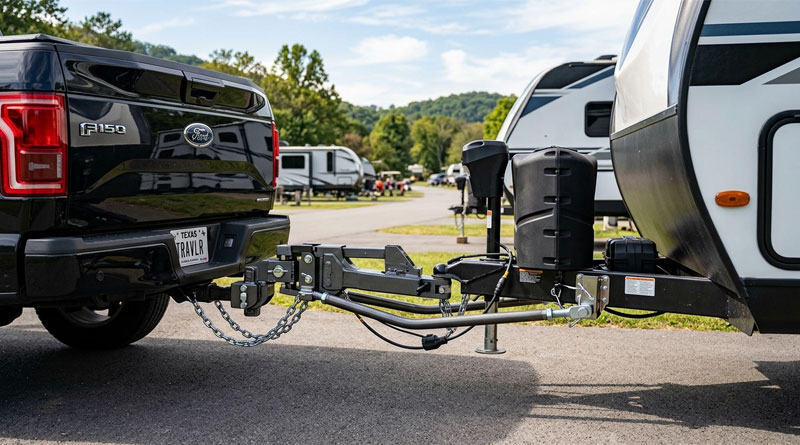
Towing a travel trailer shouldn’t feel like a high-stakes wrestling match with your steering wheel. Achieving a balanced, rock-solid ride requires more than just a powerful engine; it demands a high-quality weight distribution hitch. By mechanically shifting tongue weight across all axles, these systems eliminate rear-end sag and dampen the white-knuckle terror of trailer sway. Choosing the right setup isn’t just a technical upgrade—it’s the definitive way to transform a stressful haul into a serene, controlled highway cruise.
1. Camco Eaz-Lift Elite 1,000lb Weight Distribution Hitch Kit

- Tongue Weight Capacity: Up to 1,200 lb
- Gross Trailer Weight: Up to 12,000 lb
- Sway Control: Manually adjusted external system
- Setup: Pre-installed hitch ball and sway control ball
The Camco Eaz-Lift Elite is the “ready-to-go” veteran of the towing world. Its biggest selling point is the factory-installed and torqued components, which eliminate the need for heavy-duty specialized tools during the initial setup. This makes it an excellent choice for weekend warriors who want to spend more time at the campsite and less time in the driveway. By leveling the load, it restores front-end traction and ensures your tow vehicle’s headlights aren’t pointing at the stars.
Beyond the easy setup, the kit includes a manual friction sway control bar that can be adjusted to your specific trailer profile and road conditions. The universal spring bars are a clever touch, as they can be mounted on either side of the hitch head without confusion. While it requires a bit of manual “dialing in” compared to fully integrated systems, its reliability and high weight capacity make it a staple for anyone pulling a standard mid-to-large travel trailer.
- Pros:
- Pre-installed components save installation time
- Manually adjustable sway control for customization
- High capacity ratings for various trailers
- Cons:
- Manual sway control requires adjustment
- External sway control can be less seamless than integrated
- Some users might prefer an automatic system
2. Equal-i-zer 4-point Sway Control Hitch

- Trailer Weight Rating: 12,000 lbs
- Tongue Weight Rating: 1,200 lbs
- Sway Control: Integrated 4-point system
- Compatibility: Works with virtually all bumper-pull trailers
Widely regarded as the gold standard in the industry, the Equal-i-zer 4-point hitch offers a sophisticated approach to trailer stability. Unlike basic setups that use separate friction bars, this system integrates sway control directly into the hitch head and the trailer brackets. This creates four distinct points of friction that actively fight sway before it even starts. It is particularly effective for large trailers with high profiles that are susceptible to crosswinds and the “push” from passing semi-trucks.
The rigid design of the Equal-i-zer provides a more unified feel between the truck and trailer, significantly reducing “porpoising” on uneven bridge transitions. Because the sway control is built-in, there is no need to remove extra bars when backing into a tight campsite or navigating sharp turns. While it requires you to purchase a hitch ball separately and involves a slightly more technical initial installation, the massive gain in driver confidence and long-term safety is worth every penny of the investment.
- Pros:
- Exceptional 4-point integrated sway control
- Improved steering and braking safety
- Broad compatibility with various trailer types
- Cons:
- Hitch ball must be purchased separately
- Potentially higher upfront cost
- Installation might be more involved than basic models
3. Husky 31423 Round Bar Weight Distribution Hitch

- Tongue Weight Range: 801-1,200 pounds
- Gross Trailer Weight: 12,000 pounds
- Height Adjustment: 8 inches total
- Sway Control Platform: Built-in dual sway control platform
The Husky 31423 is built for the pragmatist who values durability and versatility. Its round bar design is classic, but Husky has updated the head design to provide better access to the hitch ball shank, making the assembly process much less of a headache. The heavy-duty black polyester finish is a notable feature, acting as a thick shield against the salt and road grime that typically eat away at hitch components over time. It’s a workhorse designed for longevity.
What sets this Husky model apart is its adaptability; the spring bars are interchangeable, allowing you to swap them out if you eventually upgrade to a trailer with a different weight rating. While the hitch provides a dual-platform for mounting sway control, it’s important to note that the sway balls themselves are sold separately. This “modular” approach allows you to build the exact setup you need, making it a highly cost-effective and flexible solution for towers who may change trailers in the future.
- Pros:
- Easy installation with accessible hitch ball shank
- Durable black polyester finish resists corrosion
- Interchangeable spring bars for versatility
- Cons:
- Hitch balls are not included
- Sway control is a platform, not an integrated system
- Requires a 1-1/4″ shank on the trailer ball
4. VEVOR Weight Distribution Hitch with Sway Control

- Tongue Weight Capacity: 1,000 lbs
- Construction Material: High-strength hardened steel
- Sway Control: 4-point swivel control
- Coating: Double-layer black electroplating
VEVOR enters the arena with a focus on high-strength materials and modern finishing techniques. This hitch is constructed from hardened steel that undergoes a double-layer electroplating process, offering a level of rust resistance that often exceeds traditional powder coating. The 4-point swivel control mechanism is designed to handle lateral forces aggressively, ensuring that even if you’re forced into a quick evasive maneuver, the trailer stays pinned directly behind your vehicle without the dreaded “wagging” motion.
Efficiency is the theme here, as VEVOR includes a dedicated pry bar tool to help seat the spring bars safely and with minimal physical strain. While the 1,000 lb tongue weight capacity is slightly lower than some heavy-duty competitors, it is perfectly suited for the vast majority of mid-sized travel trailers. The combination of a solid steel shank and an alloy steel ball provides a dense, sturdy connection that minimizes noise and vibration during long-distance hauls, making for a much quieter cabin experience.
- Pros:
- Sturdy, high-strength hardened steel construction
- Effective 4-point swivel control enhances stability
- Excellent wear and rust resistance with double-layer coating
- Cons:
- 1,000 lbs tongue weight might be lower than some competitors
- Brand might be less recognized than established names
- Specific design might require careful initial setup
5. Reese 49912 Pro Round Bar Weight Distribution Hitch

- Capacity: 8,000 lbs GTW
- Hitch Ball: Preinstalled 2-5/16-inch
- Shank: 8.5-inch deep drop shank included
- Trailer Frame Fit: Up to 7-inch trailer frames
The Reese Pro series focuses heavily on ride comfort through its tapered spring bar design. Unlike stiff, uniform bars, tapered bars provide a more progressive weight distribution that absorbs road shocks rather than transferring them directly into the tow vehicle’s frame. This results in a much smoother ride on bumpy secondary roads. The inclusion of a deep 8.5-inch drop shank is a major plus for owners of lifted trucks or vehicles with high bumpers, ensuring the trailer stays perfectly level.
Installation is simplified by the no-drill, clamp-on brackets, which fit frames up to 7 inches. This is ideal for trailers where you want to avoid compromising the frame’s integrity with bolt holes. Although its 8,000 lb capacity is on the lighter side compared to some “monster” hitches, it is expertly engineered for the popular class of mid-weight campers. The high-strength steel head and welded construction give it a “built-to-last” feel that Reese has been known for over decades of RV history.
- Pros:
- Preinstalled hitch ball and included drop shank
- Durable high-strength steel construction
- Tapered spring bars for superior ride comfort
- Cons:
- 8,000 lbs capacity might be lower for heavier trailers
- Clamp-on brackets may not suit all preferences
- Specific drop shank might not be universally ideal
6. CURT 17063 Round Bar Weight Distribution Hitch

- Gross Trailer Weight: 10,000 to 14,000 lbs
- Tongue Weight: 1,000 to 1,400 lbs
- Sway Control: Integrated bar included
- Lubrication: Integrated system with grease zerks
The CURT 17063 is a heavy-hitter designed for the largest travel trailers on the market. With a massive capacity of up to 14,000 lbs, it is built to handle significant loads without breaking a sweat. One of its most innovative features is the integrated lubrication system. By including grease zerk fittings directly in the hitch head, CURT allows users to keep the pivot points lubricated without messy manual application. This leads to a much quieter towing experience, eliminating the squeaks and groans often associated with weight distribution.
Despite its heavy-duty nature, the hitch is surprisingly adjustable. The 2-inch shank is highly versatile, and the pre-torqued 2-5/16-inch trailer ball means you can get hitched up and moving quickly. The carbide black powder coat isn’t just for looks; it’s one of the most durable finishes available, resisting scratches and rust even in winter climates. If you are towing a triple-axle trailer or a massive toy hauler, the strength and maintenance-friendly features of this CURT hitch make it a top-tier contender.
- Pros:
- High gross trailer weight and tongue weight capacity
- Integrated lubrication system for quiet operation
- Includes pre-torqued hitch ball for convenience
- Cons:
- Round bar design may not be preferred by all
- Integrated sway control bar can be less aggressive than 4-point systems
- Can be quite heavy due to robust construction
7. Fastway Connect™ Weight Distribution Hitch

- Max Tongue Weight: 1,000 lb
- Max Trailer Weight: 10,000 lb
- Hitch Ball: 2-5/16” pre-installed
- Shank: Standard shank with 3″ drop and 7″ rise
The Fastway Connect™ is the perfect solution for those who want a “no-fuss” towing experience. It utilizes a chain-based tension system that is incredibly easy to adjust. If you find your vehicle is sagging slightly, you simply move up one link on the chain to increase the leverage. This intuitive design makes it much easier for beginners to understand exactly how the weight distribution is working. The hitch comes as a complete package, including a pre-installed ball and a versatile shank that works for most standard vehicle heights.
While the chain system is slightly more flexible (meaning it has more “give” than rigid bars), it still provides a massive improvement in steering and braking control compared to a standard ball mount. The absence of frame drilling means you can install this on almost any bumper-pull trailer without specialized equipment. It’s an approachable, reliable, and time-tested design that focuses on the core benefits of weight distribution: safety, level towing, and reduced driver fatigue during long days on the road.
- Pros:
- Fast and easy adjustments with chain links
- Includes pre-installed hitch ball and standard shank
- Universal compatibility with no frame drilling required
- Cons:
- Chain-based system might feel less rigid than other types
- 1,000 lb max tongue weight may be limiting for some
- Sway control is inherent, not a separate adjustable component
How to Choose Weight Distribution Hitches For Travel Trailer
Selecting the right weight distribution (WD) hitch is perhaps the most significant decision you will make regarding your towing safety. A travel trailer is essentially a giant sail behind your vehicle; without the right mechanical connection, wind, speed, and weight can conspire to make driving a nightmare. This guide will walk you through every nuance of the purchasing process to ensure your choice is based on physics and safety rather than guesswork.
The Physics of Weight Distribution
To choose the right hitch, you must first understand the problem it solves. When you drop a trailer onto a standard ball hitch, the “Tongue Weight” (TW) acts as a lever, pushing down on the rear axle and lifting the front axle of your truck. This causes several dangerous conditions: diminished steering response, reduced braking power, and “aiming” your headlights into the eyes of oncoming drivers. A WD hitch uses spring bars to create leverage that “lifts” the rear of the vehicle and “pushes” that weight forward onto the front tires and back onto the trailer tires. This levels the entire “train,” ensuring all tires have maximum contact with the road.
1. Calculating Your Actual Weights
Never rely on “dry weight” numbers from a brochure. You need to know two specific numbers:
- Gross Trailer Weight (GTW): This is the weight of the trailer fully loaded with water, propane, gear, and food. Most travel trailers end up 1,000–2,000 lbs heavier than their dry weight.
- Tongue Weight (TW): This should be 10% to 15% of your GTW. If your trailer weighs 8,000 lbs, your tongue weight should be between 800 and 1,200 lbs.
Pro Tip: Buy a hitch rated for slightly more than your actual tongue weight, but don’t go too high. If you use a 1,500 lb rated hitch on a 500 lb tongue, the ride will be incredibly stiff and may damage your trailer frame.
2. Deciding on Sway Control Integration
Sway is the horizontal oscillation of the trailer. It’s caused by wind or the “bow wave” of air from passing trucks. You have three main choices:
- No Sway Control: Only suitable for very small trailers in calm conditions. Not recommended for travel trailers.
- Add-on Friction Sway: A separate bar that you tighten down. It’s cheap and effective but must be removed before backing up to avoid bending the bar.
- Built-in 2-Point or 4-Point Sway: The sway control is part of the hitch head or the spring bar brackets. This is the gold standard. It provides constant tension and doesn’t need to be removed when reversing. For trailers over 20 feet, 4-point integrated sway control is highly recommended.
3. Round Bar vs. Trunnion Bar
This refers to how the spring bars attach to the hitch head. Round bars slide into the bottom of the head. They are generally more affordable but can reduce ground clearance. Trunnion bars slide into the sides of the head. They offer much better ground clearance and are often rated for higher weights. If you have a low-slung trailer or plan to go off-pavement, go with a Trunnion bar setup.
4. Shank Size and Drop/Rise
Most modern trucks use a 2-inch or 2.5-inch receiver. Ensure the hitch you buy matches your truck’s receiver size (though adapters exist). Additionally, look at the “Shank.” This is the part that allows the hitch ball to be adjusted up or down. If you have a lifted truck, you will need a shank with a significant “drop” to ensure the trailer stays level. A trailer that is nose-high is much more likely to sway dangerously.
5. Installation and Tools
Consider how “DIY-friendly” the hitch is. Some require you to drill holes into your trailer frame to mount brackets; others use a “clamp-on” system. If you aren’t comfortable with a drill and a torque wrench, look for a “Ready-to-Tow” kit like the Camco Eaz-Lift or the Reese Pro, which come with the hitch ball pre-torqued. Torquing a hitch ball often requires a specialized socket and a wrench capable of 250+ ft-lbs of torque—tools most casual DIYers don’t own.
6. Maintenance Requirements
A WD hitch is a mechanical system with metal-on-metal contact. It will make noise—popping, grinding, and squeaking are normal. However, some hitches (like the CURT 17063) have built-in grease ports to make maintenance easier. If you hate the sound of grinding metal, look for hitches that allow for lubrication or use specialized “friction pads” to dampen the noise.
7. Brand Reputation and Warranty
Brands like Equal-i-zer, Reese, and CURT have been around for decades. They offer lifetime warranties and, more importantly, you can find replacement parts (like a lost pin or a bent bracket) at almost any RV supply store in the country. Lesser-known brands may be cheaper, but finding a replacement part in the middle of a cross-country trip can be a nightmare.
Common Mistakes to Avoid
- Underestimating Gear Weight: Most people forget the weight of the water in their tanks and the gear in the “pass-through” storage at the front of the trailer. This adds directly to the tongue weight.
- Setting it and Forgetting it: Every time you change the load in your truck (like adding a heavy generator in the bed), you may need to adjust the tension on your spring bars.
- Ignoring the Manual: Every hitch has a specific “setup height” for the ball. Being off by just an inch can ruin the effectiveness of the weight distribution.
Conclusion
In summary, start by weighing your trailer. Choose a hitch that covers your max tongue weight with a 10-20% buffer. Prioritize integrated sway control for any trailer over 25 feet. Finally, ensure the shank provides enough adjustment to keep your trailer perfectly level. A properly chosen and installed weight distribution hitch is the difference between a vacation that starts the moment you leave the driveway and one that is a grueling chore until you unhook.