Hitting the open road doesn’t have to mean leaving your favorite broadcasts in the rearview mirror. While standard RV setups often struggle with grainy reception or limited channel counts, a dedicated antenna upgrade bridges the gap between nomadic freedom and high-definition entertainment. Whether you are hunkered down in a remote forest or parked at a bustling coastal site, the right hardware ensures local news, weather, and sports remain just a click away, turning your camper into a truly modern mobile sanctuary.
1. Winegard RZ-6000 Rayzar z1 RV TV Antenna – White

- Type: Amplified RV HDTV antenna
- Reception: VHF/UHF over-the-air channels
- Design: Low-profile dome styling
- Installation: Simple roof-mount
The Winegard RZ-6000 Rayzar z1 is a masterclass in blending form with function for the modern traveler. Its sleek, aerodynamic dome isn’t just about aesthetics; it is engineered to slice through wind resistance, reducing the drag and noise often associated with bulkier rooftop units. Under the hood, the internal amplifier works overtime to pull in crisp 4K and ATSC 3.0 signals, ensuring you are prepared for the next generation of broadcasting without needing another hardware swap in the near future.
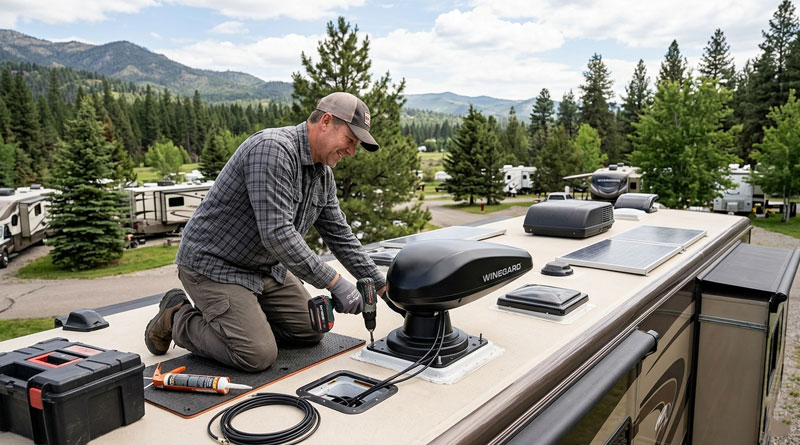
Setting this unit up is remarkably painless, designed specifically for permanent roof mounting with a minimal footprint. Because it’s built to endure the rigors of the road, it thrives in environments where standard antennas might vibrate loose or lose signal integrity. While its omni-directional nature means you won’t be out in the rain cranking a handle to find a signal, users should remember that physical distance from urban towers still dictates the ultimate channel count. It remains a top-tier choice for style-conscious RVers.
- Pros:
- Sleek, low-profile design
- Enhanced VHF/UHF reception
- Easy roof-mount installation
- 4K and ATSC 3.0 ready
- Cons:
- Range depends on location
- Roof-mount only
2. GE Portable HD TV Antenna (20 Mile Range)

- Range: Up to 20 miles
- Reception: 360° for VHF/UHF channels
- Compatibility: 1080p, 4K, 8K, ATSC 3.0 Ready
- Mounting: Strong magnetic base
For those who prefer a “no-strings-attached” approach to technology, the GE Portable HD TV Antenna is a revelation in simplicity. This compact monopole doesn’t require a permanent commitment to your RV’s roof; instead, it uses a heavy-duty magnetic base to cling to any metal surface. This makes it a perfect companion for tailgating or quick overnight stops where you just want to catch the evening news without a complex setup. Its 360-degree reception allows for immediate signal acquisition without tedious aiming.
Despite its diminutive size, it is surprisingly future-proof, boasting compatibility with 4K, 8K, and the upcoming NEXTGEN TV standards. While its 20-mile range makes it more of a “city dweller” than a “deep woods” explorer, it excels in suburban environments and popular campgrounds near metropolitan hubs. The inclusion of U.S.-based technical support provides a safety net for less tech-savvy users. If your travels keep you relatively close to civilization, this GE unit offers the ultimate blend of portability and high-definition performance without the need for drilling holes.
- Pros:
- Highly portable and compact
- Magnetic base for easy placement
- 360° signal reception
- ATSC 3.0 compatible
- Cons:
- Limited 20-mile range
- Best for close-range signals
3. Five Star Upgraded 2024 Omni-Directional Outdoor HD Digital TV Antenna

- Range: Up to 150+ miles
- Reception: 360° Omni-Directional VHF/UHF
- Filter: Built-in 4G LTE Filter
- Compatibility: ATSC 3.0, 4K 1080P HD
The Five Star Upgraded 2024 model is essentially the “long-range scout” of the antenna world. Boasting a massive 150-mile theoretical reach, it is designed for the RVer who dares to go where others won’t. This unit is built like a tank, featuring an anti-UV coating and weatherproofing that laughs at snow and rain. Its standout feature is the integrated 4G LTE filter, which acts as a digital shield against cellular interference, ensuring that your 4K movie marathon isn’t interrupted by nearby smartphone traffic.
What makes this antenna particularly impressive is its multi-TV capability; it comes ready to feed up to four separate screens, making it ideal for large luxury coaches or family-sized trailers. While the omni-directional design is intended to be hassle-free, users should note that at extreme distances, physical placement still matters. It is a robust, high-performance solution for users who want to maximize their channel lineup across multiple rooms while enjoying protection from the elements and signal noise. This is truly an “all-in-one” powerhouse for serious enthusiasts.
- Pros:
- Impressive 150+ mile range
- Omni-directional, no aiming
- Effective 4G LTE filter
- Durable, weather-resistant design
- Cons:
- Optimal omni-range 40-60 miles
- May require specific placement for weakest signals
4. Winegard RV-3095 Sensar III Batwing Amplified RV TV Antenna
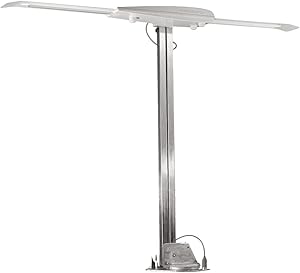
- Range: Up to 55 miles
- Reception: VHF/UHF, Digital, 4K Ready
- Design: Classic “Batwing” amplified
- Durability: Proven long-lasting design
The “Batwing” is a legend for a reason. While newer, flashy designs populate the market, the Winegard Sensar III remains the gold standard for many seasoned road warriors. Its directional nature is its greatest strength; by manually aiming the antenna toward the broadcast source, you can achieve a level of signal stability that omni-directional models often miss. This makes it the go-to choice for those camping in valleys or areas where signals are bouncing off obstacles and require a “laser-focused” capture method.
Construction-wise, it is built to survive decades of sun exposure and highway speeds. The amplified circuitry is tuned to pull in both VHF and UHF frequencies with high efficiency, spanning a reliable 55-mile radius. Yes, you do have to use the interior crank to lift and rotate it, which some might find tedious, but the trade-off is a consistent, flicker-free image even in fringe areas. For the purist who values a time-tested track record and doesn’t mind a bit of manual labor for a better picture, the Sensar III is unbeatable.
- Pros:
- Extremely durable and reliable
- Proven track record for RV use
- Amplified for better signal strength
- 55-mile extended range
- Cons:
- Directional, requires aiming
- Classic design might not suit all aesthetics
5. 1byone Outdoor TV Antenna (100+ Miles Range)

- Range: 100+ miles
- Reception: 360° Omni-Directional VHF/UHF
- Amplifier: Built-in Pre-Amplifier with Smart pass
- Filter: 4G LTE Filter
The 1byone Outdoor TV Antenna is a versatile chameleon, equally at home on an RV roof as it is in a residential attic. It utilizes a “Smart pass” amplifier system, which intelligently balances the signal to prevent the overloading of nearby towers while boosting those faint, distant broadcasts. This makes it an exceptionally reliable choice for travelers who alternate between urban RV parks and more isolated rural campgrounds. Its 100-mile range provides a massive “safety net” for staying connected to local affiliate stations.
Beyond its raw power, the 1byone includes a generous 32ft RG6U cable and an integrated LTE filter, effectively streamlining the installation process. It focuses on providing a clean, high-bandwidth 4K image without the need for manual rotation. While the manufacturer suggests it works best for a single TV output to maintain peak signal integrity, the sheer volume of channels it can pull from all directions makes it a top contender for the solo entertainment enthusiast. It’s a modern, tool-free solution for those who want long-range power without technical headaches.
- Pros:
- Exceptional 100+ mile range
- True 360° omni-directional reception
- Built-in amplifier and 4G LTE filter
- Easy, tool-free installation
- Cons:
- Recommended for single TV output
- Performance depends on broadcast towers
6. Amplified RV Antenna by Continu.us | CA1500 Digital TV

- Range: 55 miles
- Reception: 360° Omni-Directional VHF/UHF
- Outputs: 2 TV outputs with power amplification
- Design: Low profile, weatherproof, UV resistant
The Continu.us CA1500 has earned its reputation as the “silent worker” of the RV industry, often being the go-to factory choice for many vehicle manufacturers. Its primary draw is its sheer resilience; this antenna is designed to live in the most extreme climates, functioning perfectly between -25°F and 145°F. This makes it the ideal candidate for four-season travelers who might find themselves in a desert heatwave one week and a mountain blizzard the next. Its black, low-profile casing is both discrete and incredibly tough.
Functionality is centered around ease of use, providing a 360-degree reception arc that eliminates the need for any internal cranking or external aiming. With dual TV outputs and built-in power amplification, it is perfectly suited for modern campers that feature both an indoor living room TV and an outdoor entertainment center. While its 55-mile range is mid-tier, the stability of the signal within that radius is exceptional. It is a set-it-and-forget-it solution that prioritizes long-term durability and multi-room entertainment over extreme-distance gimmicks.
- Pros:
- Omni-directional, no aiming required
- Supports two TV outputs
- Extremely durable and weatherproof
- Low-profile and UV resistant
- Cons:
- 55-mile range might be limiting in very remote areas
- Requires roof-mount installation
7. Winegard RZ-6035 Rayzar z1 RV TV Antenna – Black

- Reception: Optimal UHF with strong High-Band VHF
- Design: Streamlined, compact (8.4″ tall)
- Operation: Effortless rotation, no cranking
- Testing: Rigorously tested for RV conditions
The black version of the Winegard Rayzar z1 offers a sleek, “stealth” aesthetic for those who want high-performance tech that doesn’t scream for attention. Standing at just 8.4 inches, it provides one of the best height-to-performance ratios in the industry. It is specifically optimized for High-Band VHF and UHF, which covers the vast majority of digital channels broadcast today. This ensures that you aren’t just getting “some” channels, but a full spectrum of available local programming with minimal interference.
What sets this apart from the older “Batwing” models is the effortless rotation mechanism. You can dial in the perfect signal with a simple interior handle—no cranking up or down required—which drastically reduces the risk of accidental damage when you pull out of a campsite in a hurry. It has been rigorously vibration-tested to ensure it won’t rattle apart after a thousand miles of bumpy backroads. This antenna is for the RVer who wants a modern, “best-of-both-worlds” device: the focused power of a directional antenna without the mechanical clutter of legacy designs.
- Pros:
- Strong UHF and VHF reception
- Modern, compact, low-profile design
- Effortless rotation, no cranking
- Built for RV durability
- Cons:
- Directional, requires manual rotation
- Range varies by location
How to Choose RV TV Antenna Upgrades
Buying an RV TV antenna upgrade is a strategic move that involves more than just picking the first “long-range” box you see. To get the most for your money, you need to understand the environment you travel in, the physical constraints of your rig, and the future of television technology. This comprehensive guide will break down the essential steps for making a purchase you won’t regret when you’re 50 miles away from the nearest town.
Step 1: Audit Your Travel Habits
The “perfect” antenna doesn’t exist in a vacuum; it exists relative to your coordinates. Before spending a dime, ask yourself where you spend 80% of your time. Are you a “boondocker” who seeks solitude in National Forests, or are you a “glamper” who stays in high-end RV parks near metropolitan areas?
If you are frequently in remote regions, range is your primary metric. You will need an antenna with a high-gain, directional design (like the Winegard Sensar III) or a super-long-range omnidirectional unit with a powerful amplifier (like the Five Star 150-mile model). Conversely, if you stay near cities, a 150-mile antenna might actually be counterproductive, as the excessive amplification can “swamp” your tuner with too much signal, causing pixelation. In urban areas, a portable 20-mile monopole or a low-profile dome is often more than sufficient.
Step 2: Decide Between Directional and Omnidirectional
This is the most critical technical choice you will make. It’s a trade-off between convenience and performance.
- Directional Antennas: These require you to know where the broadcast tower is. You use a handle inside the RV to point the “face” of the antenna toward the signal. Because they focus all their energy in one direction, they are vastly superior at pulling in weak signals from far away. They also naturally filter out noise coming from behind or beside them.
- Omnidirectional Antennas: These are 360-degree “nets.” You never have to aim them. For the casual traveler, this is a massive quality-of-life improvement. However, they are generally less sensitive. They are also more susceptible to “multipath interference”—where signals bounce off buildings or mountains and hit the antenna at different times, causing ghosting or loss of signal.
Step 3: Check for Future-Proofing (ATSC 3.0 and 4K)
The broadcast world is currently undergoing a massive shift to ATSC 3.0, also known as “NextGen TV.” This new standard allows for 4K resolution, better signal penetration into vehicles, and even interactive features. When purchasing an upgrade, ensure the box explicitly mentions “ATSC 3.0 Ready” or “4K Ready.” While older antennas *can* sometimes pick up these signals, the internal filters and amplifiers in newer models are specifically tuned to handle the wider bandwidth and different frequency allocations of modern digital TV. Investing in an older, non-4K antenna now might save you $20 today, but it will force you to upgrade again in 2 to 3 years.
Step 4: Assess Mounting and Installation Constraints
Where will the antenna live? Most RVers prefer a roof mount for the height advantage. Height is the single most important factor in signal reception; every foot you gain helps you clear trees and neighboring RVs. However, roof mounting requires drilling and meticulous weather-sealing. If you are renting your RV or are hesitant to drill holes in your roof, look for portable options with magnetic bases or tripod mounts.
If you choose a roof mount, consider the “profile.” A high-profile antenna can be a magnet for low-hanging branches in campgrounds. Low-profile domes are much safer but sometimes offer slightly less gain. Also, ensure you have a clear path to route the coaxial cable from the roof to your internal media center. If your RV is already pre-wired for a specific brand (like Winegard or Continu.us), choosing the same brand for your upgrade can make the installation a “plug-and-play” affair.
Step 5: Don’t Ignore the Interference Factors
In the 2024 landscape, the biggest enemy of TV signals isn’t distance; it’s cellular data. 4G and 5G signals operate on frequencies very close to TV broadcasts. This can lead to “noise” that prevents your TV from locking onto a channel. High-quality antenna upgrades now include built-in “LTE Filters.” Always look for this feature. It acts like a pair of noise-canceling headphones for your TV, blocking out the chatter from nearby cell towers so the broadcast signal can come through cleanly.
Step 6: Power Requirements
Almost all high-performance RV antennas are “amplified.” This means they require a 12V DC power source. Check if your current RV wall plate has a “booster” switch (usually a small button with a green LED). If your RV doesn’t have this, you will need to purchase an antenna kit that includes a power injector. This device sits between the antenna and the TV, “injecting” power into the coaxial cable to run the antenna’s internal preamp. Without power, an amplified antenna will actually perform *worse* than a non-amplified one, as the unpowered circuitry acts as a barrier to the signal.
Step 7: Final Feature Checklist
Before hitting “Buy,” run through this quick checklist to ensure the product meets your specific needs:
- Multi-TV Support: Does it have a built-in splitter, or can the signal handle being split to the bedroom and living room?
- VHF/UHF Balance: Some antennas are great at UHF (channels 14-51) but terrible at VHF (channels 2-13). Many major networks like ABC or NBC still broadcast on VHF in certain markets. Ensure the antenna is rated for both.
- Construction Material: Is it UV-stabilized plastic? If not, the sun will turn it brittle and yellow within two seasons.
- Warranty and Support: Brands like Winegard and GE offer dedicated support lines which are invaluable when you’re trying to troubleshoot a signal in the middle of nowhere.
Conclusion
An RV TV antenna is a mechanical gatekeeper to your entertainment. By prioritizing range for rural travel, choosing a mounting style that fits your DIY comfort level, and ensuring the device is equipped with an LTE filter and ATSC 3.0 compatibility, you turn a simple purchase into a long-term investment. Don’t just buy a “boosted” antenna—buy the one that fits the way you live on the road.