Cold nights on the road don’t have to mean suffering through shivers in your RV. Propane heaters have quietly become the go-to weapon against dropping temperatures for seasoned road warriors — no shore power dependency, no complicated setup, just reliable heat when you need it most. Whether you’re a weekend warrior or a full-time nomad, the right propane heater transforms your rig from a chilly box on wheels into a genuinely comfortable retreat. Here’s a no-fluff breakdown of the best options on the market right now.
1. Mr. Heater MH9BX Portable Propane Heater

- BTU Output: 4,000 to 9,000 BTUs
- Heating Area: Up to 225 square feet
- Material: Steel, plastic, nickel
- Run Time (Min BTU): 5.6 hours (on 1lb tank)
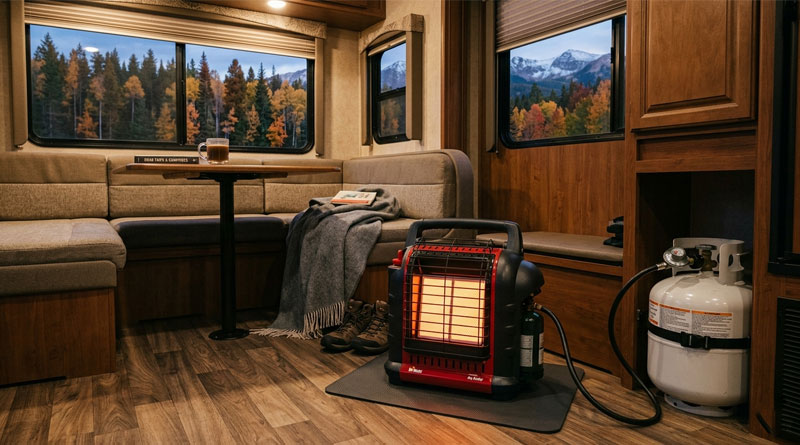
The MH9BX isn’t the flashiest heater on this list, but it’s earned a near-cult following among RVers for good reason. Its radiant heat design punches out between 4,000 and 9,000 BTUs — enough muscle to tame a 225 sq. ft. interior — while its two heat settings let you dial things back when temperatures aren’t brutally cold. The steel-and-nickel build feels like it can take a beating, and the fold-down handle plus swivel-out regulator make tank connections refreshingly painless. One thing worth noting: climbers and high-altitude campers should be aware the unit can shut off above 7,000 feet.
Where this heater genuinely shines is in its safety engineering. The automatic tip-over shutoff, pilot-out detection, and oxygen depletion sensor work together as a three-layer safety net — critical for enclosed RV spaces. It’s Massachusetts and Canada approved, which speaks to its rigorous standards compliance. The trade-off is that propane tanks come separately, and attaching unauthorized accessories will void your warranty. Still, for a grab-and-go supplemental heater that won’t let you down on a frozen campsite, the MH9BX remains a benchmark in its category.
- Pros:
- Portable and straightforward to operate
- Triple-layer safety system (tip-over, ODS, pilot-out)
- Efficient radiant heating with dual settings
- Rugged multi-material construction
- Cons:
- Can shut off at elevations above 7,000 ft
- Propane tank sold separately
- Third-party accessories void the warranty
2. Sweetcrispy 48,000 BTU Propane Patio Heater

- BTU Output: 48,000 BTUs
- Heating Diameter: 18 feet
- Burner: Double-layer 304 stainless steel
- Safety: Tilt auto-shutoff, flame-out gas cut-off
If your idea of RV living includes expansive patio setups and evening gatherings under the stars, the Sweetcrispy is the kind of heater that makes people linger long after dinner. Its 48,000 BTU output projects warmth across an 18-foot diameter — comfortably enveloping groups of four to eight people in heat. The double-layer 304 stainless steel burner isn’t just a marketing talking point; it genuinely outperforms single-burner competitors in both heat consistency and long-term durability. Integrated wheels mean repositioning it around your campsite takes seconds, not effort.
The safety package is thorough: a 45-degree tilt triggers automatic shutoff, and gas supply cuts instantly if the flame goes out. The built-in tabletop surface is a clever touch — a place to rest drinks without dragging over a separate table. Anchoring spikes add stability on uneven ground. The honest caveat here is that this is an outdoor-only machine; don’t let the RV-adjacent marketing blur that line. It’s a serious patio heater with serious propane appetite, best suited for those who treat their outdoor living space as an extension of the rig rather than an afterthought.
- Pros:
- Commanding 48,000 BTU output
- Wide 18-foot heating radius
- Premium double-layer stainless steel burner
- Comprehensive tilt and flame-out safety
- Convenient tabletop surface and rolling wheels
- Cons:
- Strictly for outdoor/patio use only
- High BTU rating means faster propane burn
- Larger footprint than interior-focused heaters
3. Fitfirst Portable Propane Tent Heater

- BTU Output: 6,000 to 9,000 BTUs
- Heating Area: Up to 225 square feet
- Safety: Tip-Over Protection, Oxygen Depletion Sensor (ODS)
- Fuel Compatibility: 1 lb or 20 lb propane tanks
The Fitfirst occupies a sweet spot for RVers who want something genuinely portable without sacrificing meaningful heat output. At up to 9,000 BTUs spread across two adjustable settings, it can handle spaces up to 225 sq. ft. — enough for most travel trailer interiors or large tents. The piezo ignition lights reliably without fuss, and the carry handle makes relocation from RV to campsite to ice fishing shack completely effortless. A 1 lb cylinder gets you around 3.5 hours of runtime, which covers most evening chill sessions without needing a refill.
Tank flexibility is this heater’s underrated superpower. It runs on standard 1 lb cylinders for true portability but accepts 20 lb tanks via an optional hose adapter for extended cold-weather campaigns. The dual safety system — tip-over protection and an ODS sensor — handles the enclosed-space anxiety that comes with any unvented propane heater. The important reminder: radiant heat warms objects and bodies in its path, not the ambient air, so position it thoughtfully. Also, the hose for larger tanks isn’t included, which feels like a minor oversight given how useful that option is.
- Pros:
- Fully cordless and genuinely portable
- Dual safety system (tip-over + ODS)
- Works with both 1 lb and 20 lb propane tanks
- Two heat settings for flexible warmth
- Cons:
- 20 lb tank hose adapter sold separately
- Requires adequate ventilation during use
- Warms by radiation, not air circulation
4. Camco Olympian Wave-3 Catalytic Safety Heater

- BTU Output: 1,600 to 3,000 BTUs
- Heating Area: Up to 100 square feet
- Heater Type: Catalytic (no open flame)
- Starter Life: 20,000 starts (Piezo)
The Wave-3 operates on an entirely different philosophy than the radiant heaters in this lineup. Instead of a flame, it uses a catalytic chemical reaction across a platinum-treated pad to generate heat — producing absolutely zero fan noise and no open flame whatsoever. For full-timers and boondockers who treat silence as a non-negotiable, this is a game-changer. The 1,600 to 3,000 BTU range is deliberately modest, making it best suited for spaces up to 100 sq. ft., but within that footprint it performs with impressive consistency. Its footprint is compact enough to mount permanently or carry as a portable unit.
Durability is baked into the Wave-3’s DNA. The piezo igniter is rated for a staggering 20,000 starts — that’s decades of reliable lighting before it even hints at wearing out. The safety shut-off valve adds a meaningful layer of protection. One nuance worth understanding: catalytic heaters consume oxygen from surrounding air and generate moisture, so ventilation isn’t optional — it’s essential. The catalytic mat is also the one component that demands careful handling; rough treatment shortens its life. For RVers who prioritize whisper-quiet, flameless efficiency over raw BTU muscle, the Wave-3 is essentially without peer.
- Pros:
- Near 100% efficient catalytic heating
- Completely silent — no fan or blower
- No open flame, no flue needed
- Mounts permanently or used as portable
- Piezo igniter rated for 20,000 starts
- Cons:
- Lower BTU ceiling limits it to smaller spaces
- Ventilation is mandatory during operation
- Catalytic mat requires careful, gentle handling
5. FOGATTI RV Furnace 35,000 BTU

- BTU Output: 35,000 BTUs
- Heater Type: Forced-air furnace
- Control: Thermostat controlled
- Construction: Corrosion-resistant materials
The FOGATTI isn’t competing with portable heaters — it’s replacing them entirely for serious RV heating setups. With 35,000 BTUs of forced-air output distributed through your rig’s ductwork, it eliminates cold corners and uneven warmth in a way no portable unit can match. The precision thermostat means you set your temperature and forget it; the furnace does the thinking. Corrosion-resistant materials throughout the build signal that this was engineered for the long haul, not a season or two. Full-timers who’ve dealt with inadequate factory furnaces will immediately appreciate the step up in performance.
The installation commitment is real and worth acknowledging upfront — this is a permanent fixture, not something you pull out of a closet on cold nights. It draws 12V power for its blower, which matters if you spend significant time off-grid. That said, for motorhome owners or those with large travel trailers who prioritize whole-rig comfort over portability, no product on this list comes close to the FOGATTI’s comprehensive heating ability. Think of it less as a heater purchase and more as a serious infrastructure upgrade for your mobile living situation.
- Pros:
- 35,000 BTU capacity handles large RV interiors
- Forced-air system distributes heat evenly
- Set-and-forget thermostat control
- Built with corrosion-resistant materials for longevity
- Quiet integrated operation once installed
- Cons:
- Permanent installation required — not portable
- 12V power draw can stress off-grid battery banks
- Installation is more involved than plug-and-play options
How to Choose the Best RV Propane Heater
Shopping for an RV propane heater sounds simple until you’re standing in front of five different options and realizing you’re not entirely sure which one actually fits your situation. The market ranges from $50 radiant portables to $1,000+ installed furnaces, and the wrong choice doesn’t just waste money — it leaves you cold, frustrated, or in the worst case, unsafe. Understanding what actually separates a good purchase from a regrettable one requires thinking through your real-world camping habits, your rig’s characteristics, and a few technical details that most buyers gloss over.
Know Your Heater Type Before Anything Else
The propane heater market breaks into three distinct categories, and each operates on a fundamentally different principle. Getting clear on this first makes every other decision easier.
Forced-air furnaces are the built-in workhorses. They combust propane in a sealed chamber, push the resulting warm air through ductwork, and vent exhaust gases outside the RV. Because combustion byproducts never enter your living space, they’re the safest option for sustained interior use. The downsides are real though: the blower motor draws considerable 12V power (a genuine problem for boondockers), and the cycling fan noise wakes light sleepers.
Catalytic heaters skip the flame entirely. Propane reacts chemically with oxygen across a platinum-coated pad, generating heat through oxidation rather than combustion. The result is nearly silent operation, impressive fuel efficiency, and no combustion byproducts — though they do consume interior oxygen and produce moisture, making ventilation non-negotiable. These shine in smaller spaces and off-grid setups where battery conservation is critical.
Radiant heaters burn propane to heat an element that then radiates infrared energy outward, warming people and objects directly rather than heating the air. They’re the most portable and fastest to provide perceived warmth. The trade-off is directional heat — they don’t distribute warmth evenly across a space the way a forced-air system does.
Calculate the BTU Output You Actually Need
BTU stands for British Thermal Unit and measures how much heat a unit produces per hour. The common rule of thumb is 20 BTUs per square foot of living space, but treating this as gospel will mislead you. A well-insulated Class A motorhome in moderate autumn temperatures needs far fewer BTUs than a poorly insulated travel trailer parked in January at altitude.
A realistic approach: measure your RV’s actual square footage, note your insulation quality (most factory RVs are mediocre at best), and think honestly about the coldest temperatures you’ll realistically face. For a 200 sq. ft. interior in mild conditions, 4,000–6,000 BTUs is sufficient. For the same space in serious cold with thin walls, you’re looking at 9,000–12,000 BTUs. Over-sizing creates its own problems — excessive heat that you’re constantly fighting down isn’t comfortable or fuel-efficient.
Safety Features Are Not Optional Checkboxes
Propane in an enclosed space is serious business, and the safety features on modern heaters aren’t marketing padding — they’re genuinely important. Here’s what each one actually does and why it matters.
The Oxygen Depletion Sensor (ODS) continuously monitors oxygen concentration in the surrounding air. When levels drop below a safe threshold — which happens gradually as any unvented heater consumes interior oxygen — the ODS triggers automatic shutoff before concentrations become dangerous. This is the most important safety feature on any unvented heater.
Tip-over protection uses a sensor or mechanical switch that kills the gas supply the moment the heater tips past a certain angle. Anyone who’s had a dog, a child, or an unexpected sharp corner hit a portable heater understands exactly why this matters.
Thermal overload protection monitors the heater’s own temperature and shuts it down if internal components exceed safe operating limits — preventing damage and reducing fire risk from restricted airflow.
Certifications from organizations like CSA or UL signal that the heater has passed third-party safety testing rather than just the manufacturer’s own quality control. Always look for these marks, particularly on lower-priced units where cut corners are more common.
Ventilation — The Rule Most Buyers Underestimate
Every propane heater — including the safest catalytic units — consumes oxygen and produces byproducts. For forced-air furnaces, the combustion happens in a sealed chamber and exhaust exits outside; interior air stays unaffected. For everything else, the air inside your RV is part of the combustion equation.
The practical minimum for unvented heaters is cracking a window one to two inches. This creates enough air exchange to prevent oxygen depletion and vent out moisture accumulation without defeating the warmth entirely. Roof vents partially opened are another option. The key point: operating an unvented heater in a fully sealed RV is dangerous regardless of what the ODS sensor promises. Treat ventilation as a non-negotiable operating requirement, not an optional precaution.
Beyond safety, moisture management matters too. An unvented propane heater running in a sealed space can deposit enough moisture on interior surfaces to encourage mold growth over extended trips. Ventilation solves both problems simultaneously.
Power Draw Matters Enormously for Off-Grid Campers
If you plug into shore power at every campsite, this section is less critical. If you boondock — camping without electrical hookups — how much 12V power your heater demands will directly determine how often you’re draining your house batteries.
Forced-air furnaces use blower fans that pull anywhere from 3 to 12 amps while running, depending on the unit. Over a cold night with the furnace cycling frequently, that adds up to serious amp-hours. A modest 100Ah battery bank gets depleted quickly under those conditions without solar recharging during the day.
Catalytic and radiant heaters, by contrast, use power only for their ignition systems — typically a single spark from a piezo igniter that draws no sustained current. Once lit, they operate entirely on propane chemistry with zero ongoing electrical draw. For anyone running a solar and battery setup without a generator, this distinction is often the deciding factor in which heater type makes sense.
Portability Versus Permanent Installation
This is less a technical question than a lifestyle question. Portable heaters offer genuine flexibility — you can use the same unit inside the RV on cold nights and outside around a campfire on slightly warmer evenings. They store away during summer, don’t require professional installation, and can move between different rigs if you upgrade your vehicle.
Permanently installed furnaces eliminate that flexibility but replace it with whole-RV coverage, thermostat control, and a cleaner interior aesthetic. For full-timers who’ve committed to a specific rig and prioritize comfort over adaptability, a quality installed furnace is almost always the superior long-term choice. For weekenders or those who camp seasonally, a portable supplemental heater often delivers better value.
Fuel Efficiency and Real-World Propane Consumption
Propane costs money, weighs something, and requires periodic refilling. Understanding how efficiently a heater uses fuel affects both your budget and your camping convenience. Catalytic heaters claim efficiency ratings near 99%, meaning almost all propane energy converts to heat rather than exhaust waste. Radiant heaters perform similarly. Forced-air furnaces are less efficient, losing some energy through the venting process and running their blowers continuously.
A practical calculation: a standard 1 lb propane cylinder holds roughly 21,600 BTUs of energy. A 9,000 BTU heater running continuously would theoretically exhaust that cylinder in about 2.4 hours. Efficiency losses and the fact that most heaters cycle rather than run flat-out mean real-world runtime is typically longer, but this math gives you a useful baseline for estimating propane consumption over a multi-day trip.
Noise Tolerance and Sleep Quality
It sounds like a minor consideration until you’ve been woken up at 3 AM by a furnace blower cycling on for the fourth time. Forced-air furnaces have a distinct operational pattern: the thermostat calls for heat, the igniter fires, the blower kicks on with a noticeable whoosh, runs for a few minutes, then shuts off. In a quiet campsite, this cycle is plainly audible.
Catalytic and radiant heaters produce no fan noise whatsoever. Once ignited, they operate in complete silence. For light sleepers, couples where one partner runs warmer, or anyone who camps in environments where the ambient silence is part of the appeal, the noise difference between heater types is a genuine quality-of-life factor worth weighing seriously.
Installation and Ongoing Maintenance
Before purchase, think honestly about the installation complexity you’re willing to handle. Portable heaters require zero installation — open the box, attach a propane cylinder, light it. Installed furnaces require routing ductwork, making propane line connections, and potentially cutting into RV cabinetry. Many RVers hire a professional for furnace installations, adding to the total cost.
Maintenance demands vary similarly. A good portable radiant heater may need nothing more than occasional cleaning and eventually a new thermocouple after years of use. Catalytic heaters need gentle handling to protect their platinum-impregnated pads, which can crack or degrade if handled roughly or contaminated with silicone-based products. Forced-air furnaces have more components — blower motors, sail switches, limit switches — that eventually wear and require replacement.
Whatever you choose, keep a carbon monoxide detector installed and tested in your RV at all times. This applies regardless of heater type. It’s the one piece of safety equipment that covers you regardless of what goes wrong and costs a fraction of what peace of mind is actually worth on a cold night far from civilization.