Hit the open road with total confidence by securing one of the most vital upgrades your RV will ever need: a high-fidelity propane detector. Propane is the lifeblood of the nomadic lifestyle, powering everything from midnight snacks to cozy winter nights, but an undetected leak can transform a dream vacation into a serious hazard. This guide cuts through the noise to highlight top-tier models that prioritize rapid detection, rugged durability, and effortless operation, ensuring your safety remains as steady as your steering wheel.
1. Bestfire Propane Tank Gauge & Leak Detector

- Compatibility: 5-40 lb propane tanks
- Connection Type: QCC1/Type 1
- Monitoring: Color-coded dial (real-time)
- Material: Heavy-duty brass construction
The Bestfire Propane Tank Gauge serves as a robust sentry for your external gas supply, blending heavy-duty engineering with intuitive visuals. Built from solid brass, it handles the rigors of travel—vibration, humidity, and temperature swings—without breaking a sweat. The standout feature is the color-coded dial that translates complex pressure readings into a simple “traffic light” system: green for go, yellow for caution, and red for a refill. This takes the anxiety out of meal prep, ensuring you never run out of fuel mid-sear.
Beyond convenience, its safety mechanism is impressive. The unit is designed to automatically restrict flow if it detects a massive pressure drop indicative of a leak, acting as a critical first line of defense before gas even reaches your appliances. Installation is refreshingly simple; the handwheel design allows for a tool-free, airtight seal in seconds. Just ensure the tank is mounted horizontally for the most accurate readings. It’s a low-cost, high-impact insurance policy for any camper or griller who values both safety and uninterrupted fuel management.
- Pros:
- Universal fit for standard 5-40lb tanks
- Instant visual feedback via color-coded zones
- Tool-free, hand-tightened installation
- Cons:
- Performance depends on proper horizontal alignment
- Ambient temperature can slightly shift pressure readings
2. DOZYANT Propane Tank Gauge & Leak Detector

- Quantity: Set of 2
- Compatibility: 5-40 lb propane tanks
- Connection Type: QCC1 / Type 1
- Monitoring: Color-coded dial
If you’re managing multiple fuel sources—perhaps a main RV tank and a secondary grill cylinder—the DOZYANT 2-pack is a value-driven masterclass in safety. These gauges provide a secure, airtight link between your tank and regulator, utilizing high-quality materials that resist the corrosive effects of outdoor exposure. By providing a clear window into the tank’s internal pressure, these detectors eliminate the primitive “shake the tank” method, replacing guesswork with a reliable, at-a-glance monitoring system that works effectively across various propane-powered outdoor appliances.
The installation process is incredibly streamlined, requiring no wrenches or specialized plumbing skills. The ergonomic handwheel grip ensures that even those with limited hand strength can achieve a leak-proof connection easily. While these gauges are primarily pressure indicators, their role in leak detection is vital; a sudden drop in the needle while appliances are off serves as an immediate warning of a breach in the line. It’s a practical, “set it and forget it” upgrade that enhances the security of your outdoor kitchen or mobile basecamp with minimal effort.
- Pros:
- Excellent value with a two-unit bundle
- Strong, airtight seals prevent minor seepage
- Universal QCC1 compatibility for wide-ranging use
- Cons:
- Requires manual inspection (no remote alerts)
- Pressure readings fluctuate in extreme cold
3. Camco RV Propane Gauge and Leak Detector

- Connection Type: Type 1
- Compatibility: DOT cylinders (Post-1995 ACME/OPD)
- Safety Features: Excess flow and thermal protection
- Operation: Flows-based reading
Camco is a titan in the RV world, and their propane gauge reflects a deep understanding of road-bound hazards. This isn’t just a level indicator; it’s a sophisticated safety valve. The unit features built-in excess flow protection, which acts like a fuse for your gas line, snapping shut if it senses a rupture. Furthermore, it includes thermal protection, a critical fail-safe that shuts off the gas supply in the event of high heat or fire, preventing a localized emergency from escalating into a catastrophic explosion.
Unlike some static gauges, the Camco model provides its most accurate readings while gas is actively flowing through the system. This makes it particularly useful for monitoring your consumption during active cooking or heating sessions. It is specifically tailored for post-1995 DOT cylinders, ensuring it meets modern safety standards for ACME and OPD connections. For the RVer who prioritizes mechanical reliability and brand-name trust, this detector offers a “belt and suspenders” approach to gas safety that is difficult to beat for the price point.
- Pros:
- Integrated thermal shut-off for fire safety
- Automatic flow restriction in case of line breaks
- Trusted brand with high manufacturing standards
- Cons:
- Gauge is inactive until gas is turned on
- Simple analog interface lacks precision metrics
4. Smarter Living WiFi Gas Alarm Leak Detector

- Compliance: UL 1484 compliant
- Detection Type: Propane, Methane, Butane, LPG
- Connectivity: 2.4GHz WiFi (App support)
- Alarm: 70dB audible + Phone notifications
For the modern traveler, the Smarter Living WiFi Gas Alarm brings “Smart Home” security to the mobile lifestyle. This device bridges the gap between traditional alarms and digital convenience by piping real-time data directly to your smartphone. Whether you’re hiking miles from your rig or just lounging in the bedroom, you’ll receive instant notifications if gas concentrations reach 7% LEL. It’s UL 1484 compliant, meaning it meets the same rigorous standards as professional-grade home detectors, but in a compact, plug-in form factor perfect for trailers.
The beauty of this unit lies in its versatility. It doesn’t just sniff out propane; it monitors for methane, butane, and other explosive gases, providing a broad safety net for your interior air quality. While it requires a 2.4GHz WiFi connection for remote alerts, the 70dB local siren functions independently, ensuring you are woken up even if the internet drops out. With no subscription fees and a simple Bluetooth-assisted setup, this is the ultimate choice for tech-savvy RVers who want to monitor their “home on wheels” from anywhere in the world.
- Pros:
- Remote monitoring via smartphone app
- Detects a wide spectrum of combustible gases
- No monthly subscription fees required
- Cons:
- Requires 110V outlet (plug-in) and WiFi
- 70dB alarm is slightly quieter than hard-wired models
5. PANGAEA RV CO & Propane Dual Gas Detector PRC2000
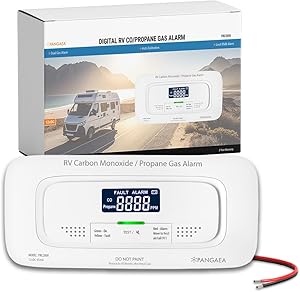
- Detection: Carbon Monoxide (CO) & Propane (LPG)
- Power: Hard-wired DC 12V
- Display: Large LCD screen
- Alarm: 85dB loud alarm
The PANGAEA PRC2000 is a specialized 2-in-1 powerhouse designed to replace outdated, factory-standard detectors with something far more informative. Most stock RV detectors use a simple blinking light; the PRC2000 upgrades you to a large LCD screen that provides real-time concentration numbers. This is a game-changer for troubleshooting, allowing you to see if gas levels are slowly rising or if a spike was a momentary fluke. It handles both Propane and Carbon Monoxide, covering the two most lethal invisible threats in one sleek, flush-mounted unit.
Wired directly into your RV’s 12V system, this detector provides 24/7 protection without the need for battery swaps. It features a piercing 85dB alarm and a multi-color LED system for instant status checks. Its dimensions are specifically chosen to match common cutout sizes from older MTI or CCI models, making it a “drop-in” replacement for many DIYers. Meeting UL1484 and UL2034 standards, it’s a professional-grade safety tool that brings transparency and high-decibel protection to the forefront of your RV’s living area.
- Pros:
- Dual detection saves space and wiring effort
- LCD display provides actual gas concentration data
- Easy replacement for common factory models
- Cons:
- Requires hard-wiring and a wall cutout
- Constant 12V draw (minimal, but present)
6. Nuleto RV Dual LP/CO Alarm Detector

- Detection: Carbon Monoxide (CO) & Propane (LP)
- Sensors: High-sensitivity semiconductor/electrochemical
- Display: Digital screen
- Certification: UL Listed
Nuleto’s dual alarm stands out for its rapid-fire response times and specialized sensing technology. By utilizing independent probes for CO and Propane, it avoids the “cross-talk” issues that sometimes plague cheaper combined units. The high-sensitivity semiconductor sensor is tuned for propane, while the electrochemical sensor focuses on CO, ensuring surgical accuracy. When gas hits the threshold, the device reacts in as little as 0.5 seconds—a vital window of time when every heartbeat counts in an evacuation scenario.
Installation is where the Nuleto truly shines for the average owner. It includes lever nut connectors, which are far more reliable and easier to use than traditional wire nuts or electrical tape. This ensures a vibration-proof connection that won’t wiggle loose on washboard roads. The digital display provides a clear readout of gas PPM (parts per million), helping you assess the severity of a situation at a glance. It’s a modern, highly sensitive, and user-friendly solution for anyone looking to maximize their family’s safety during extended camping trips.
- Pros:
- Near-instant 0.5s response time
- Tool-free wiring connectors included
- UL-listed sensors for high reliability
- Cons:
- Requires a shallow wall recess for mounting
- No battery backup; relies entirely on house power
7. PANGAEA Digital RV Propane Gas Detector

- Detection: Propane gas only
- Sensor Type: Highly sensitive semiconductor
- Power: DC 12V
- Display: Digital screen (real-time)
For those who already have a standalone CO detector and just need a dedicated, high-performance propane monitor, this PANGAEA model is a perfect choice. It focuses exclusively on combustible gas, using a highly sensitive semiconductor sensor designed to trigger at the first whiff of a leak. The real-time digital display is its best feature, showing you the current gas concentration levels and providing error codes if the sensor ever fails. This “smart” feedback loop ensures you never have to wonder if the device is actually working.
The design is incredibly flexible, allowing for either surface mounting (no wall cutting required) or a sleek flush mount. This makes it an ideal aftermarket addition to older campers that weren’t built with gas detectors in mind. With its loud 85dB siren and UL1484 certification, it provides professional-level security in a compact, black aesthetic that blends into modern RV interiors. It’s a specialized tool that does one thing exceptionally well: keeping you informed of your propane safety status with digital precision.
- Pros:
- Very fast detection of low-level propane leaks
- Digital readout eliminates ambiguity
- Flexible surface or flush mount options
- Cons:
- Does not detect Carbon Monoxide
- Requires 12V hard-wiring
How to Choose RV Propane Detectors
Living the RV life means carrying a portable energy grid with you wherever you go. Propane is the “magic” fuel that makes it all possible—running your fridge in the middle of a national forest, heating your water for a morning shower, and keeping the furnace humming on a snowy mountain pass. But because propane is stored under pressure and is highly flammable, it demands respect. Buying a detector isn’t just about ticking a box on a checklist; it’s about understanding how to protect your living space from one of the few hazards that can escalate in seconds.
1. Decide Between Ambient and Inline Monitoring
The first step in your purchase journey is understanding that “leak detection” happens in two different places. Ideally, you want both, but they serve different roles:
- Inline Detectors (Tank Gauges): These sit outside at the tank. They are great for checking fuel levels and catching massive leaks at the tank connection before they enter the RV. They are mechanical and usually don’t require power.
- Ambient Detectors (Interior Alarms): These are the “smoke detectors” of the propane world. They live inside your RV and sniff the air. If a stove burner is left on or a pipe inside a wall vibrates loose, these are the only things that will save you.
2. Power Source: Hard-Wired vs. Portable
Most dedicated RVers prefer 12V DC Hard-Wired units. Why? Because they are powered by your RV’s house batteries. As long as your rig has power, your detector is on. They are “always-on” sentinels. However, they do have a “parasitic draw,” meaning they slowly sip battery power even when the RV is in storage. If you store your RV without a battery disconnect, a hard-wired detector could eventually drain your battery.
Battery-Operated or Plug-in (110V) models are easier to install but come with risks. Battery models can die without you noticing, and plug-in models only work if you are connected to shore power or running an inverter. For a vehicle that bounces down the road, a hard-wired connection is generally the safest bet for consistent protection.
3. The “Dual” Advantage: Propane + CO
If you are replacing an old unit, look for a Dual LP/CO Detector. Propane and Carbon Monoxide (CO) are two different beasts. Propane is a fuel; CO is a toxic byproduct of burning that fuel. Because RVs are small, airtight spaces, a faulty furnace can fill the cabin with CO just as easily as a leaky pipe can fill it with propane. A dual detector monitors both threats from a single device, saving you wall space and wiring hassle. It’s the most efficient way to achieve total peace of mind.
4. Sensitivity and Response Time
Look for the LEL (Lower Explosive Limit) rating. Propane becomes explosive when it reaches about 2.1% of the air volume. A high-quality detector will sound an alarm when the gas level is only 5% to 10% of that explosive limit. This gives you a massive head start to get out and turn off the gas. Check the “Response Time” in the specs—top-tier models respond in under 2 seconds. In a gas leak, every second you spend not knowing is a second of increased risk.
5. Digital Displays vs. Simple Lights
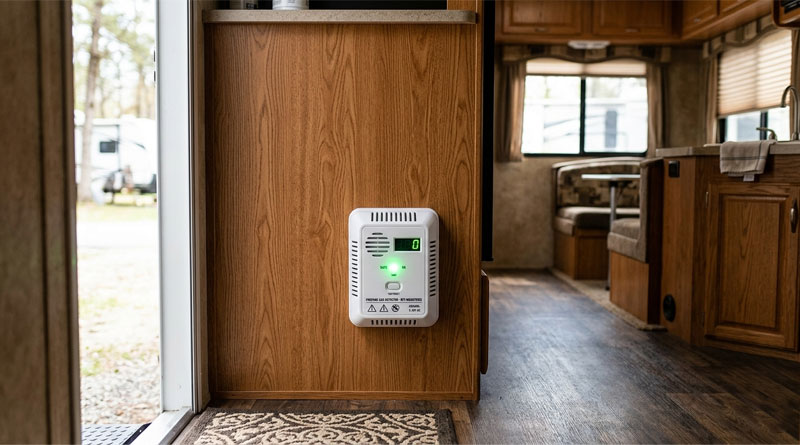
While older models used a simple green/red light system, modern detectors often feature Digital LCD Screens. This is highly recommended. If an alarm goes off, a digital screen can tell you exactly how much gas is present. Is it a tiny 50 PPM leak from a dusty stove, or is it a 2000 PPM emergency? Having that data helps you make better decisions in a crisis. Furthermore, digital screens often show error codes, letting you know if the sensor has reached its end-of-life or if the voltage is too low.
6. Ease of Installation (The DIY Factor)
If you aren’t comfortable with wiring, look for models that include Lever Nuts or Quick-Connectors. These allow you to simply insert your RV’s wires and snap a lever down, creating a secure connection without needing crimpers or solder. Also, check the mounting style. Flush Mount units look cleaner because they sit inside the wall, but they require a specific cutout size. Surface Mount units sit on top of the wall and are much easier to install if you don’t want to cut into your cabinetry.
7. Certification: The “Must-Haves”
Never buy a gas detector that isn’t UL (Underwriters Laboratories) Listed. Specifically, look for UL 1484 for propane detectors and UL 2034 for CO detectors. These certifications mean the device has been blasted with gas in a lab and proven to work every single time. Cheap, uncertified knock-offs might look the part, but they often have high failure rates or “go deaf” after a few months of exposure to dust and humidity.
8. Understanding Lifespans
Propane sensors are chemical components that degrade over time. Even if you never have a leak, the sensor will eventually “expire.” Most RV propane detectors are rated for 5 to 7 years. Many modern units will have an “End of Life” signal (a specific beep or light pattern) to tell you it’s time for a replacement. When buying, check the manufacture date if possible, and always write the “Replace By” date on the cover with a permanent marker once installed.
9. Placement is Everything
Propane is heavier than air. This is a crucial scientific fact for RVers. If you have a leak, the gas will sink and pool on the floor like water. Therefore, your propane detector must be mounted low (usually 4 to 10 inches off the floor). If you mount it near the ceiling like a smoke detector, the entire RV could be filled with gas before the alarm ever sees it. Ensure your chosen model is designed for low-level mounting and isn’t obstructed by furniture or curtains.
10. Features for the Modern Camper
If you travel with pets and often leave them in the RV, consider a WiFi-Enabled Smart Detector. If a leak occurs while you’re out at dinner, a standard alarm will just beep to an empty room. A smart detector will send an emergency alert to your phone, allowing you to rush back or call the campground office to save your furry friends. It’s a small price to pay for the ability to monitor your home from the trailhead.
Final Check Before You Buy
Before hitting “add to cart,” take a quick measurement of your existing detector if you’re doing a replacement. RV manufacturers love using different-sized cutouts, and finding a model that matches your current hole will save you from having to patch or cut your interior panels. With the right detector in place—one that is certified, properly powered, and strategically placed—you can stop worrying about “what if” and start focusing on the “where to” of your next adventure.