Dirt follows you home — even when home has wheels. The moment you’ve swept sand off a trail or hauled a muddy dog through the door, your camper needs a vacuum that’s as mobile as you are. These seven compact picks cut through crumbs, pet hair, and grit without stealing precious storage space, whether you’re plugged into shore power or parked three miles off the grid.
1. BLACK+DECKER dustbuster AdvancedClean Handheld

- Suction: Cyclonic action for consistent power
- Nozzle: Rotating slim nozzle for tight spaces
- Weight: Lightweight and portable design
- Battery: Lithium-ion rechargeable
Walk into any camper and you’ll find exactly the kind of awkward geometry this vacuum was built for. The rotating slim nozzle twists to attack behind dinette benches and beneath storage bins, sparing your wrist the usual contortions. Meanwhile, the cyclonic action keeps debris away from the filter so suction stays strong right through a dusty weekend haul — the large bowl doesn’t need emptying mid-session.
What genuinely sets it apart is the integrated accessory approach. The pull-out crevice tool and flip-up brush live inside the unit itself, so you’ll never fish around for an attachment that rolled under the bed. It works equally well on carpeted cab mats and smooth upholstery, and the cordless format means no cord management in already-tight quarters. For most campers, this is the one you reach for first.
- Pros:
- Integrated tools — nothing to misplace
- Consistent cyclonic suction
- Large dust bowl empties cleanly
- Cons:
- Charging dock needs 110V power
- Nozzle wider than some rivals
- Battery best suited for quick runs
2. Armor All AA12V2 Compact 12V Wet/Dry Vac

- Function: Wet and dry mess cleanup
- Power: 12V DC automotive port plug
- Suction: 5KPA / 20-inch water lift
- Reach: 15-foot expandable spiral cord
Camping and moisture go hand in hand — rain tracked in, drinks tipped during a sharp turn, condensation dripping from the skylight. The Armor All handles all of it. Its wet/dry capability makes it one of the most practically versatile tools here, and the 15-foot spiral cord stretches across a standard travel trailer from driver’s seat to rear bunks without breaking a sweat.
Seven accessories ship in the box, and the pet hair rake is the headline act — it pulls fur out of upholstery far more efficiently than any standard nozzle. The removable dust cup pops out for mess-free disposal, which matters when your hands are already dirty from camp chores. If you’d rather draw power straight from the vehicle than trust a battery, this reliable 12V workhorse fits the bill perfectly.
- Pros:
- Handles liquid and dry spills
- Standard 12V outlet — always available
- Generous seven-piece accessory kit
- Cons:
- Lower suction than cordless units
- Cord limits outdoor reach
- Spiral cord strains if overextended
3. RoadPro RPSC-807 Wet/Dry Canister Vacuum

- Capacity: Large 1-gallon storage tank
- Motor: Heavy-duty 12,500 RPM
- Hose: 36-inch flexible hose with swivel
- Reach: 17-foot 12V lighter socket cord
When a handheld simply won’t cut it, you reach for a canister — and the RoadPro brings that format into the 12-volt world without asking you to give up convenience. A one-gallon capacity means you can do a thorough deep clean of a family-sized travel trailer in a single session. The heavy-duty motor chews through sand and trail dirt without slowing down, and the 36-inch flexible hose reaches overhead cabinets and deep under-bed storage bays with ease.
The swivel cuff on the hose is a small detail that makes a noticeable difference in tight quarters — no kinking, no wrestling. Reusable filter bags keep running costs low on long trips, and the 17-foot power cord means you won’t be shuffling the unit from outlet to outlet mid-session. Families who consistently deal with high volumes of debris will find this their most-used piece of camp gear.
- Pros:
- 1-gallon capacity — fewer empty stops
- Flexible hose reaches everywhere
- Reusable filters cut ongoing costs
- Cons:
- Bulkier than handheld options
- Plastic build feels lightweight
- Suction drops as bag fills
4. HyperVac 2-in-1 Handheld Vacuum & Blower

- Suction: 18.5kPa brushless motor
- Battery: 7500mAh — up to 45 min runtime
- Utility: 2-in-1 vacuum and blower
- Charge: USB-C fast charging
The HyperVac makes a strong case that size and strength don’t have to trade off. At 1.5 lbs, it fits in a jacket pocket, yet its 18.5kPa brushless motor delivers more pulling power than most full-size car vacs. It doesn’t just vacuum, either — flip the function and it becomes a forceful air blower capable of clearing dust from AC vents or window tracks that suction can’t reach. A DC pass-through mode lets it run off 12V power when the battery runs low, which is a genuinely clever feature for boondockers.
The 12-piece accessory set covers every scenario from keyboard detailing to upholstery grooming, and USB-C charging means one less cable to pack. Tech-forward travelers who want a single tool that earns its shelf space twice over will find little competition at this performance level. The premium price tag is the only real barrier — the capability justifies it.
- Pros:
- Exceptional suction for its footprint
- Blower adds real utility
- USB-C and 12V DC pass-through
- Cons:
- Higher price point than rivals
- Loud on maximum power
- Small filter fills quickly
5. CODN 12000PA Cordless Mini Vacuum

- Suction: 12,000PA high-speed motor
- Weight: Ultra-lightweight 0.8 lbs
- Function: Suction, blowing, and inflating
- Battery: 4000mAh with USB-C charging
At 0.8 lbs, the CODN is the kind of vacuum that disappears into a glove box or door pocket without argument. Yet it punches well above its weight, delivering 12,000PA of suction through a HEPA filter that captures the fine dust and allergens a small camper interior circulates. The dual-ended design is clever: one side vacuums, the other inflates — useful when the campsite air mattress needs topping up and your lungs don’t.
The integrated LED light solves the dark-corner problem that plagues camper cleaning, illuminating storage nooks and under-seat gaps so no crumb goes unnoticed. A full charge takes 3.5 hours and yields a 30-minute runtime, which is ample for daily maintenance tasks. For solo travelers or minimalist van dwellers prioritizing every cubic inch of space, the CODN is an uncommonly efficient buy.
- Pros:
- Featherlight 0.8 lbs frame
- Inflator end adds rare versatility
- Bright LED illuminates dark nooks
- Cons:
- Dust bin fills quickly
- Runtime shorter than larger units
- Blower suited only to light tasks
6. THISWORX High Power 12V Car Vacuum

- Power: 12V auxiliary outlet corded
- Reach: 16-foot power cable
- Weight: 2.4 lbs ergonomic design
- Filtration: HEPA filter — spare included
There’s an argument to be made for a vacuum you’ll never have to charge: the THISWORX plugs into the camper’s auxiliary port and runs as long as you need it to, no battery management required. Its 16-foot cord was clearly designed with a full-length van or travel trailer in mind — you can detail both the cab and the sleeping area without relocating. The transparent dust bin lets you gauge fill level at a glance rather than guessing.
Three attachments — flathead, extendable, and brush — handle most interior surfaces, and a spare HEPA filter plus carrying bag are bundled in the box. That kind of thoughtful packaging matters when you’re living out of a small space and can’t have accessories rattling loose in a cabinet. Practical, consistent, and priced honestly, this is the no-nonsense 12V pick for travelers who clean regularly and want zero drama from their tools.
- Pros:
- Unlimited runtime on 12V
- Transparent bin — easy monitoring
- Carrying bag keeps kit organized
- Cons:
- Tethered to 12V power sources
- Long cord tangles in tight spaces
- Best performance on light debris
7. KMM 9000Pa 2-in-1 Handheld Vacuum

- Suction: 9000Pa + air duster mode
- Weight: Ultra-compact 0.72 lbs
- Battery: 4000mAh with fast charging
- Power: 120W high-performance motor
The lightest unit in this roundup at 0.72 lbs, the KMM is the one you’ll actually pick up without thinking twice. Extended cleaning sessions in a camper — crouching under dinettes, reaching into overhead compartments — are noticeably less tiring when your tool weighs nothing. The 2-in-1 design toggles between suction and blower, so clogged window tracks and dusty dash vents are handled in the same pass without swapping tools.
One-click bin dismantling makes emptying faster than almost anything else here, and the washable HEPA filter eliminates the need to hunt down replacements mid-trip. The built-in LED is perfectly positioned for dark storage bays, and the fast-charging 4000mAh battery means it’s ready again well before your next cleaning round. A well-rounded, eco-conscious alternative to single-use compressed air cans that belongs in every camper’s toolkit.
- Pros:
- Lightest in its class — effortless to hold
- Dual suction and blowing modes
- One-click bin disposal
- Cons:
- Not suited for deep carpet cleaning
- Small filter needs frequent washing
- Blower mode runs loud
How to Choose a Small Vacuum for Your Camper
Inside a travel trailer or motorhome, every item has to earn its place. A vacuum that sits unused because it’s too heavy, too slow to charge, or runs out of juice halfway through is just dead weight. The guide below breaks down every variable that separates a vacuum that genuinely fits your life on the road from one that ends up forgotten in a storage bay.
Storage Footprint Comes First
Before suction power, before price — consider where this thing will live. The best camper vacuums are shaped to disappear: handheld units roughly the size of a hair dryer, or canister models that break into smaller parts for compact stowage. Check whether the vacuum includes a dedicated storage bag or dock. A purpose-built bag keeps every nozzle and hose together and stops accessories from bouncing around on washboard roads. If a model doesn’t have a clear storage solution, factor in time to engineer one yourself.
Size Benchmarks Worth Knowing
Handhelds between 0.7 and 1.5 lbs will fit in a glove box or side door pocket. Units between 1.5 and 3 lbs typically need a dedicated cabinet slot. Canister models exceeding 3 lbs — like the RoadPro — require intentional planning but reward you with significantly more capacity per session.
Corded 12V vs. Cordless Rechargeable
This is the decision that affects daily usability more than any spec on the box, and it comes down to one question: how do you actually camp?
The Case for 12V Corded
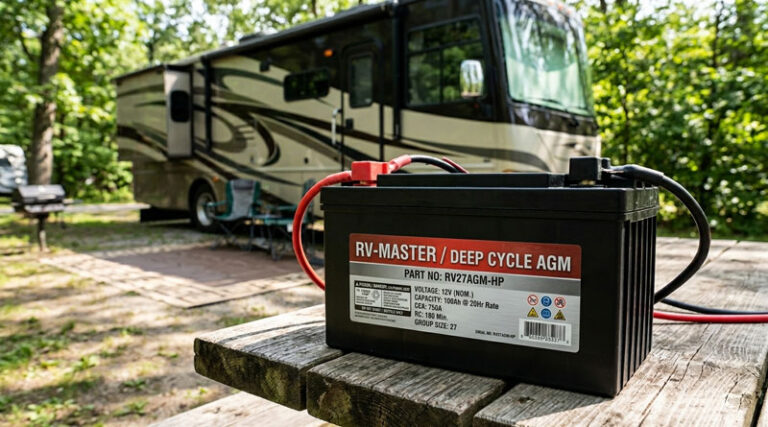
A 12V vacuum plugs into the auxiliary port (the cigarette lighter socket) present in virtually every camper, RV, and tow vehicle. As long as your engine is running or your house battery is charged, so is your vacuum — indefinitely. There’s no battery to deplete, no charging schedule to manage, and no degradation over time. Corded 12V models are also typically lighter and less expensive because the heavy battery pack is replaced by a simple cord. The trade-off is range: choose a model with at least a 15-foot cable, ideally 16 to 17 feet, to reach every corner of a standard-length trailer without repositioning.
The Case for Cordless Rechargeable
Cordless units offer movement no 12V model can match. Take them outside to clean a muddy entry mat. Carry them to the roof to clear debris from vents. Use them inside without routing a cord across doorways. Most modern cordless camper vacuums use lithium-ion batteries that charge via USB-C — the same port as your phone — which simplifies your cable situation significantly. Runtime typically falls between 15 and 45 minutes depending on suction setting; that range covers most daily maintenance sessions comfortably. Where it gets complicated is boondocking: if you’re off-grid without 110V power for days at a stretch, look specifically for a model with a 12V charging input or a DC pass-through mode that lets it run while plugged into the vehicle. The HyperVac’s DC pass-through is the best implementation of this feature in this roundup.
Suction Power: What the Numbers Mean
Suction is measured in Pascals (Pa), and the range across camper vacuums is wider than it first appears. Here’s a practical framework:
- 3,000–6,000 Pa: Adequate for crumbs, light dust, and dry debris on hard floors. Fine for daily tidying in a well-maintained camper.
- 7,000–10,000 Pa: Handles pet hair on upholstery and gritty sand on carpeted surfaces. The right range for most campers traveling with animals.
- 11,000–18,500 Pa: Premium territory. Pulls fine beach sand out of carpet fibers and removes fur deeply embedded in seat fabric. Worth the investment for heavy-use situations.
Beyond raw numbers, look for brushless motors. They run cooler, produce more suction per watt, and last significantly longer than brushed alternatives — important when you can’t easily swap a motor at a campground.
Why 2-in-1 Blower Models Earn Their Place
A vacuum that also blows air is a meaningfully more useful object in a camper than a vacuum alone. The blower function solves problems suction physically cannot: forcing dust out of air conditioning vents, clearing compacted debris from window tracks, dislodging grit from keyboard keys, and inflating small air mattresses or beach toys. In a space where every item must justify its storage footprint, a tool that serves two distinct purposes occupies the same slot as a tool that serves one. The KMM, CODN, and HyperVac all offer this capability — the HyperVac’s blower is the most powerful of the three.
Wet/Dry Capability: A Practical Necessity
Camping environments are wet environments. Rain tracks in on boots. Drinks tip during drives over rough terrain. Cooler ice melts. A standard dry vacuum can sustain serious motor damage if it ingests liquid — its filter system is not designed for moisture. Wet/dry vacuums use separated collection chambers and moisture-resistant filters that handle liquid alongside dry debris without risk. If you camp with children, pets, or in consistently rainy climates, a wet/dry model like the Armor All or RoadPro is not a luxury. It’s damage prevention.
Filtration and Air Quality in Enclosed Spaces
A camper’s interior is a small, sealed environment. A vacuum with poor filtration doesn’t capture fine particles — it simply relocates them, expelling them back into the air you breathe. HEPA filters (High-Efficiency Particulate Air) trap particles down to 0.3 microns, including dust mite debris, pollen, and fine trail dust. For campers, washable and reusable HEPA filters are the right choice: they eliminate the need to source specific replacement filters while traveling, and they reduce long-term running costs. Rinse, dry thoroughly before reinserting, and the filter performs like new.
Attachments That Actually Earn Their Place
Camper interiors are full of geometry that standard nozzles can’t address. The attachments below are the ones worth prioritizing when evaluating a kit:
- Crevice tool: Thin, angled nozzle for seat gaps, wall junctions, and the narrow channel between a slide-out and the main floor.
- Brush nozzle: Soft bristles protect dashboard surfaces, screens, and speaker grilles from scratching during cleaning.
- Flexible extension hose: Allows you to reach up into overhead cabinet shelves or down behind fixed furniture while keeping the vacuum body in your other hand.
- LED light: Integrated into the nozzle head or vacuum body, this illuminates dark storage bays and under-bed compartments where debris accumulates unseen.
- Pet hair rake: Rubber or electrostatic teeth that grab fur from woven upholstery rather than letting it clog a standard intake.
Weight and Ergonomics Over Extended Use
Cleaning a camper is rarely a quick, upright task. You’ll be bending into storage bays, reaching overhead, cleaning in a crouch with your arm extended. Under those conditions, a 3-lb vacuum feels much heavier than it does in your hand at a store. Target models between 0.7 and 2.5 lbs for comfortable extended use. Beyond weight, look for trigger locks — a button or switch that keeps suction active without requiring continuous finger pressure. This small feature prevents hand fatigue during longer sessions and is worth actively checking before buying.
Maintenance Habits That Extend Lifespan
A small vacuum worked harder than it was designed for — packed full, filter clogged, cord stretched — will fail faster than its specifications suggest. A few consistent habits prevent most premature failures:
- Empty after every use. A full bin strains the motor and reduces suction in subsequent sessions. Don’t wait until it’s clearly full.
- Wash filters regularly. Monthly for heavy users, every six to eight weeks otherwise. A clogged filter cuts suction by half before you notice anything wrong.
- Dry filters completely. A damp filter back in a vacuum causes more damage than a dirty one. Give it a full day in open air after rinsing.
- Don’t overstretch cords. 12V spiral cords are designed to extend to a rated length, not beyond it. Overstretching breaks internal strands and creates intermittent power loss over time.
- Store without accessory pressure. Attachments crammed together or wedged against the vacuum body can crack at thin points during vibration on rough roads.
Matching the Vacuum to How You Actually Travel
The right vacuum is the one built for your specific travel pattern, not the one with the most impressive spec sheet. A solo van lifer covering long mileage with minimal stops benefits most from the KMM or CODN — ultra-light, USB-C charged, occupying almost no space. A family in a 32-foot fifth wheel dealing with beach sand, pets, and three kids needs the RoadPro’s gallon-capacity or the Armor All’s wet/dry capability. Tech-forward full-timers who want power without compromise should budget for the HyperVac. And anyone who wants a dependable daily driver without overthinking it will find the BLACK+DECKER dustbuster has been answering that call for years for very good reason. Pick the one that solves your actual problem, and your camper floors will take care of themselves.