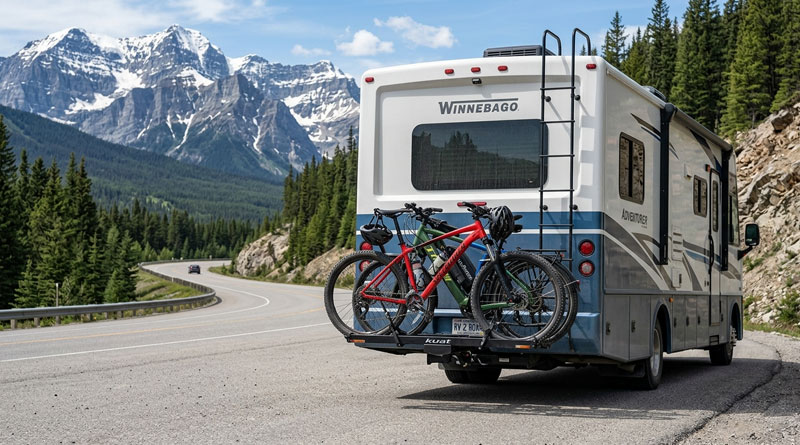
Hitting the open road in an RV offers unparalleled freedom, but for many, that journey isn’t complete without two wheels and a trail. However, the rear of a motorhome is a turbulent environment where standard racks often fail. The “whip” effect of a long chassis can turn a minor bump into a violent jolt, demanding gear that is specifically engineered for endurance. Below, we explore premier RV-rated carriers designed to keep your bicycles steady while you chase the horizon.
1. Arksen Smart Tilting 2-Bike Platform Rack

- Weight Capacity: 150 lbs total (75 lbs per bike)
- Tire Compatibility: Up to 5.5-inch fat tires
- Mount Type: 2-inch hitch receiver
- Security: Padded hook locks and wheel straps
The Arksen Smart Tilting rack is a structural fortress for the serious cyclist. While many racks struggle with the sheer mass of modern e-bikes, this unit thrives under pressure, offering a 150-pound total capacity. Its platform design eliminates the awkward “bike Tetris” often required with hanging racks, keeping your frames level and spaced perfectly to avoid friction. The heavy-duty steel construction is specifically tuned to dampen the vibrations common at the rear of travel trailers and SUVs.
Practicality matches its strength, featuring a tilting mechanism that allows the rack to lean away for rear-hatch access. The wheel cradles are remarkably generous, swallowing fat tires up to 5.5 inches with ease, while the ratcheting padded hooks secure the frames without scarring the paint. For those navigating nighttime arrivals, the integrated reflective stickers provide a subtle but vital safety boost. It is a set-it-and-forget-it solution for riders who demand stability over long-distance hauls across rugged terrain.
- Pros:
- High 75lb per bike capacity
- Fits wide fat tires easily
- Adjustable for various wheelbases
- Cons:
- Heavy unit weight
- Requires 2-inch receiver
2. Swagman RV 2-Bike Bumper Rack
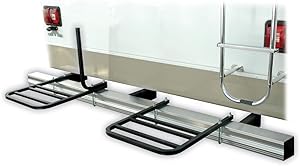
- Bumper Fit: 4 to 4.5-inch square steel bumpers
- Capacity: 2 bicycles (30 lbs each)
- Construction: Heavy-duty solid steel
- Unit Weight: 21 pounds
For the minimalist traveler whose RV lacks a rear hitch, the Swagman Bumper Rack is a masterclass in simplicity. This rack bypasses the need for complex receivers by bolting directly onto a standard 4-inch square steel bumper. It is an ideal setup for those who already use their hitch for towing a secondary vehicle or a cargo tray. The solid steel construction ensures that despite its low profile, the rack remains rigid against the swaying forces of the road.
While it is designed for lighter traditional bicycles rather than bulky electric models, its reliability is legendary in the RV community. The upright support bar provides a high anchor point, allowing you to secure frames with bungees or straps to prevent the “pendulum effect” during travel. At only 21 pounds, it is incredibly easy to install or remove between trips, making it a favorite for weekend warriors who want a budget-friendly way to bring their road bikes along for the ride.
- Pros:
- Very simple bolt-on installation
- Lightweight and space-saving
- Budget-friendly price point
- Cons:
- Low 30lb weight limit
- Only fits square steel bumpers
3. MaxxHaul 70210 Deluxe 4-Bike Hitch Mount Rack

- Bike Count: Transports up to 4 bicycles
- Total Capacity: 150 lbs total load
- Feature: Swing-down for rear access
- Compatibility: 2″ x 2″ hitch receivers
Family adventures require more than just a pair of bikes, and the MaxxHaul 70210 is built to handle the whole crew. This high-capacity carrier fits four bikes onto a single 2-inch receiver, utilizing a hanging-style design that maximizes space efficiency. The powder-coated steel frame is built to resist the corrosive effects of road salt and rain, ensuring that the swing-down mechanism remains fluid and functional over years of cross-country travel through diverse climates.
The rack’s standout feature is its “swing-down” capability, which allows the main vertical mast to tilt forward. This is a game-changer for Class A or C motorhomes where the rear engine or storage compartments need to be accessed without fully detaching the rack. Each bike is cradled in an adjustable rubber strap system that minimizes frame-to-frame contact. While it requires bikes to have a traditional top tube, it offers an economical way to mobilize the entire family’s fleet without needing multiple carriers.
- Pros:
- Carries four bikes at once
- Swing-down arm for convenience
- Durable powder-coated steel
- Cons:
- Requires horizontal top bar
- Not suitable for heavy e-bikes
4. Stromberg Carlson Platform Style 2-Bike Carrier

- Mounting: 2″ hitch or 4″-4.5″ bumper adapter
- Weight Limit: 80 lbs total (40 lbs per bike)
- Design: Platform-style wheel tray
- Brand History: Trusted RV specialist since 1959
Stromberg Carlson understands the RV lifestyle better than almost anyone, and their platform carrier is a testament to that heritage. This model is the ultimate “chameleon” of bike racks, as it ships with hardware to fit both a 2-inch hitch receiver and a 4-inch square bumper. This versatility is perfect for owners who might switch between a travel trailer and a motorized coach, providing a long-term solution that adapts to their evolving gear needs without requiring a new purchase.
The platform design prioritizes the integrity of your bike. By supporting the weight at the wheels, it avoids the frame stress and cable-rubbing common with hanging racks. This makes it particularly suitable for bikes with unconventional frame geometries or sensitive finishes. The assembly is robust, engineered specifically to handle the “bounce” of a trailer’s rear end. While the 40-pound-per-bike limit isn’t for heavy e-cargo bikes, it provides a incredibly stable and wobble-free ride for standard mountain and road bikes.
- Pros:
- Includes bumper and hitch mounts
- Platform style protects frames
- Very stable and wobble-free
- Cons:
- Max 40lbs per bike limit
- Takes longer to assemble initially
5. Quick Products RV Bumper-Mounted 2-Bike Rack
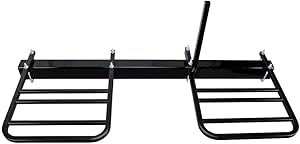
- Adjustability: Width adjusts for any bike length
- Weight Limit: 30 lbs per bicycle
- Stability: Includes a vertical stabilizer post
- Finish: Powder-coated all-steel build
The Quick Products QPRBM2R takes a different approach to bumper mounting by using a two-part independent bracket system. This design is brilliant for handling bikes of varying lengths, as the brackets can be spaced as wide or narrow as necessary on your RV bumper. This ensures that the wheels are always perfectly centered over the supports, reducing the risk of a bike shifting or sliding during high-speed highway travel or on winding backcountry roads.
A key addition to this kit is the vertical stabilizer post. It acts as a central spine, giving you a firm point to strap the bike frames against, which drastically reduces side-to-side swaying. The all-steel construction is finished in a thick powder coating to repel moisture and road grime. While it is limited to a 30-pound capacity per bike, its ability to provide a custom-fit wheelbase makes it one of the most secure options for owners of standard cruisers and mountain bikes.
- Pros:
- Adjustable width for custom fits
- Includes stabilizer post for safety
- Rust-resistant powder coating
- Cons:
- Not for fat tires or 29″+ wheels
- 30lb weight limit per bike
6. Camco RV Ladder Mount 2-Bike Rack

- Mount Type: Fits most standard RV ladders
- Capacity: 2 bikes (60 lbs total)
- Material: Heavy-duty steel construction
- Storage: Folds flat when not in use
Camco’s ladder rack is the ultimate solution for RVers who are protective of their ground-level clearance. By mounting to the rear access ladder, it moves your bikes completely out of the way of the hitch and bumper, which is essential for those towing trailers or using large rear-mounted storage boxes. It uses a clever form-fit cradle system that “hugs” the bike frames, and the included security straps ensure the bikes don’t vibrate against the ladder or the RV wall.
The rack is surprisingly unobtrusive; when the bikes are off, the arms fold flat against the ladder so you don’t have to remove the unit to use the ladder or park in tight spaces. Since it’s made by Camco, a giant in the RV accessory world, the steel is treated to handle years of sun and rain exposure. It’s the perfect choice for someone with lightweight road bikes who wants to keep their setup simple and their hitch free for other gear.
- Pros:
- Saves hitch and bumper space
- Folds flat for easy storage
- Fast, tool-free attachment
- Cons:
- Puts stress on the RV ladder
- Not compatible with small frames
7. Young 200LB High Capacity 2-Bike Hitch Rack

- Max Load: 200 lbs total capacity
- Compatibility: 2-inch hitch receivers
- Tire Size: Fits up to 5-inch fat tires
- Adjustability: Fits 20″ to 29″ wheels
When “heavy-duty” isn’t enough, the Young High Capacity rack steps in with a staggering 200-pound weight limit. This is arguably the ultimate choice for couples traveling with two fully-loaded electric mountain bikes. Most racks cap out at 60 or 75 pounds per bike, but the Young rack provides a massive safety margin, ensuring that even with batteries installed, your bikes are nowhere near the rack’s mechanical limits. It is a beast of a carrier that prioritizes pure strength.
Despite its brawn, it is remarkably user-friendly. The smart tilting lever can be operated with one hand, and the rack folds up vertically when empty to reduce the vehicle’s footprint. The wheel trays are deep and wide, accommodating everything from road slicks to 5-inch fat tires without needing specialized adapters. It also includes an anti-wobble hitch tightener, which is crucial for a rack this heavy to prevent it from hammering against the receiver on bumpy roads. It’s the gold standard for e-bike enthusiasts.
- Pros:
- Massive 200lb weight capacity
- Includes hitch tightener for stability
- Very easy tool-free installation
- Cons:
- Heavier than most 2-bike racks
- Strictly for 2-inch receivers only
How to Purchase RV Bike Rack: The Ultimate Buying Guide
Buying a bike rack for a standard car is easy. Buying one for an RV is a complex engineering decision. Because the rear of a motorhome or travel trailer is so far from the rear axle, it experiences a “lever effect.” This means a 50-pound bike can exert hundreds of pounds of force when you hit a pothole. If you choose the wrong rack, you risk losing your bikes, damaging your RV, or causing a highway accident. This guide will walk you through the 1,000-word journey of choosing the perfect, safe, and durable rack for your mobile lifestyle.
Step 1: Verify the “RV-Rated” Badge
The single most important rule in purchasing an RV bike rack is to look for the “RV-Rated” or “Motorhome Approved” certification. You might see a beautiful, high-end rack at a local sporting goods store, but if the manual says “Not for use on trailers or RVs,” do not buy it. Manufacturers use this disclaimer because the G-forces at the back of an RV are significantly higher than those on a sedan. Racks that aren’t RV-rated often suffer from metal fatigue in the hitch tongue, which can lead to the rack snapping off entirely. RV-rated racks are built with thicker steel, reinforced welds, and specialized hardware to handle this unique stress.
Step 2: Assess Your Mounting Point
Before you even look at models, look at your RV. Where will the rack go? You generally have four options:
- Hitch Receiver: The most common. Most motorhomes have a 2-inch receiver. If you have a 1.25-inch receiver, your options are limited, and you should consider upgrading the hitch itself.
- Square Bumper: Many travel trailers have a 4-inch square steel bumper. You can mount racks directly to these, but you must ensure the bumper is continuously welded to the frame. If the bumper is thin or poorly attached, the weight of the bikes can actually twist the metal or tear it off.
- Rear Ladder: If you have no hitch or a weak bumper, a ladder rack is a “no-drill” solution. However, check your ladder’s weight capacity first; most ladders aren’t meant to hold more than 100–150 lbs total.
- A-Frame/Tongue: For travel trailers, some racks mount over the propane tanks on the front tongue. This is great for weight distribution but requires a specific “jack-it” style mount.
Step 3: Calculate Your Real-World Weight
Be honest about what your bikes weigh. A carbon fiber road bike might weigh 17 lbs, but a modern e-bike with a battery and motor can easily hit 75 lbs. If you have two e-bikes, you need a rack rated for at least 150 lbs. Always leave a “buffer” of 10-15%. If your bikes weigh exactly 60 lbs and the rack is rated for 60 lbs, you are pushing the limits. For e-bikes, a platform-style rack is almost always required, as hanging racks cannot support the weight and may damage the bike’s electronics.
Step 4: Platform vs. Hanging Style
Platform Racks are the current industry standard for RVers. They have trays that the wheels sit in. They are much easier to load (you only lift the bike a few inches) and they prevent the bikes from banging into each other. They are also safer for “step-through” frames or bikes with no top tube. Hanging Racks are lighter and cheaper, but they require the bike to have a horizontal top bar. If you have a mountain bike with a slanted frame, you’ll need to buy an additional “adapter bar” to make it hang correctly.
Step 5: Tire Width and Wheelbase
Standard bike racks are built for skinny tires. If you have a “Fat Tire” bike (tires 3 inches or wider), a standard rack tray will be too narrow. Ensure the rack you purchase explicitly states it is “Fat Tire Compatible.” Similarly, check the maximum wheelbase. Long-frame mountain bikes (Enduro or Downhill bikes) might be too long for some compact racks. Check the rack’s specs against your bike’s “axle-to-axle” measurement.
Step 6: Accessibility and Clearance
Does your RV have a rear engine (like a diesel pusher) or a large storage bay at the back? If so, you need a Tilting or Swing-Away rack. A tilting rack leans down so you can crack the door, while a swing-away rack moves entirely to the passenger side. Also, consider “ground clearance.” On long RVs, the rear can “drag” when going up steep driveways. Look for a rack with a “raised shank”—this is a bend in the hitch bar that lifts the rack higher off the ground to prevent it from scraping.
Step 7: Security and Peace of Mind
When you’re at a campground, your bikes are prime targets for theft. Look for racks that include Integrated Locking Systems. This usually includes a locking hitch pin (so no one can steal the rack) and locking frame hooks or cables (so no one can steal the bikes). If the rack doesn’t come with these, factor in the cost of buying a high-quality 10mm steel cable lock. Furthermore, check for Anti-Wobble hardware. A rack that shakes in the hitch is not just annoying—it’s slowly damaging your RV’s receiver. A “J-pin” or threaded hitch bolt is essential for a quiet, safe ride.
Step 8: Weather Resistance
Unlike a car rack that you might take off after a weekend, RV racks often stay on for months at a time. They are exposed to intense UV rays, rain, and road salt. Look for Powder-Coated Steel or Anodized Aluminum. Avoid racks with too many plastic parts in high-stress areas, as plastic can become brittle and crack after a year of sun exposure. Check the reviews specifically for mentions of rust; a good rack should look new for years, not months.
Step 9: Installation Complexity
Some racks arrive fully assembled; others arrive as a box of 100 bolts and a confusing manual. If you aren’t handy with a wrench, look for “mostly pre-assembled” models. For bumper racks, ensure you have the right tools to tighten the U-bolts securely. If you are buying a heavy platform rack (which can weigh 60+ lbs itself), consider whether you can physically lift the rack into the hitch receiver by yourself, or if you will need a second person to help ogni time you set up camp.
Step 10: Final Safety Checklist
Once you’ve made your purchase and installed it, your job isn’t done. Before every trip:
- Check the tightness of the hitch bolt.
- Ensure the wheel straps are UV-protected and not fraying.
- Verify that the bikes don’t block your RV’s taillights or license plate (you can be ticketed for this!).
- Use a “stabilizer strap” if the rack has any play.
By following these steps, you aren’t just buying a bike rack; you’re buying the confidence to explore every trail you find on your journey.