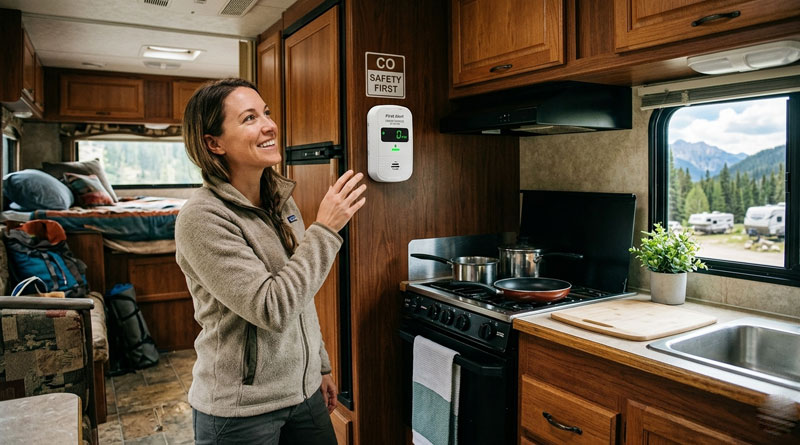
Ensuring your safety on the road starts with reliable air quality monitoring. The right carbon monoxide detector use provide life-saving alerts against odorless CO gas and flammable propane leaks. Our guide explores top-rated dual-gas sensors and portable alarms designed to withstand the unique vibrations and environmental challenges of mobile living, keeping your family protected during every adventure.
1. SENSYX RV Carbon Monoxide & Propane Dual Detector

- Power Source: Hard-wired DC 12V system
- Sensor Technology: Japanese Figaro Electrochemical/Semiconductor
- Alarm Volume: 85dB high-decibel output
- Compliance: UL1484, UL2034, and CE certified
The SENSYX dual detector is a top-tier safety upgrade for any motorhome. Utilizing advanced Japanese Figaro sensors, it provides highly precise monitoring for both CO and propane, significantly reducing the risk of false alarms. The vibrant LCD screen and color-coded LED lights offer immediate visual feedback on gas concentrations, while the 85dB alarm ensures you are alerted even during deep sleep or loud cooking activities.
Installation is impressively user-friendly with a surface-mount design that eliminates the need for large wall cutouts. It serves as an excellent replacement for older MTI Safe-T-Alert models. With a robust five-year lifespan and built-in low voltage protection, this unit remains a reliable guardian for your RV’s air quality throughout its operational life, displaying an “End” code when it is finally time for a replacement.
- Pros:
- Dual gas detection in one unit
- No-drill surface mount installation
- Clear real-time LCD gas display
- Cons:
- Requires 12V hard-wiring
- Limited five-year sensor lifespan
2. VETOUCH Plug-in Carbon Monoxide Detector

- Installation: Standard AC outlet plug-in
- Sensor Type: Professional electrochemical (±5ppm)
- Display: 3-in-1 color LCD screen
- Extra Features: Temperature and humidity tracking
The VETOUCH detector is an innovative 3-in-1 device that monitors more than just carbon monoxide. It features a professional electrochemical sensor for high-accuracy CO detection alongside real-time tracking of cabin temperature and humidity. The bright color LCD screen makes it easy to monitor your indoor environment at a glance, providing a comprehensive air quality overview that is perfect for kitchens or bedrooms where ventilation is a concern.
Operation is exceptionally simple thanks to its plug-and-play design. There is no complex wiring required—simply plug it into a standard outlet. While it is ideal for RVs with consistent AC power, it also includes a self-test function and intuitive buttons for adjusting brightness and units. This versatility makes it a great secondary monitor for travelers who want to track their comfort levels while maintaining a safe environment from CO gas.
- Pros:
- Monitors temperature and humidity too
- Highly accurate electrochemical sensor
- No complex installation required
- Cons:
- Requires an active AC outlet
- Does not detect propane gas
3. Kidde Battery Powered Portable CO Alarm
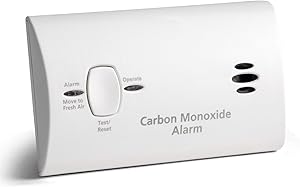
- Power: 2-AA batteries (included)
- Sensor: Advanced electrochemical technology
- Alert System: 85dB alarm and dual LED status
- Memory: Peak level event memory feature
Kidde’s portable CO alarm is a reliable, budget-friendly choice for RVers who need protection without relying on the vehicle’s electrical system. Because it runs on standard AA batteries, it continues to monitor for dangerous carbon monoxide even during total power failures or while the RV is in storage. The unit can be easily mounted on a wall or placed on a tabletop, offering great flexibility for different floor plans and sleeping areas.
The device features an event memory function that records the last time CO was detected, which is vital for troubleshooting potential leaks. A green LED confirms the unit is powered, while a red LED accompanies the loud 85-decibel alarm if gas is present. It is a no-nonsense, life-saving tool that provides consistent electrochemical sensing technology in a compact, portable package that is easy to move between vehicles.
- Pros:
- Works during RV power outages
- No wiring or installation needed
- Portable tabletop or wall use
- Cons:
- Requires regular battery replacements
- No digital concentration display
4. VITITE 2-in-1 Flush Mount RV Gas Detector
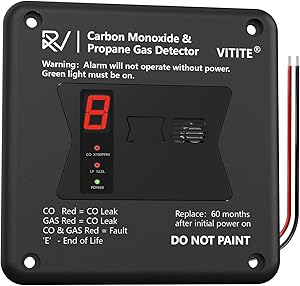
- Mounting Type: Flush mount (2″ x 3 3/8″ cutout)
- Response Time: Rapid 0.5 to 2 seconds
- Lifespan: 60 months (5 years) with support
- Connectivity: Lever nut connectors included
The VITITE dual alarm is specifically engineered as a direct replacement for the popular #31011 RV detectors. It features a sleek flush-mount design that sits neatly against your wall, monitoring for propane and carbon monoxide simultaneously. The rapid response time of under two seconds ensures that you are alerted to leaks the moment they occur, which is critical during nighttime hours or while using propane-powered appliances for cooking.
What sets this unit apart is the ease of installation. It comes equipped with lever nut connectors, eliminating the need for messy electrical tape or complicated crimping. The digital screen provides a clear reading of gas concentrations, and the loud 85dB alarm offers significant early warning. With a dedicated 60-month service window, this detector is a reliable, long-term safety investment for any travel trailer or camper owner.
- Pros:
- Direct replacement for #31011 models
- Very fast gas response time
- Easy tool-free lever connectors
- Cons:
- Requires a wall cutout for mounting
- Flush mount may not fit all walls
5. funomo Dual RV LP/CO Gas Detector

- Power: 12V DC wired connection
- Alarm Thresholds: 150 PPM (CO) / 5 LEL% (Propane)
- Installation: Screw or adhesive sticker options
- Indicators: Separate LEDs for each gas type
The funomo dual detector offers comprehensive 24/7 protection by tracking both carbon monoxide and propane levels with high precision. One of its standout features is the separate indicator light system, which allows you to distinguish instantly between a CO threat and a propane leak. The real-time LCD screen updates gas values constantly, helping you make informed decisions about ventilation and safety procedures before concentrations reach dangerous levels.
This unit is exceptionally flexible to install. Users can choose between a secure screw-in method or a simple adhesive-backed sticker, making it ideal for those who want to avoid drilling into their RV’s interior. It is designed to be mounted low to the floor (4-20 inches) to catch heavy propane gas effectively. With a full five-year lifespan and a clear “End” of life indicator, it is a practical safety essential.
- Pros:
- Separate lights for CO and Propane
- Adhesive mounting option available
- High-decibel alarm with visual flash
- Cons:
- Requires hard-wiring to 12V source
- Bulkier design than flush models
6. Nuleto 2-in-1 High Sensitivity RV Alarm

- Sensors: Precision semiconductor and electrochemical
- Warm-up Time: 3-minute automatic calibration
- Mounting: Panel flush or direct surface mount
- Response: 0.5 to 2 seconds detection speed
The Nuleto dual alarm is built for speed and accuracy, featuring independent probes for CO and propane gas. This 2-in-1 system ensures that both gases are monitored simultaneously with high-sensitivity sensors that react in as little as half a second. The clear digital display shows current concentrations, while specific alarm thresholds (150 PPM for CO and 5% LEL for propane) provide ample time for emergency evacuation or mitigation.
Installation is highly adaptable, offering both flush-mount and surface-mount configurations to fit any RV interior. The inclusion of lever nut connectors simplifies the wiring process significantly, making it accessible for first-time DIY installers. Once powered, the unit performs an automatic three-minute warm-up to calibrate its sensors, ensuring that the protection it provides is both reliable and accurate from the moment you start your trip.
- Pros:
- Dual mounting bracket included
- UL-listed high-precision sensors
- Tool-free wiring with lever nuts
- Cons:
- Longer 3-minute warm-up period
- Requires precise placement for LP gas
7. Safe T Alert 35-742-BL Dual LP/CO Alarm

- Power Draw: Efficient 108mA at 12V DC
- Temp Range: -40°F to +158°F operational
- Mounting: Standard flush-mount replacement
- Safety: Rapid recovery sensor technology
The Safe T Alert 35-742-BL is a gold standard in the RV industry, specifically designed to withstand the extreme temperature fluctuations found in recreational vehicles. This patented “Double-Duty” alarm replaces separate 12V units without needing extra wiring. Its rapid recovery sensor is a standout feature; it reactivates quickly after an alarm event to ensure continuous protection if gas levels remain in a dangerous range during ventilation efforts.
Operating on a low 108mA draw, this unit is highly energy-efficient, preserving your house batteries during off-grid camping. It includes a smart mute button that allows for safe ventilation without disabling the system entirely. As a direct replacement for many older CCI and Safe-T-Alert models, it offers a seamless upgrade path for owners of older motorhomes or campers looking for maintenance-free, certified safety performance.
- Pros:
- Works in extreme temperature ranges
- Low power draw on house batteries
- Rapid recovery sensor technology
- Cons:
- No digital PPM display
- More expensive than generic brands
How to Choose Carbon Monoxide Detectors For RV
Choosing a carbon monoxide detector for your RV is a critical decision that involves more than just picking a standard home alarm. Carbon monoxide (CO) is known as the “silent killer” because it is colorless, odorless, and tasteless. In the tight confines of a camper or motorhome, CO concentrations can reach lethal levels much faster than in a traditional house. Furthermore, RVs often utilize propane for heating and cooking, adding another layer of risk that necessitates specific detection features.
The Difference Between Home and RV Detectors
Many travelers assume they can simply buy a cheap battery-operated detector from a local hardware store and stick it on their RV wall. While this provides some protection, it is not ideal.
Vibration and Temperature Resistance
RVs are subject to constant vibrations while traveling and extreme temperature swings when parked. RV-specific detectors are engineered to maintain sensor accuracy despite these conditions, whereas home units may fail prematurely or give frequent false alarms.
Dual Gas Capability
Because propane is the primary fuel source in most RVs, a dual-gas detector is often the smartest choice. These units monitor for both CO and Liquid Propane (LP) gas, providing a comprehensive safety solution in a single device.
Understanding Power Sources
Your choice of power source affects both installation difficulty and long-term reliability.
12V Hard-Wired Detectors
These are the industry standard. They connect directly to your RV’s house battery system. The advantage is that they are always “on” as long as your batteries have a charge, and you never have to worry about replacing small 9V or AA batteries. They are typically required by law for propane detection because propane sensors consume more power than CO sensors.
Battery-Operated Detectors
These are great as secondary monitors or for RVs without a complex electrical system. They are portable and continue to work even if your house batteries are disconnected or dead. However, they usually only detect CO, not propane.
The Importance of Sensor Technology
Modern detectors use electrochemical sensors for CO detection. These sensors are highly accurate and have a lower power draw. For propane, many units use semiconductor sensors. When shopping, look for units featuring high-quality components, such as Japanese Figaro sensors, which are renowned for their precision and longevity.
Placement and Installation Height
Where you install your detector is just as important as the model you choose.
Low Placement for Propane
Propane is heavier than air and will sink to the floor. Therefore, a dual detector must be mounted low—usually about 4 to 20 inches from the floor—to catch a propane leak early.
High Placement for CO
Carbon monoxide is slightly lighter than air and tends to rise with warm air from heaters. If you are using a CO-only detector, it should be mounted higher up, near the sleeping area at head height.
Certifications and Standards
Never compromise on certifications. A life-saving device should be tested to rigorous standards. Look for UL2034 (for carbon monoxide) and UL1484 (for propane gas). Units that also meet CE or ADR standards provide additional assurance of quality and safety compliance.
Digital Displays vs. Indicator Lights
A digital display (PPM) allows you to see the exact concentration of gas. This is helpful for identifying small leaks or tracking rising levels before an alarm sounds. Simple LED units use color-coded lights (Green for OK, Red for Alarm) which are easier to read from a distance but provide less detail during a troubleshooting event.
Lifespan and Expiration Alerts
Gas sensors do not last forever. Most RV detectors have a lifespan of 5 to 7 years. Once the internal chemistry of the sensor is exhausted, it can no longer detect gas. High-quality detectors include an “End of Life” (EOL) signal, often a chirping sound or a specific display code, to let you know it’s time to buy a new one.
Mute and Test Functions
False alarms can happen, especially if you are using hairspray or cleaning chemicals near the sensor. A “Mute” or “Silence” button is essential for temporary relief while you ventilate the area. However, the “Test” button is more important; you should test your unit weekly to ensure the circuitry and alarm horn are still functional.
Replacement Compatibility
If you are replacing an old factory-installed unit, check the dimensions. Brands like Safe T Alert and MTI are common in RVs. Choosing a replacement with similar “cutout” dimensions or a surface-mount design will save you from having to patch holes or do extensive cabinet work.
Audible Alarm Volume
In a small RV, an 85dB alarm is standard and incredibly loud. This volume is necessary to wake you from a deep sleep, even if you are in a separate bedroom area. Ensure the alarm is loud enough to be heard over the sound of an air conditioner or generator running outside.