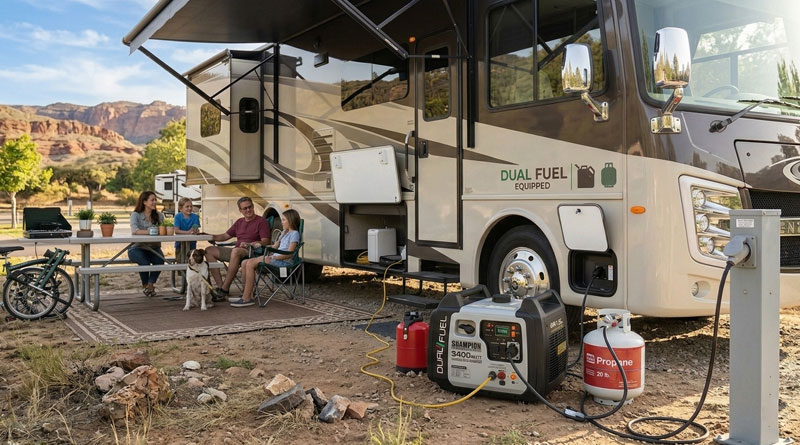
Ditching the grid shouldn’t mean leaving comfort behind. Dual fuel generators are the ultimate road-trip chameleons, letting you fluidly swap between readily available gasoline and clean-burning propane. This dual-source flexibility translates to massive run times, stress-free fuel scouting, and the power to adapt to any campsite reality. Whether you need to blast the AC during a summer scorcher or safely juice up your iPad, finding the perfect hybrid powerhouse is your ticket to uninterrupted, off-grid freedom.
1. WEN Quiet Dual Fuel RV-Ready Inverter Generator

- Engine Displacement: 224cc
- Gasoline Output: 6800 surge watts, 5100 rated watts
- Propane Output: 6000 surge watts, 4500 rated watts
- Safety Features: CO Watchdog Shutdown Sensor, Fuel Shut-off
The WEN DF680iX is a beast of a generator designed for high-demand travelers who refuse to compromise on appliance usage. Its robust 224cc heart churns out exceptional wattage, easily managing heavy-duty start-up loads like dual AC units. Interestingly, it breaks traditional molds by offering a bonded-neutral 240V setup, granting EV and hybrid owners a rare, mobile Level 2 emergency charging lifesaver while deep in the backcountry.
Despite its raw strength, WEN packs in sophisticated systems to protect your gear and your family. The smart CO Watchdog acts as a silent sentry, instantly killing the engine if carbon monoxide spikes. For storage prep, the carburetor-clearing fuel shut-off prevents stale gas gumming, while the integrated wheel kit and folding handle make moving this heavy-duty unit surprisingly manageable.
- Pros:
- High power output for demanding RV needs
- EV charging capability is a unique bonus
- Advanced CO shutdown sensor for safety
- Cons:
- Heavier due to higher wattage
- Higher initial investment than lower-wattage models
2. Champion Dual Fuel RV Ready Portable Inverter Generator

- Starting Watts: 4000W (Gasoline)
- Running Watts: 3000W (Gasoline), 2700W (Propane)
- Noise Level: 64 dBA (from 23 feet)
- Safety Feature: CO Shield carbon monoxide auto shutoff
Champion strikes a sweet spot for mainstream campers with this highly reliable, out-of-the-box dual-fuel solution. With 4000 starting watts, it holds plenty of muscle to boot up a standard 15,000 BTU RV air conditioner without breaking a sweat. It produces whisper-clean electricity, ensuring your laptops and phones recharge safely without the risk of harmonic distortion spikes ruining their batteries.
Campground harmony is guaranteed thanks to a quiet-tuned engine casing that hums along at a conversation-friendly 64 dBA. Safety-conscious users will appreciate the integrated CO Shield tech, which actively defends your living space from dangerous emissions. Combined with an integrated TT-30R RV outlet, this machine eliminates the hassle of carrying specialized plug adapters to your campsites.
- Pros:
- Very quiet operation (64 dBA)
- Dual fuel capability for versatility
- CO Shield for enhanced safety
- Cons:
- Parallel kit sold separately
- Propane running watts are slightly lower
3. Pulsar GD400BN Dual Fuel Portable Inverter Generator

- Gasoline Output: 4000 peak watts / 3200 running watts
- Propane Output: 3600 peak watts / 2800 running watts
- Weight: 47.3 pounds
- Noise Level: 59 dBA (at half load)
Pulsar challenges the heavy weight limits of typical 4000-watt generators by packing impressive performance into an incredibly lightweight chassis. Tipping the scales at a mere 47.3 pounds, it is a dream for solo travelers who dread wrestling heavy machinery out of their truck beds. It runs smoothly on both fuels, ensuring you stay powered up even if gasoline stations are miles away.
This unit is exceptionally stealthy, outputting just 59 dBA at half load to keep your campsite peaceful and respect wild spaces. It features premium inverter internals that produce exceptionally clean energy, making it safe for delicate gadgets. While the physical fuel tank is on the smaller side to save weight, the added propane connectivity easily offsets any long-run demands.
- Pros:
- Extremely lightweight and portable
- Super quiet operation for peaceful use
- Produces clean power for sensitive electronics
- Cons:
- Relatively small fuel tank means shorter runtimes on gas
- Propane output is lower than gasoline
4. WEN Dual Fuel RV-Ready Inverter Generator DF360iX

- Gasoline Output: 3600 surge watts, 2900 rated watts
- Propane Output: 3500 surge watts, 2600 rated watts
- Clean Power: Yes (safe for sensitive electronics)
- Safety Feature: WEN Watchdog CO Shutdown Sensor
For the budget-conscious traveler looking for a compact powerhouse, the WEN DF360iX strikes an incredible balance of economy and utility. It produces plenty of wattage to handle everyday RV tasks, easily running microwave ovens and portable heaters simultaneously. The pure sine wave inverter technology acts as an invisible shield, protecting your delicate devices from destructive electrical spikes.
Operating with a subtle hum, this model is custom-built for crowded state parks and tight boondocking sites. Safety is front and center with the integrated Watchdog carbon monoxide sensor, backed up by a smart fuel-starve switch to clear the carb before storage. Though it lacks built-in wheels, its compact frame slides easily into tight storage compartments.
- Pros:
- Extremely quiet operation
- Dual fuel capability for versatile power
- Produces clean power for sensitive electronics
- Cons:
- Lower wattage than some competitors
- No wheels included for portability
5. Westinghouse Dual Fuel Inverter Generator

- Peak Watts: 4000W
- Rated Watts: 3300W
- Noise Output: As low as 52 dBA
- Starting Options: Remote, Electric, Recoil
Westinghouse delivers a premium, highly automated power experience with this exceptionally engineered dual-fuel inverter. It packs a heavy punch with 4000 peak watts, yet operating it is an absolute breeze thanks to a convenient remote-start key fob. You can fire it up or shut it down right from the comfort of your RV bed without stepping into the morning cold.
Quietness is this model’s superpower, dropping down to an astonishingly low 52 dBA—quieter than most household refrigerators. It stretches fuel efficiency to the limit via an automated Economy Mode that matches engine throttle directly to active power demands. Complete with a direct TT-30R RV outlet and a carbon monoxide safety shutdown, it’s a stellar premium companion.
- Pros:
- Extremely quiet operation (52 dBA)
- Versatile triple start options (including remote)
- RV-ready and produces clean power
- Cons:
- Can be heavier than smaller inverter models
- Parallel cable sold separately if more power is needed
6. maXpeedingrods Dual Fuel Inverter Generator

- Gasoline Output: 4000 peak watts, 3200 rated watts
- Propane Output: 3600 peak watts, 3000 rated watts
- Noise Level: 58-60 dBA (Eco mode, 23 feet)
- Key Feature: Bluetooth App Remote Control
This tech-forward entry from maXpeedingrods brings smart-home convenience straight to your campsite. Equipped with Bluetooth connectivity, it interfaces directly with your smartphone to display live power output, fuel levels, and remaining run times. It completely demystifies generator management, putting full starting power and diagnostic data right in the palm of your hand.
Despite its rich feature set, the generator remains impressively portable at just 52.9 pounds, keeping setup from straining your back. It runs exceptionally quiet in Eco mode, making it perfect for peaceful, noise-restricted state parks. Backed by solid emissions compliance and a 2-year warranty, it’s a reliable, forward-thinking investment for modern, tech-loving RVers.
- Pros:
- Innovative Bluetooth app control and monitoring
- Electric start enhances user convenience
- Very quiet operation in Eco mode
- Cons:
- Bluetooth range might be limited
- Propane power output is slightly lower
7. PowerSmart Portable Dual Fuel Inverter Generator

- Gasoline Output: 3800 starting watts, 3300 running watts
- Propane Output: 3500 starting watts, 3100 running watts
- Run Time: 4.5 hours at 50% load (gasoline)
- Noise Level: 59 dBA (23 feet, 25% load)
The PowerSmart 3800W is a rugged, no-nonsense utility player built for those who value dependable power over fancy bells and whistles. Its dual-fuel system delivers solid wattage numbers on both fuel types, giving you incredible emergency versatility when weather or location limits your options. It outputs stable, pure sine wave power to keep delicate devices completely safe.
Engineered with a conversation-level 59 dBA footprint, it won’t earn you angry looks from neighboring campers. It comes ready with a dedicated 30A RV port, allowing a hassle-free connection directly to your rig. Backed by a suite of essential shutdown sensors, this robust generator keeps your campsite safe and powered through any weekend storm.
- Pros:
- Dual fuel capability for enhanced versatility
- Very quiet operation, suitable for campgrounds
- RV-ready 30A outlet included
- Cons:
- Relatively short run time at half load (4.5 hours)
- No electric or remote start option
How to Choose Dual Fuel Generators For RV
Unlocking the true freedom of the open road requires reliable off-grid power. Dual fuel generators have taken the RV community by storm because they erase the anxiety of fuel scarcity. When you can switch from gasoline to propane with the turn of a dial, you gain complete control over your energy supply. However, picking the right unit isn’t just about grabbing the highest wattage rating on the shelf. Let’s dive deep into what you need to look for to find the perfect match for your rig.
Step 1: Calculate Your Rig’s Real-World Power Profile
Generators operate on two primary wattage metrics: starting (surge) watts and running (continuous) watts. Electric motors, especially those inside your RV’s air conditioner or refrigerator, require an initial burst of energy (starting watts) to spin up before settling into a lower, stable power draw (running watts). To buy the right size generator, you must audit your daily electrical needs.
Create a simple power budget by listing the appliances you plan to run simultaneously. For example:
- 15,000 BTU RV Air Conditioner: ~3500 starting watts, ~1500 running watts
- Microwave Oven: ~1000 running watts
- LED TV and Laptop Charger: ~250 running watts
- RV Refrigerator (Electric Mode): ~600 starting watts, ~300 running watts
If you run these together, your absolute peak demand is around 5350 watts, but your continuous run rate is closer to 3050 watts. Typically, a standard 30-amp RV service is perfectly paired with a generator in the 3000 to 4000-watt range. If you have a larger 50-amp rig with dual air conditioners, you’ll need to look at heavy-duty units starting at 5000 watts, or consider linking two smaller units together.
Step 2: Compare Gas vs. Propane (LPG) Efficiency
Understanding how different fuels behave in the field is vital for long-term satisfaction. Dual-fuel models let you optimize your fuel source based on availability, weather, and localized rules.
Gasoline Advantages & Drawbacks: Gasoline is incredibly energy-dense. It gives you the maximum rated wattage out of your generator’s engine. It is also available at every street corner. On the downside, gas degrades quickly (often within 30 days) and can gum up your engine’s carburetor if left sitting. It also requires you to carry heavy, smelly gas cans inside or on your vehicle.
Propane (LPG) Advantages & Drawbacks: Propane is incredibly clean-burning, meaning your spark plugs stay clean, and you won’t have to deal with carburetor gum-up. Propane tanks have an indefinite shelf life and are highly stable to store. However, because propane has lower energy density than gasoline, your generator’s power output will drop by roughly 10% to 15%, and it will consume fuel slightly faster. Having both options means you can run on gas when you need maximum raw power, and switch to propane for cleaner, quieter, low-maintenance idling.
Step 3: Pay Attention to Noise Levels (dBA)
Generator noise is the fastest way to ruin a quiet evening in nature or anger your campsite neighbors. Decibel levels are measured on a logarithmic scale; a 10 dBA increase represents a sound that is twice as loud to the human ear. Look for closed-frame inverter generators that run between 50 dBA and 60 dBA under light loads. At this level, the generator’s sound mimics a gentle hum or a standard household fan, allowing you to easily hold a conversation nearby. Traditional open-frame construction models often roar past 70 dBA, making them highly disruptive and frequently banned in national parks.
Step 4: Factor in Weight and Physical Portability
Your generator needs to travel with you, which means you have to lift, store, and secure it. A 4000-watt generator can weigh anywhere from a featherlight 48 pounds to a back-straining 110 pounds. If you travel solo or have physical limitations, prioritize lightweight models under 60 pounds or look for units with built-in, heavy-duty wheels and telescoping luggage-style handles. Always check your RV’s storage bay dimensions before buying to ensure the unit fits comfortably without blocking access to other gear.
Step 5: Verify “RV-Ready” Connections and Clean Power Outlets
To avoid a messy web of adapters and potential wiring hazards, look for generators with built-in RV-ready plugs. An ideal generator will feature a dedicated NEMA TT-30R (Travel Trailer 30-Amp) outlet, allowing you to plug your RV’s main power cord directly into the machine. Additionally, ensure the generator utilizes inverter technology. Inverters produce clean, stable power with a Total Harmonic Distortion (THD) of less than 3%. This “clean power” mimics the electricity in a modern home, protecting your expensive TVs, smartphones, laptops, and built-in RV control boards from terminal electrical damage.
Step 6: Insist on Critical Safety Features
Modern engineering has made portable generators incredibly safe, but you should never buy a unit that cuts corners on safety systems. Ensure your generator includes these essential safeguards:
- Carbon Monoxide (CO) Shutdown: This sensor constantly samples the air. If the generator is running in a stagnant pocket where CO gas is pooling, it instantly kills the engine to protect you from odorless, lethal fumes.
- Low-Oil Shutdown: If your oil level drops below safe operating limits, the engine shuts down automatically to prevent costly internal engine damage.
- Overload Protection: A built-in circuit breaker that trips if you attempt to pull more power than the generator can safely handle, protecting both the generator and your RV’s appliances.
Step 7: Choose Your Preferred Start Mechanism
Decide how much effort you want to put into starting your machine. A traditional manual recoil start is reliable and requires no battery maintenance, but can be tough on your shoulders. A push-button electric start is incredibly convenient and makes starting the engine effortless. For the ultimate luxury, look for models featuring remote key fobs or smartphone Bluetooth app control, allowing you to fire up your generator from inside your warm RV while the coffee brews.
Step 8: Consider Long-Term Maintenance and Parallel Capabilities
Look for brands that offer reliable customer service, easy access to spare parts, and robust multi-year warranties. Features like an integrated “fuel shut-off” switch are incredibly valuable; they let you run the carburetor completely dry of fuel before storage, preventing costly engine service visits. Finally, if you want a lightweight setup now but might buy a larger RV in the future, choose a “parallel capable” unit. This feature allows you to link two identical small generators together with a simple cable, giving you double the power output when needed without forcing you to carry a single, massive 100-pound machine.