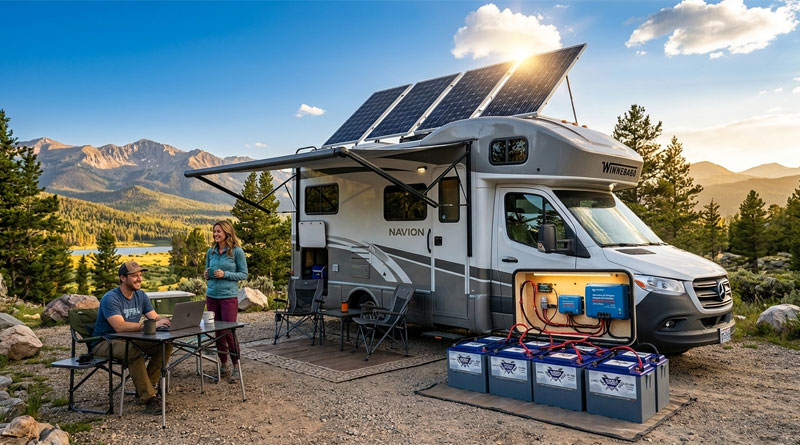
If you’re powering an RV with solar panels, your battery choice makes all the difference. The right battery stores the sun’s energy so you can run lights, fans, and gadgets anytime—day or night. In this guide, we’ll walk you through the best RV batteries for solar setups. You’ll learn which types last longer, charge faster, and handle off-grid life best, all explained in plain, simple language.
1. GOLDENMATE 12V 100Ah LiFePO4 Lithium Battery

- Cycle Life: 4000 to 15000+ deep cycles
- Management: Integrated 100A BMS protection
- Expansion: Supports up to 4P4S configuration
- Charge Rate: 50A maximum continuous charge
The GOLDENMATE 12V 100Ah lithium battery is a powerhouse designed for those who demand longevity from their solar setup. Utilizing premium LiFePO4 cells, it offers ten times the lifespan of traditional lead-acid units, reaching up to 15,000 cycles. The sophisticated 100A BMS ensures safety against overheating and short circuits while maintaining a negligible self-discharge rate for long-term storage.
This Group 31 battery is exceptionally versatile, making it ideal for everything from trolling motors to complex RV solar arrays. Its ability to scale up to 400Ah in parallel allows your system to grow alongside your energy needs. It supports fast charging via solar MPPT controllers, ensuring your energy bank is replenished quickly during peak daylight hours without any memory effect issues.
- Pros:
- Extremely high cycle count
- Maintenance-free lithium technology
- Flexible series/parallel expansion
- Cons:
- Not for engine starting
- Requires specific LiFePO4 charger
2. KEPWORTH 12.8V 100Ah LiFePO4 Solar Battery
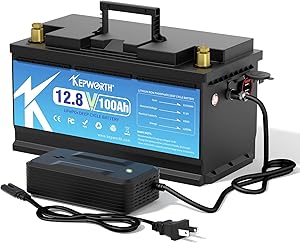
- Cells: Grade A Lithium Iron Phosphate
- Ports: USB and aviation head charging
- Discharge: 100A continuous / 200A peak
- Warranty: 5-year technical support
The KEPWORTH 12.8V 100Ah battery stands out with its unique user-centric design features specifically for outdoor enthusiasts. It includes an aviation head charging port to prevent polarity reversal and a dedicated side USB port for charging mobile devices directly. This makes it a multi-functional power hub for campers who need to keep small electronics powered while managing their primary RV solar loads.
Internally, the battery utilizes Grade A cells protected by an upgraded 100A BMS with high and low-temperature cut-offs. This protection is critical for maintaining battery health during extreme weather camping. It supports series connections up to five units, offering significant voltage flexibility. The inclusion of a free 7A charger adds immediate value, allowing for both top-terminal and side-port charging simultaneously for faster recovery times.
- Pros:
- Built-in USB charging ports
- Grade A cell reliability
- Excellent customer support network
- Cons:
- Not waterproof without box
- Charging temperature restrictions
3. DR.PREPARE 12V 100Ah LiFePO4 Lithium Battery

- Dimensions: Compact 11.81 x 7.6 x 8.94 inches
- Weight: Ultralight 28.5 pounds
- Bank Size: Supports up to 16 batteries
- Energy: 1280Wh total energy density
DR.PREPARE has engineered a lithium battery that focuses on space efficiency without compromising on total power output. This 100Ah unit is roughly 8.7% smaller than standard lithium competitors, making it the perfect choice for compact RVs or van conversions where every square inch is vital. Despite its small footprint, it delivers a full 1280Wh of energy and weighs only 28.5 pounds, significantly reducing your vehicle’s overall load.
The integrated BMS is highly intelligent, featuring low and high-temperature cut-offs that automatically resume operation once conditions stabilize. This makes it a rugged choice for off-grid solar systems in varying climates. For those with massive power needs, these batteries can be wired in extensive series and parallel configurations to build a home-sized bank of up to 20.48 kWh, providing massive storage for prolonged boondocking.
- Pros:
- Space-saving compact footprint
- Extreme scalability for large banks
- Lightweight for easier installation
- Cons:
- Strict charging current limits
- High-temp protection delays charging
4. LOSSIGY 12V 280Ah Deep Cycle Lithium Battery

- Capacity: 280Ah high-energy storage
- Lifespan: 10-year service life design
- Technology: Auto Grade-A lithium cells
- BMS: Automatic cell balancing system
For RV owners looking for a massive single-unit energy reserve, the LOSSIGY 12V 280Ah battery is a premier solution. Built with automotive Grade-A cells, it provides 2560Wh of energy, enough to run heavy appliances for days. The high energy density allows for a more stable performance under load, and the internal BMS utilizes high-end chips to ensure automatic balancing between cells, which is essential for maintaining the battery’s 10-year lifespan.
This battery simplifies solar installation by replacing multiple smaller batteries with one high-capacity unit, reducing cabling complexity. It handles deep cycles with ease, offering at least 4000 cycles while protecting against short circuits and overloads. LOSSIGY backs this unit with responsive technical support, ensuring that your off-grid solar system remains reliable. It is an ideal anchor for large RV solar projects where high capacity and long-term stability are the primary goals.
- Pros:
- Massive 280Ah single-unit capacity
- Automatic internal cell balancing
- Grade-A automotive cell quality
- Cons:
- Considerable weight and size
- Requires high-output charger
5. LiTime 12V 100Ah Lithium LiFePO4 (2 Pack)

- Quantity: 2-Pack (200Ah total capacity)
- Weight: 24.25 lbs per battery
- Safety: UL-tested premium cells
- Expansion: Up to 51.2V 400Ah system
The LiTime 12V 100Ah 2-pack offers an excellent value proposition for RVers building a 200Ah house bank. These batteries are incredibly lightweight, weighing only about a third of a comparable lead-acid battery, which makes them very easy to reposition or install in tight compartments. Each unit features UL-tested cells and a multi-protection BMS with over 20 safeguards, ensuring that your solar energy storage is as safe as it is efficient.
This set is designed to scale effortlessly, allowing you to build a massive 20.48kWh system if your power needs grow. With a cycle life of up to 15,000 cycles at shallower discharge depths, these batteries are built to outlast your RV itself. They are particularly popular for 30-70lb trolling motors and off-grid solar applications due to their stable power delivery and rapid charging capabilities, representing a smart long-term investment for any traveler.
- Pros:
- Excellent value for 200Ah total
- Extremely lightweight construction
- High safety rating with UL cells
- Cons:
- Doesn’t include interconnect cables
- Manual tracking of two units
6. Interstate Batteries 12V 110Ah Deep Cycle AGM

- Chemistry: VRLA / AGM Spill-Proof
- Capacity: 110Ah Deep Cycle
- Size: BCI Group Size 29
- Testing: 7-Point Quality Protocol
For those who prefer the proven reliability of AGM technology, the Interstate DCM0100 is a professional-grade deep-cycle battery optimized for solar and RV applications. It is engineered for heavy-demand cycles, providing a longer life than standard lead-acid batteries. The VRLA (valve regulated) design makes it completely maintenance-free and spill-proof, which is essential for the vibration-heavy environment of a moving recreational vehicle or a rugged off-grid solar storage cabinet.
Interstate is known for its rigorous 7-Point Quality Protocol, exceeding industry standards for performance and reliability. This 110Ah battery is a universal fit for many 100Ah applications, offering a slight boost in capacity. While it is heavier than lithium alternatives, it provides a cost-effective, dependable source of power that doesn’t require specialized lithium charging profiles. It’s a “set-it-and-forget-it” solution for campers who want reliable power without the complexity of lithium management systems.
- Pros:
- No specialized charger required
- Maintenance-free spill-proof design
- Extensive nationwide dealer support
- Cons:
- Very heavy compared to lithium
- Limited depth of discharge (50%)
7. ECO-WORTHY 12V 280Ah LiFePO4 RV Battery

- Monitoring: Built-in Bluetooth with App
- BMS: 200A with low-temp cutoff
- Energy: 3584Wh massive capacity
- Structure: Internal metal compression frame
The ECO-WORTHY 12V 280Ah battery is at the cutting edge of RV solar technology, featuring real-time Bluetooth monitoring via a smartphone app. This allows you to track voltage, current, and capacity without needing external shunts or monitors. The battery is physically reinforced with an internal metal compression frame, which prevents cell expansion and protects against the shocks and vibrations common in off-road trailers and heavy motorhomes.
Equipped with a high-output 200A BMS, this unit includes a low-temperature cutoff that prevents charging below 19.4°F, protecting the cells from permanent damage in winter conditions. It delivers a staggering 3584Wh of energy and can be expanded into 48V solar systems. Despite its high capacity, it is designed for ease of use, taking about six hours to charge with a standard 600W solar array. It is the ultimate choice for tech-savvy RVers who want full control over their solar storage.
- Pros:
- Smartphone app for real-time data
- Internal shock-stabilizing frame
- High-output 200A BMS system
- Cons:
- Bluetooth range is somewhat limited
- Higher upfront cost for tech
How to Choose RV Batteries for Solar
Selecting the right battery for your RV solar system is the most critical decision you will make in your off-grid journey. Your solar panels harvest the energy, but your batteries are the “fuel tank” that keeps your lights on and your fridge running when the sun goes down. To make the best choice, you must understand the interplay between capacity, chemistry, and your specific camping style.
1. Lithium vs. AGM: Deciding on Chemistry
The first crossroads you will face is choosing between Lithium Iron Phosphate (LiFePO4) and Absorbed Glass Mat (AGM) batteries. Lithium batteries have become the gold standard for solar because they can be discharged to 100% without damage, they weigh 60% less, and they last up to 10 years. AGM batteries are more affordable upfront and don’t require specialized chargers, but they can only be safely discharged to 50% and are significantly heavier. If you plan to camp frequently or full-time, lithium is almost always the better long-term investment due to its efficiency and cycle life.
2. Calculating Your Amp Hour Requirements
Your energy needs are measured in Amp Hours (Ah). To choose the right size, you must conduct a power audit. Total the wattage of every light, fan, pump, and appliance you use daily, then divide by 12 to get the amp hours. For example, a 12V fridge might pull 50Ah per day. To ensure you don’t run out of power during a cloudy day, it is recommended to have at least two to three days of storage. Most solar-equipped RVs find their “sweet spot” with a 200Ah to 400Ah battery bank.
3. Understanding the BMS (Battery Management System)
If you choose lithium, the BMS is the “brain” of your battery. It protects against overcharging, deep discharge, and short circuits. A high-quality BMS is essential for safety and longevity. Look for a BMS that includes a low-temperature charging cutoff. Lithium batteries can be damaged if they are charged in freezing temperatures; a smart BMS will stop the charge to protect the cells until they warm up. Higher-end models now even offer Bluetooth connectivity, allowing you to monitor your battery’s state of charge directly from your phone.
4. Discharge Rates and Inverter Compatibility
Not all batteries can output the same amount of power at once. If you plan to run a microwave or an air conditioner through an inverter, you need a battery with a high continuous discharge rate. A standard 100Ah lithium battery usually has a 100A BMS, allowing for about 1200 watts of output. If you have a 3000W inverter, you will need a battery bank that can handle a 250A-300A continuous discharge, which often requires multiple batteries wired in parallel or a single high-capacity unit with a beefier BMS.
5. Space and Weight Constraints
Weight is always a concern in an RV. Replacing two Group 31 lead-acid batteries (about 140 lbs total) with two 100Ah lithium batteries (about 50 lbs total) can save you nearly 100 lbs of cargo weight. Additionally, consider the footprint. Some batteries, like the Dr. Prepare models, are designed to be more compact than traditional sizes. This is crucial if your battery compartment is small or if you are trying to squeeze a larger 280Ah unit into a space originally designed for a 100Ah battery.
6. Charging Efficiency and Solar Input
One of the biggest advantages of lithium for solar is its charging efficiency. Lithium batteries can accept a much higher current than AGM, meaning they can charge from 0% to 100% much faster when the sun is out. They also don’t require a long “absorption” phase like lead-acid batteries do. This means if you only have four hours of good sunlight, a lithium battery might reach a full charge while an AGM battery would only be 80% full. Ensure your solar charge controller has an “AGM” or “Lithium” profile to match your choice.
7. Temperature Sensitivity
Consider where you camp. AGM batteries handle cold weather discharging better than lithium, though their capacity still drops. Lithium batteries are excellent in the heat but very sensitive to charging in the cold. If you are a winter camper, look for lithium batteries with built-in heaters or ensure they are installed inside the heated living space of the RV. If your batteries are on the tongue of a trailer in Alaska, AGM might actually be the more reliable, albeit less efficient, choice.
8. Parallel vs. Series Connections
Think about how you want to expand your system. Parallel connections increase your Amp Hours (12V 100Ah + 12V 100Ah = 12V 200Ah), while series connections increase voltage (12V 100Ah + 12V 100Ah = 24V 100Ah). Most RVs use 12V systems, but larger off-grid rigs are moving toward 24V or 48V for better efficiency with large inverters. Ensure the batteries you buy support the specific configuration you plan to use; some BMS units are limited to only 4 units in parallel.
9. Cycle Life and Total Cost of Ownership
Don’t just look at the price tag; look at the cost per cycle. An AGM battery might cost $250 and last 500 cycles ($0.50 per cycle). A lithium battery might cost $400 and last 5,000 cycles ($0.08 per cycle). Over the course of 10 years, the lithium battery is actually much cheaper. If you are a casual weekend warrior, the AGM might suffice, but for anyone looking for the most dependable power source over a decade, lithium wins on value every time.
10. Brand Reputation and Support
Finally, consider the warranty and technical support. Since batteries are a heavy and expensive item to ship, having a brand that stands by its product is vital. Look for brands that offer at least a 3-to-5-year warranty and have a history of responsive customer service. Reviews from other RV owners can give you a clear picture of how well a battery stands up to the constant vibration and varying temperatures of the road. Trusted names like Interstate, LiTime, and Renogy have built reputations on providing consistent performance in these demanding conditions.