Forget what you think you know about holding tank treatments — the best ones aren’t just odor-fighters wearing a chemical mask. They’re microscopic workhorses dissolving waste, shredding toilet paper, and clearing out grease before a single clog has the nerve to form. Picking the wrong product means pyramid plugs, phantom sensor readings, and a dump station experience nobody wants to repeat. Here’s what actually works.
1. Unique RV Digest-It+, Extra-Strength RV Toilet Treatment

- Formulation: Extra-strength bio-enzymatic
- Capacity: 32 oz (multiple uses)
- Waste Breakdown: Liquefies all waste & toilet paper
- Tank Type: Black and gray tanks
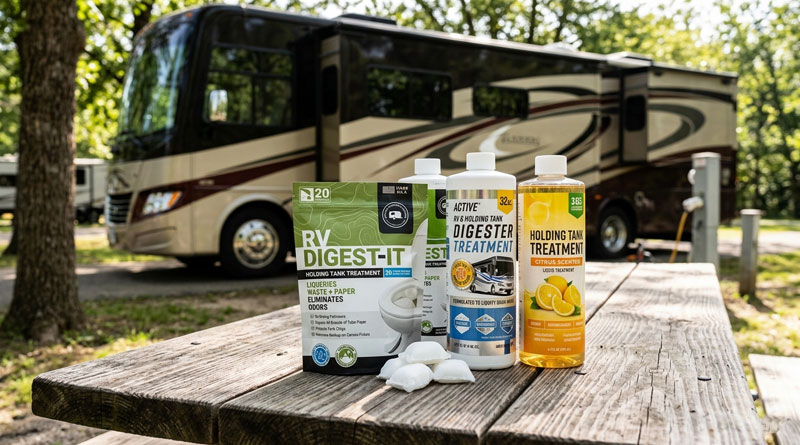
Most tank treatments promise odor control and quietly hope you don’t look too closely at the waste pile still forming underneath. Unique RV Digest-It+ takes the opposite approach — its extra-strength bio-enzymatic formula goes after the waste itself, aggressively liquefying solids and toilet paper before pyramid plugs ever get a foothold. The result is a noticeably cleaner dump, less residue clinging to your hose, and a tank that actually empties the way it should.
Where this product quietly earns its premium price is in sensor maintenance. Liquified waste doesn’t cling to probe tips, so your tank gauge reflects reality rather than wishful thinking. Gray tank users also benefit — the enzymes chew through grease, oil, and food particles with the same efficiency. Unique backs every bottle with their “Unique Cares” program, giving you access to certified RV technicians if any wastewater mystery stumps you.
- Pros:
- Extra-strength formula demolishes waste other treatments leave behind
- Targets odor at the source rather than masking it
- Keeps sensor probes reading accurately
- Cons:
- Best results demand following “The Unique Method” precisely
- Costs more than entry-level alternatives
2. Camco TST MAX RV Toilet Treatment Drop-INs

- Formulation: Reactive odor-eliminating technology
- Scent: Refreshing orange
- Quantity: 30 drop-ins per pack
- Tank Capacity: Treats up to 40-gallon tanks
The drop-in format sounds simple because it is — and that’s exactly the point. No measuring cups, no spilled liquid, no second-guessing your dose. Camco’s TST MAX drop-ins use reactive odor-eliminating chemistry that doesn’t just layer a citrus smell over something unpleasant; it chemically neutralizes odor compounds while simultaneously breaking down waste and RV toilet paper. One packet handles tanks up to 40 gallons and keeps things under control for up to seven days.
This product earns its loyal following largely from boondockers and weekend warriors who want something reliable without a complicated routine. Made in the USA and safe for all septic systems, these drop-ins are equally at home in a portable camping toilet or a full-size RV black tank. The orange scent is polarizing — either a genuine quality-of-life improvement or an unwanted intrusion, depending on who you ask.
- Pros:
- No-mess, pre-measured format eliminates dosing errors
- Neutralizes odors for up to seven days per treatment
- Breaks down waste and RV toilet paper reliably
- Cons:
- Orange scent is not universally loved
- Less effective than enzyme treatments against severe clogs
3. Unique RV Digest-It Ultra RV Toilet Treatment

- Formulation: Ultra-concentrated bio-enzymatic
- Uses per Bottle: 32 treatments
- Waste Breakdown: Liquefies all waste & toilet paper
- Sensor Care: Prevents probe buildup
Think of Digest-It Ultra as what happens when the already-strong Digest-It+ formula gets taken to the lab and told to stop holding back. Thirty-two treatments packed into a single 32-oz bottle with an easy-measure design means no fumbling with spoons or eyeballing pour lines at a campsite. The ultra-concentrated bio-enzymatic blend tears through waste and toilet paper faster than the classic version, leaving far less solid material to create problems during your dump.
Sensor accuracy is another area where Ultra earns its name — the aggressive enzymatic action prevents any sticky residue from coating probes, so your gauge stays honest even after weeks of heavy use. Gray tanks respond just as well, with grease and food particles getting digested rather than slowly coating your tank walls. Unique’s “Unique Cares” technician support comes included, which matters more than it sounds when you’re 200 miles from the nearest RV service center.
- Pros:
- 32 treatments per bottle with a convenient easy-measure design
- Substantially more powerful than the classic Digest-It formula
- Eliminates odors and fully liquifies waste
- Cons:
- Precise measurement is essential — too little and you lose effectiveness
- Optimal performance requires following “The Unique Method”
4. Happy Campers Holding Tank Treatment
- Formulation: Concentrated mineral-based powder
- Doses per Container: 64 treatments
- Scent: Unscented
- Tank Type: Black and gray tanks
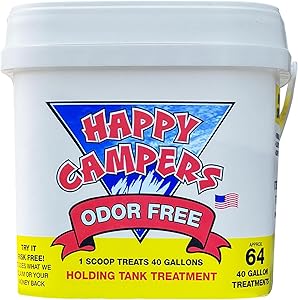
Happy Campers operates on a completely different philosophy from enzyme or chemical competitors — it uses a concentrated mineral-based powder that doesn’t bother with perfume or biological agents. One scoop handles a 40-gallon tank. Sixty-four doses per container. The formula actively breaks down solids, prevents mineral crystal buildup on tank walls, and keeps sensors from getting coated in the debris that causes phantom “full” readings. No scent means no argument about whether citrus is better than lavender.
The real differentiator is heat performance. While many bio-enzymatic products slow down considerably above 85°F, Happy Campers maintains full effectiveness past 90°F — a practical detail that separates it from the competition during summer desert travel or humid Gulf Coast camping. It dissolves quickly with adequate water flow, works across all tank materials, and is fully septic-safe. For unscented, heat-stable, no-fuss odor control, this mineral powder is genuinely hard to beat.
- Pros:
- Exceptional odor neutralization with zero masking fragrances
- Maintains full potency in temperatures exceeding 90°F
- Prevents sensor buildup, clogs, and slow draining
- Cons:
- Low water flow may require agitation to fully dissolve the powder
- No scent option means nothing to replace tank odors during the transition period
5. Walex Porta-Pak Black Holding Tank Deodorizer & Portion Control

- Formulation: Portion-controlled drop-ins
- Scent: Fresh scent
- Quantity: 10 drop-ins per pack
- Tank Capacity: 2.5 to 40-gallon tanks
Walex has been quietly manufacturing sanitation products since before most RVers knew holding tanks needed treatment at all. Their Porta-Pak drop-ins carry that institutional knowledge in a small, water-soluble packet that dissolves the moment it hits water. The formula rapidly breaks down waste and RV toilet paper while attacking odors before they migrate toward living quarters. Coverage spans from 2.5-gallon portable camping toilets up to standard 40-gallon black tanks, making this one of the more versatile drop-ins on the market.
Sensor cleaning is a quieter but meaningful feature — the treatment keeps probe surfaces clear of the sticky debris that causes misreadings, eliminating that maddening experience of a “full” alert on a half-empty tank. Made in the USA, the Porta-Pak carries a reputation built over decades in the marine and RV market. The 10-pack count is lower than competitors, which affects the per-treatment cost, but the packaging stays compact and tidy in any storage compartment.
- Pros:
- Mess-free drop-in design with instant dissolution
- Rapidly breaks down waste and toilet paper
- Reliable odor prevention with a fresh scent
- Cons:
- Only 10 packets per pack — fewer doses than most competitors
- Scent profile will not suit everyone
6. Eco Strong RV Toilet Treatment
- Formulation: Enzyme-based liquid
- Uses per Container: 128 treatments (gallon)
- Scent: Lavender
- Action: Liquifies waste, eliminates odor, cleans sensors
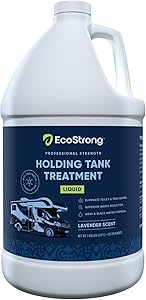
One gallon. One hundred and twenty-eight treatments. Eco Strong’s math alone makes it worth a closer look. The enzyme-based liquid formula handles black tank management in three simultaneous directions — liquifying waste and toilet paper to prevent clogs, eliminating odors at their biological source, and clearing the debris that accumulates on sensor probes. The liquid format also means uniform distribution throughout the tank from the first flush, without any powder granules settling unevenly or clumping in low-flow conditions.
Climate performance is an underappreciated feature here. Unlike some enzyme products that lose effectiveness in extreme temperatures, Eco Strong’s formula is engineered to remain active in both summer heat and cold-weather camping. Lavender scent keeps the interior atmosphere pleasant without being aggressive. Per-treatment cost is among the lowest of any product in this category, making it particularly attractive for full-timers and frequent travelers who go through treatment regularly.
- Pros:
- Three simultaneous actions: waste digestion, odor elimination, sensor cleaning
- Enzyme-based formula works in all climates
- 128 treatments per gallon delivers outstanding cost efficiency
- Cons:
- Liquid format requires measuring — spills happen
- Lavender scent rules it out for those preferring fragrance-free options
7. Camco TST MAX RV Toilet Treatment

- Formulation: Reactive odor-eliminating liquid
- Scent: Refreshing orange
- Quantity: 1-gallon jug (multiple uses)
- Dosage: 2 oz treats up to 40-gallon tank
Two ounces per treatment. One gallon per jug. That arithmetic produces a lot of trips before you need to restock, which is why Camco’s TST MAX liquid has stayed in the toolkit of practical RVers for years. Its reactive odor-eliminating technology stops black tank smells for up to seven days — not by layering a citrus smell on top, but by chemically targeting the odor compounds themselves. Waste and RV toilet paper break down efficiently, keeping your dump valve clear and your sewer hose from collecting unpleasant surprises.
Sensor performance improves with regular use since the formula prevents the waste adhesion that causes false “full” readings. Camco built this product biodegradable and septic-safe from the ground up, so it clears municipal systems cleanly and won’t upset a home septic tank if that’s part of your setup. Whether you’re living aboard full-time, weekend camping, or managing a portable toilet at a remote site, the TST MAX liquid scales cleanly to all of it.
- Pros:
- Seven days of genuine odor elimination per two-ounce dose
- Breaks down waste and toilet paper without leaving residue
- Biodegradable, septic-safe, and made in the USA
- Cons:
- Liquid measuring adds a step that drop-in formats avoid
- Pouring from a gallon jug in a small bathroom requires some coordination
How to Choose the Right RV Holding Tank Treatment
RV holding tank treatments occupy a strange corner of the market — products that nobody particularly wants to think about until the moment they desperately need to. The result is that most people grab whatever’s on the shelf at the nearest camping store without considering whether it actually matches how they travel, where they camp, or what their tank systems are dealing with. A boondocker spending two weeks in the Arizona desert in July has completely different needs from a retiree hooked up at a full-service campground every weekend. Getting this decision right is less about finding the “best” product in some universal sense and more about finding the right match for your specific circumstances.
Start With What Your Tank Actually Needs
Before you look at any product label, spend a moment thinking honestly about your tank situation. Do you have persistent odors that survive multiple dump cycles? That points toward a treatment focused on enzymatic or bacterial breakdown rather than chemical suppression. Are your sensors chronically misreading? You need something that specifically addresses probe buildup, not just a general deodorizer. Do you travel frequently in heat above 90°F? Many enzyme products slow dramatically in high temperatures, so formulation matters. Are you managing both a black tank and a gray tank, or just one? Not every product is designed for dual-tank use, and some that work beautifully in a black tank do very little for grease and food debris in a gray tank.
The clearer you are about your actual problem, the less likely you are to buy something that addresses a different problem entirely. Most holding tank frustration comes not from bad products but from well-designed products used in situations they weren’t designed for.
Understand the Three Core Formulation Types
Every holding tank treatment on the market falls into one of three general categories, and understanding the difference determines which products you should even be considering.
Enzyme-based treatments deploy naturally occurring enzymes to break down organic material — waste, toilet paper, grease — into liquid form. The chemistry is elegant: enzymes latch onto specific organic molecules and catalyze their breakdown without being consumed in the process. They keep working as long as organic material is present, which is why they’re particularly effective for tanks that sit between uses. They’re generally safe for all plumbing materials, septic systems, and the broader environment, and they eliminate odors at the source by removing the organic matter that produces the smell rather than simply suppressing it.
Bacterial or probiotic treatments use a different mechanism — live beneficial bacteria that actively consume waste as a food source and reproduce as they work. This makes them highly effective for sustained odor control in tanks that stay in use consistently. The bacteria continue multiplying as long as waste is present, providing ongoing treatment rather than a single-dose effect. They’re environmentally responsible, safe for all plumbing, and often the preference of full-time RVers who want a biologically active tank ecosystem rather than a chemically sterile one.
Chemical treatments work by killing bacteria and sanitizing the tank environment, delivering rapid odor knockdown. Older formulations using formaldehyde have largely been retired due to legitimate environmental concerns and documented damage to rubber seals and septic systems. Newer “advanced chemistry” formulations aim to capture the immediate effectiveness of chemical treatments while avoiding the most problematic ingredients. If you choose a chemical treatment, verify it’s labeled formaldehyde-free and safe for the specific materials in your plumbing system.
Match the Format to Your Routine
Treatment effectiveness is meaningless if you don’t use the product consistently, and you won’t use it consistently if the format is inconvenient for how you actually operate at a campsite. This is where format selection matters more than most buyers realize.
Drop-in packets remove every friction point from the process. Pre-measured, no spilling, no measuring cups, no wondering if you got the right amount. Drop one in, flush, done. The tradeoff is slightly less flexibility in dosing for unusual tank sizes or situations requiring extra treatment strength. For occasional campers, first-timers, or anyone who simply wants one less thing to think about, drop-ins are the rational choice regardless of whether a liquid formula might technically perform marginally better.
Liquid treatments offer precision and typically better value per treatment volume. A two-ounce dose from a gallon jug is easy to measure accurately, and you can adjust dosing for larger tanks or tanks requiring extra treatment without opening a second packet. The downsides are real — liquid spills, gallon jugs are awkward in small bathroom spaces, and measuring in dim campsite conditions at night is less pleasant than it sounds in a product description.
Powder treatments are typically the most concentrated by volume and often the most cost-effective per treatment. They dissolve with water flow, which is usually sufficient in a properly functioning tank, but can require extra flushing or agitation if water pressure is low. Storage is clean and compact. The format suits detail-oriented campers comfortable with precise measurement and thorough flushing habits.
Think Seriously About Temperature and Climate
This factor gets overlooked far more than it should. Enzyme and bacterial treatments are living chemistry — they slow down in cold conditions and, critically, many formulations lose significant effectiveness in sustained heat above 85°F. If you’re camping in Texas in August, the Carolinas in July, or anywhere the Southwest desert in summer, a treatment that performs beautifully in a Pacific Northwest spring may essentially stop working during your hottest trips. Mineral-based powder treatments like Happy Campers are specifically engineered to sidestep this limitation, maintaining effectiveness well past 90°F. If heat is part of your regular travel reality, that characteristic deserves serious weight in your decision.
Cold-weather camping creates a different challenge — treatments need to remain effective at lower temperatures without losing potency or freezing in storage. All-climate enzyme formulations address this, but verify the claim specifically rather than assuming any enzyme product handles temperature extremes.
Factor in Sensor Maintenance From the Start
Inaccurate sensor readings are one of the most universally complained-about RV experiences, and most of the time the cause isn’t a faulty sensor — it’s waste residue coating the probe tips and causing them to register “full” regardless of actual tank level. Treatments that specifically include sensor-cleaning capability address this problem preventively. The mechanism is straightforward: when waste is fully liquified, nothing clings to sensor probes. When waste is only partially broken down, residue accumulates over time and the sensors become progressively less reliable.
If you’re already dealing with sensors that read full on an empty tank, a treatment alone may not resolve the issue — you may need a dedicated sensor cleaning flush first. But once you’ve reset the probes, a treatment with strong liquification capability will keep them functioning correctly going forward.
Environmental Responsibility Is a Practical Concern, Not Just an Ethical One
Dump stations connect to municipal wastewater systems. Some campgrounds discharge to septic fields. What you put in your tank eventually goes somewhere, and treatments containing harsh biocides or formaldehyde derivatives can disrupt the biological treatment processes at wastewater facilities and damage septic ecosystems. Beyond the ethical dimension, some campgrounds and dump stations actively prohibit certain treatment chemicals, and using a prohibited product can result in being turned away.
Choosing biodegradable, formaldehyde-free, septic-safe treatments avoids all of these complications entirely. The good news is that most high-performing modern treatments already meet these criteria — the products in this list are all safe choices from a disposal standpoint.
Calculate True Cost Per Treatment, Not Sticker Price
A $30 bottle of ultra-concentrated liquid that yields 128 treatments costs substantially less per use than a $12 pack of 10 drop-ins. Running the per-treatment math before purchasing is a simple exercise that frequently reverses the intuitive “cheaper product” conclusion. Full-time RVers who treat tanks every few days will find concentrated liquid formats almost always deliver better long-term value. Occasional weekend campers may find that a small pack of drop-ins serves them for an entire season, making the per-unit cost nearly irrelevant compared to the convenience benefit.
Use the Treatment as Part of a System, Not a Substitute for One
No treatment compensates for poor tank habits. Always use adequate water — a dry or low-water tank concentrates waste and overwhelms any treatment formula. Only flush toilet paper designed to dissolve quickly in RV systems; standard household brands resist breakdown and create accumulation problems no enzyme product fully overcomes. Dump when your tank reaches at least two-thirds capacity so there’s sufficient volume and pressure for a thorough flush. Rinse the tank after dumping before adding fresh treatment. Consider a periodic deep clean with a dedicated tank rinser every few months to clear any accumulated buildup that regular treatment leaves behind.
The right treatment, used consistently in a well-maintained system, turns holding tank management from an ongoing source of frustration into a five-minute routine that you stop thinking about entirely — which is exactly where it should be.