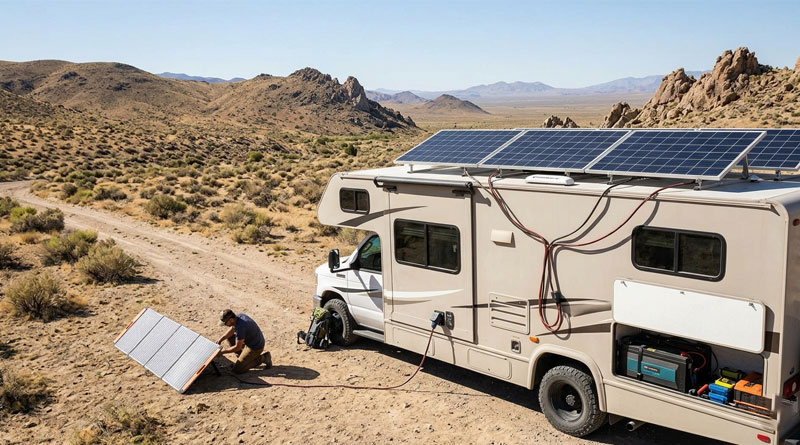
Choosing the right solar setup is crucial for keeping your lights on, devices charged, and essential appliances running smoothly without the constant hum of a generator. This guide will illuminate the key factors to consider when selecting the best solar panels for your RV boondocking needs, ensuring you have ample power to extend your adventures further into the wild. Prepare to harness the sun’s energy and elevate your off-grid experience.
1. GRECELL 100W Portable Solar Panel

- Power Output: 100W, 20V
- Efficiency: Up to 23.5% (monocrystalline)
- Compatibility: Multiple DC adapters (8mm, 5.5*2.5mm, 3.5*1.35mm, 5.5*2.1mm) + Anderson Cable
- Material: Waterproof Oxford cloth, ETFE lamination
The GRECELL 100W Portable Solar Panel stands out as a versatile and efficient solution for RV boondockers and outdoor enthusiasts seeking reliable off-grid power. Designed with high-efficiency monocrystalline solar cells, it boasts an impressive conversion rate of up to 23.5%. Its comprehensive connectivity options, including multiple DC adapters and an Anderson cable, make it compatible with nearly all popular solar generators and portable power stations on the market. The built-in smart chip further optimizes charging speed while safeguarding your devices against overcharging and overloading.
Portability is a cornerstone of the GRECELL 100W panel. Its lightweight, bifold design, coupled with a zippered accessory pouch, makes transport and storage effortless, folding down compactly like a briefcase. Integrated kickstands allow for easy positioning to catch optimal sunlight, and reinforced grommets offer additional mounting options on RVs or tents. Constructed from durable, waterproof Oxford cloth and protected by ETFE lamination, this panel is built to withstand the rigors of outdoor use. Furthermore, its ability to combine with another panel for increased power output adds scalability.
- Pros:
- High conversion efficiency (23.5%)
- Wide compatibility with power stations
- Foldable, portable design with kickstands
- Cons:
- 100W might be low for heavy users
- No USB ports directly on panel
2. Renogy 400W Portable Solar Panel Suitcase

- Power Output: 400W
- Efficiency: 23% (A+ monocrystalline cells)
- Folded Dimensions: 33.7″x27.95″
- Weight: 30.2 lbs
The Renogy 400W Portable Solar Panel Suitcase is a formidable power solution designed for serious RV boondockers and off-grid adventurers who require significant energy output without sacrificing portability. Despite its high wattage, this panel folds down to a remarkably compact 33.7″x27.95″ and weighs just 30.2 lbs. Its setup is impressively swift, taking less than a minute with no tools required, thanks to sturdy, rust-proof kickstands that ensure stable positioning.
Constructed with premium materials, including reinforced fiberglass and an ETFE coating, the Renogy 400W panel is built for longevity and reliability in harsh outdoor conditions. The ETFE surface enhances UV resistance and waterproofing (IP67-rated), protecting the high-efficiency A+ monocrystalline cells, which maintain 23% efficiency even after years of use. An aluminum backsheet prevents overheating, further extending its lifespan. A standout feature is its parallel wiring design, which ensures uninterrupted power generation even when parts of the panel are under partial shading – a common challenge in wooded boondocking locations.
- Pros:
- Very high 400W power output
- Compact and lightweight for its wattage
- Extremely quick, tool-free setup
- Cons:
- Higher price point
- Still larger than smaller portable panels
3. ECO-WORTHY 200W Monocrystalline RV Solar Panel Kit
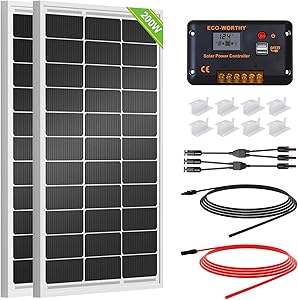
- Power Output: 200W (2x 100W panels)
- Efficiency: Up to 21.5% (monocrystalline)
- System Voltage: 12V/24V (with included 30A PWM controller)
- Dimensions (per panel): 35.2″ x 23.1″ x 1.37″
The ECO-WORTHY 200 Watts Solar Panel Kit provides a comprehensive and efficient solution for RV boondockers looking for a fixed or semi-permanent solar setup. This kit includes two 100W high-efficiency monocrystalline solar panels, capable of delivering up to 21.5% conversion efficiency. The package is truly “complete and easy,” offering everything needed for immediate installation: a 30A PWM charge controller, Z mounting brackets, 16.4ft 10 AWG solar cables, 2-in-1 connectors, and a 4.92ft tray cable. This all-inclusive approach makes it an excellent choice for DIY enthusiasts or those seeking a hassle-free setup for their RV, camper, or caravan.
Designed for durability, the ECO-WORTHY panels feature corrosion-resistant aluminum alloy frames, allowing them to withstand harsh weather conditions including strong winds (2400Pa) and heavy snow loads (5400Pa). The IP65-rated junction box provides robust protection against environmental elements. The flexibility of connecting the panels in series for 24V systems or parallel for 12V systems, alongside the included charge controller, allows for adaptable power management tailored to your specific battery bank requirements.
- Pros:
- Complete kit with all installation components
- Durable, weather-resistant fixed panels
- High monocrystalline cell efficiency
- Cons:
- Not a portable, foldable solution
- PWM controller less efficient than MPPT
4. DOKIO 300W Portable Foldable Solar Panel Kit
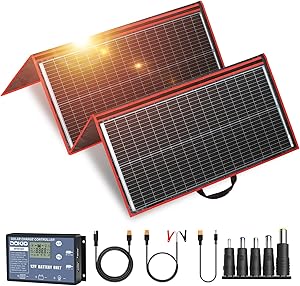
- Power Output: 300W
- Folded Dimensions: 19.3″ x 37.4″ x 1.1″
- Weight: 15.2 lbs
- Cable Length: 9.85ft (3m)
The DOKIO 300W Portable Foldable Solar Panel Kit offers a robust power solution for RV boondockers who need substantial wattage in a highly portable package. Weighing a mere 15.2 lbs and folding down to a compact 19.3×37.4×1.1 inches, this panel delivers serious energy output while remaining exceptionally easy to transport, mount, or store. Its lightweight design makes it an ideal companion for vans, boats, RVs, and emergency backup scenarios where space and mobility are key considerations. The high-grade monocrystalline cells ensure better conversion efficiency, capturing more sunlight for faster charging even in less-than-ideal conditions.
A standout feature is the inclusion of a separate PWM controller, which provides crucial protection against reverse polarity, overcharge, overload, and short-circuit, enhancing the safety and longevity of your 12V battery system. This separate controller can also be easily replaced or upgraded, offering future flexibility. The generous 9.85ft (3m) cable allows for flexible panel placement in direct sunlight while keeping your controller or power station safely shaded.
- Pros:
- High 300W output for its weight
- Very portable and lightweight
- Includes separate, protective PWM controller
- Cons:
- PWM controller is less efficient than MPPT
- Power station input limits may restrict full 300W
5. Renogy 200W Portable Solar Panel E.Flex

- Power Output: 200W
- Efficiency: 25% (16BB N-Type cell technology)
- Folded Dimensions: 23.72″ x 22.99″ x 1.97″
- Weight: 13.89 lbs
The Renogy 200W Portable Solar Panel, part of their E.Flex series, is an advanced and remarkably efficient power solution for RV boondockers prioritizing performance and portability. Boasting an industry-leading 25% efficiency thanks to upgraded 16BB N-Type cell technology, it significantly outperforms standard panels, delivering more power from the same amount of sunlight. This higher efficiency is particularly beneficial in limited spaces or during cloudy conditions, ensuring faster energy generation and a higher daily output for charging batteries or running appliances. Its certification to UL 61730 standards also provides assurance of safety and reliability for your off-grid power needs.
Weighing just 13.89 lbs, this is one of the lightest 200W panels in its class, folding down to a backpack-friendly size of 23.72 x 22.99 x 1.97 inches. The innovative magnetic closure simplifies setup and storage, a notable upgrade from traditional snap or Velcro designs. Beyond MC4 output for power stations and 12V battery systems, it features versatile charging capabilities with 1 USB-C PD (45W max) and 2 USB-A ports (18W & 15W). The stable, adjustable kickstands (40°/ 50°/ 60° angles) and IP65-rated, dust and splash-proof construction ensure robust performance in diverse outdoor environments.
- Pros:
- Industry-leading 25% efficiency
- Extremely lightweight and compact
- Multiple direct USB charging ports (USB-C PD, USB-A)
- Cons:
- Premium price point
- 200W might be insufficient for very high demands
6. DOKIO 200W Portable Foldable Solar Panel Kit

- Power Output: 200W
- Folded Dimensions: 20″ x 27″ x 1.1″
- Weight: 9.7 lbs
- Cable Length: 9.84ft (3m)
The DOKIO 200W Portable Foldable Solar Panel Kit is an excellent choice for RV boondockers who prioritize ultra-light portability and efficient power generation. Weighing a mere 9.7 lbs and folding down to a compact 20×27×1.1 inches, this panel is exceptionally slim and easy to carry, making it perfect for those with limited storage space in RVs, vans, boats, or trailers. Its high-efficiency monocrystalline cells ensure robust energy conversion. The panel’s design focuses on ease of use for immediate off-grid power, whether for camping or emergency backup.
This kit thoughtfully includes a separate PWM controller, vital for protecting your 12V battery system from common charging hazards like overcharge, reverse polarity, and short-circuits. The separate design also allows for easy replacement or future upgrades. A generous 9.84ft (3m) cable grants the flexibility to position the panel optimally in direct sunlight while keeping the controller or power station in the shade for cooler operation.
- Pros:
- Extremely lightweight (9.7 lbs)
- Highly portable and compact
- Includes protective separate PWM controller
- Cons:
- PWM controller is less efficient than MPPT
- Power station input limits may restrict full 200W
7. Renogy 200W Monocrystalline Fixed RV Solar Panel Kit

- Power Output: 200W (Monocrystalline)
- Efficiency: 22% (High solar cell efficiency)
- Charge Controller: Renogy Adventurer-Li 30A LCD PWM
- Frame Material: Corrosion-resistant aluminum
The Renogy 200 Watts 12 Volts Monocrystalline RV Solar Panel Kit offers a durable and efficient fixed solar solution, perfect for RVers, campers, and boat owners seeking a reliable, long-term power source for boondocking. This kit features high-performance monocrystalline panels boasting 22% solar cell efficiency, ensuring excellent power generation even with a smaller footprint. Designed for permanent installation, these panels come with a robust, corrosion-resistant aluminum frame that can withstand harsh outdoor elements, including strong winds (2400Pa) and snow loads (5400Pa), guaranteeing decades of reliable service.
The kit is made complete with the Renogy Adventurer-Li 30A LCD PWM charge controller, designed for clean, flush mounting on RV walls. This controller provides essential protection against overcharging, overload, short-circuit, and reverse polarity, safeguarding your 12V battery system. It also supports various battery types, including lithium, lead-acid, and gel, offering versatility. Installation is straightforward with pre-drilled holes and plug-and-play cables, and the newly added Y branch connectors facilitate parallel wiring for increased current if desired.
- Pros:
- High 22% monocrystalline efficiency
- Durable, weather-resistant fixed panels
- Includes a protective 30A PWM charge controller
- Cons:
- Not a portable, foldable solution
- PWM controller less efficient than MPPT
How to Purchase Your RV Solar Setup: A Comprehensive Buyer’s Blueprint
Transitioning to solar power for RV boondocking is more than just buying a shiny glass panel; it is an investment in your off-grid independence. While the technology has become highly accessible, navigating the sea of specs, system types, and compatibility requirements can easily lead to costly buying mistakes. This blueprint breaks down the exact decision-making process to ensure you purchase the perfect solar equipment for your unique travel style, energy footprint, and technical comfort level.
Step 1: Calculate Your Energy Budget (The Math Before the Money)
Never purchase a solar setup based on guesswork. Underestimating your needs means dead batteries in the middle of nowhere, while overestimating wastes hundreds of dollars and adds unnecessary weight to your rig. To find your magic number, you must calculate your Daily Watt-Hour (Wh) consumption.
| Appliance | Watts | Hours Used per Day | Daily Watt-Hours (Wh) |
|---|---|---|---|
| LED Lights (x4) | 24W (total) | 5 hours | 120 Wh |
| 12V Compressor Fridge | 50W (average draw) | 24 hours (cycled 35%) | 420 Wh |
| Laptop Charger | 65W | 3 hours | 195 Wh |
| Water Pump | 60W | 0.5 hours | 30 Wh |
| Total Daily Demand: | – | – | 765 Wh |
To safely cover a 765 Wh daily draw, factoring in typical system inefficiencies (around 15-20%), you need a solar array capable of generating roughly 950 Wh per day. In average conditions with 4 to 5 hours of peak sunlight, a 200W to 300W solar setup is your target sweet spot.
Step 2: Match Your Battery Chemistry to Your Solar Goals
Your solar panels only produce power; your batteries store it. When purchasing your solar components, you must ensure compatibility with your battery bank’s chemistry. Not all charge controllers work with all batteries.
- Lead-Acid (Flooded/AGM): These are inexpensive upfront but can only be discharged to 50% capacity without damage. If you have 200Ah of AGM batteries, you only have 100Ah of usable power. They also charge slowly during the “absorption” phase, meaning your solar panels must work longer to top them off.
- Lithium Iron Phosphate (LiFePO4): These are highly recommended for serious boondockers. They offer a 100% depth of discharge, charge incredibly fast, and last up to 10 times longer than lead-acid options. When buying your kit, ensure the included charge controller has a dedicated Lithium charging profile (such as the Renogy Adventurer-Li in Kit #7).
Step 3: Choose Your Form Factor (Fixed vs. Portable)
How do you travel? Your boondocking style dictates whether you should purchase a permanently mounted roof kit or a portable briefcase system.
Buy a Fixed Roof-Mounted Kit (Like Eco-Worthy #3 or Renogy #7) if:
- You want “set-it-and-forget-it” power that charges your batteries while you drive.
- You want to keep your interior storage spaces completely free of bulky gear.
- You prioritize security; roof-mounted panels are bolted down and very difficult to steal.
- You primarily camp in wide-open public lands (such as BLM land out West) with no tree canopy.
Buy a Portable Foldable Suitcase (Like GRECELL #1, Renogy #2, or DOKIO #6) if:
- You love camping in the shade of state parks or forests but still want to catch the sun. Portable panels can be placed up to 30 feet away in direct sunlight using extension cables.
- You do not want to drill holes in your RV roof or deal with complex permanent wiring.
- You have a smaller vehicle (like a campervan, teardrop trailer, or truck camper) with limited roof real estate.
- You want the ability to manually angle your panels toward the sun throughout the day to boost efficiency by up to 40%.
Step 4: Decode the Solar Panel Technology
When clicking “Add to Cart,” pay close attention to the solar cell technology. If budget allows, always buy Monocrystalline panels. They use high-purity silicon, allowing them to convert up to 25% of sunlight into energy (as seen in the premium Renogy E.Flex #5). Polycrystalline panels are cheaper but require significantly more physical space to produce the same wattage, which is a major drawback on space-constrained RVs.
Additionally, look for premium protective coatings. For portable panels, ETFE lamination is vastly superior to PET plastic. ETFE is highly heat-resistant, self-cleaning, boasts better light transmittance, and will not peel or yellow after a couple of seasons in the sun.
Step 5: Select the Right Charge Controller (PWM vs. MPPT)
The charge controller is the unsung hero of your system. It sits between your panels and batteries to prevent overcharging. Many entry-level kits package a basic PWM controller, but this might not be the best purchase for your needs.
- PWM (Pulse Width Modulation): Best for budget-conscious buyers with small systems (under 200W). They act as a simple switch. While cheap, they waste about 20-30% of your panels’ potential power because they force the panel to operate at the battery’s lower voltage.
- MPPT (Maximum Power Point Tracking): Essential for setups over 200W or cold-weather camping. MPPT controllers act like an automatic transmission, constantly paired to calculate the optimal voltage and current. They convert excess voltage into usable charging current, boosting your system’s efficiency by up to 30%. If you buy a kit with a PWM controller, consider budgeting for an aftermarket MPPT upgrade down the road.
Step 6: Assess Portability Specs for Storage and Handling
If you choose a portable panel, do not overlook physical dimensions and weight. A 400W suitcase like the Renogy #2 is an absolute powerhouse, but it weighs over 30 lbs and measures nearly 3 feet across when folded. Make sure you physically measure your RV’s basement storage compartments, under-bed spaces, or closets before purchasing to ensure the panel will actually fit inside your rig during transit.
Step 7: Check the Connections and Expandability
Before checking out, verify how the solar panel will connect to your power setup:
- For Solar Generators / Portable Power Stations: Look for portable panels that include a multi-connector cable (like the GRECELL #1 or DOKIO kits). You will need to match the output connector (such as 8mm, XT60, or Anderson) to the input port of your specific power station brand.
- For Traditional RV 12V Battery Banks: Ensure the kit contains standard MC4 connectors, heavy-duty tray cables, and ring terminals to hook directly to your battery terminals.
- Future Growth: Can you add more panels later? Buying a kit with a larger charge controller than you currently need (for example, a 30A controller with only 200W of panels) allows you to purchase and daisy-chain additional panels later without replacing the core brain of your system.