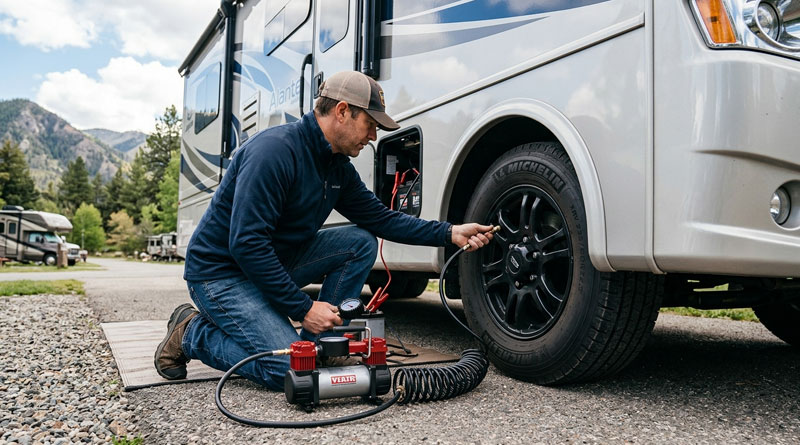
Maintaining the correct air pressure in your RV tires isn’t just about maintenance; it’s your primary defense against highway disasters. Under-inflated tires are a leading cause of blowouts, poor fuel economy, and premature tread wear. Given the immense weight of a motorhome or trailer, a standard gas station pump simply won’t cut it. This guide explores the most reliable tire inflators specifically engineered for the high-pressure demands of the RV lifestyle, ensuring you stay mobile and safe.
1. ALL-TOP Dual Cylinder 12V Portable RV Tire Inflator

- Max Pressure: 150 PSI
- Air Flow: 12.35 ft³/min
- Weight: 24 LBS
- Cylinders: Dual Aluminum
The ALL-TOP Dual Cylinder inflator is a beast designed for those who don’t want to wait around. With a staggering 12.35 CFM airflow, it dominates the market in terms of raw speed. It is built with a hollow metal shell and dual aluminum cylinders, which aren’t just for show; they provide the thermal management necessary to keep the unit running during back-to-back tire fills. This is the go-to choice for large rigs and off-roaders who frequently air down and back up.
Beyond its power, the kit is surprisingly safety-conscious, featuring integrated thermal cut-off switches to protect the motor from burnout. The package includes a 26ft rubber hose, which is essential for reaching the rear duallys on a long wheelbase. While it is significantly heavier than plastic alternatives, that weight translates to stability and durability. It feels like a professional-grade tool because it is, making it a staple for full-time travelers who prioritize hardware that can take a beating.
- Pros:
- Industry-leading airflow for near-instant inflation
- Industrial-grade dual aluminum cylinder build
- Excellent reach with 26ft hose
- Advanced thermal and over-current protection
- Cons:
- Heavy at 24 lbs, making it less “tossable”
- Significant power draw from the battery
- Excessive for small travel trailers or vans
2. VEVOR 12V Portable Heavy Duty RV Tire Inflator

- Max Pressure: 150 PSI
- Air Flow: 7.06 CFM
- Power Cord: 6.5 ft
- Air Hose: 26 ft
VEVOR has carved out a niche for providing “pro-sumer” gear at a price point that makes sense for the average weekend camper. This 12V unit offers a respectable 7.06 CFM, which strikes a perfect balance between speed and portability. It’s capable of handling the high-pressure requirements of Class C motorhomes without the bulk of the larger dual-cylinder competition. The design is utilitarian, focusing on a straightforward user experience that gets the job done without complex menus.
Safety is handled by an auto-thermal cut-off, ensuring that if you push the machine too hard on a hot afternoon, it will shut down before permanent damage occurs. The inclusion of three nozzle adapters makes it a versatile tool for the campsite, allowing you to switch from tire maintenance to inflating kayaks or bike tires in seconds. It’s a reliable mid-range option that provides enough “oomph” for most RV applications while remaining light enough to move around easily.
- Pros:
- High performance-to-price ratio
- Great versatility for multi-sport campers
- Compact enough for small storage bays
- Includes a long reach 26ft air hose
- Cons:
- Mechanical gauge can be harder to read at night
- Lacks the rapid speed of 12+ CFM units
- Requires a direct 12V connection
3. AstroAI Dual Power Portable Tire Inflator
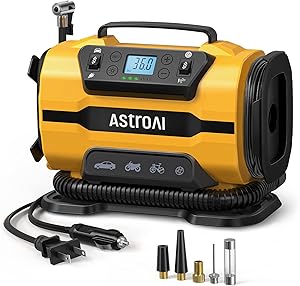
- Power: 12V DC / 120V AC
- Max Pressure: 150 PSI
- Continuous Work: 15 mins
- Inflation Rate: 350 L/min
The AstroAI Dual Power model is the ultimate choice for the RVer who wants flexibility. By supporting both 12V DC (car battery) and 110V AC (shore power), you can top off your tires in the driveway using a wall outlet or on the side of the road using your vehicle’s power. This unit features a dual-motor setup that separates high-pressure tasks from high-volume tasks. This means you aren’t using the same motor to fill a 100 PSI tire that you use to blow up an air mattress.
One of its standout tech features is OmniVent Technology, which uses an axial flow fan to pull heat away from the internals. This helps mitigate the heat soak issues common in smaller portable units. The digital interface is a major plus, offering an auto-shutoff feature that lets you set your target PSI and walk away. It even remembers your last setting, which is a small but appreciated convenience when you are working your way around four or six identical tires.
- Pros:
- Flexible AC/DC power options
- Dedicated modes for tires vs. inflatables
- Accurate digital display with auto-stop
- Advanced cooling technology
- Cons:
- 15-minute duty cycle is shorter than heavy-duty units
- Not intended for heavy-duty commercial trucks
- Plastic housing is less rugged than metal units
4. ETENWOLF VORTEX S6 Cordless Heavy-Duty RV Tire Inflator

- Battery: 19200 mAh Lithium
- Air Flow: 1.5 CFM
- Max Pressure: 160 PSI
- Duty Cycle: 100%
The ETENWOLF VORTEX S6 represents the future of tire maintenance: cordless freedom. Powered by a massive 19200 mAh battery, this unit eliminates the frustration of tangled cords and limited reach. It is specifically built for heavy-duty vehicles like the F150 or Class B motorhomes, capable of high-pressure output without being tethered to a battery. The 100% duty cycle is its most impressive feat, allowing it to run continuously until the job is done without needing “rest” breaks.
Beyond the inflation capabilities, it serves as a multi-functional emergency tool. The integrated 1000-lumen LED light is bright enough to illuminate a midnight tire change, and the USB-C port allows it to double as a power bank for your mobile devices. It features a vivid orange housing for high visibility on the road and a smart interface with seven preset modes. This is the ideal tool for the minimalist RVer who wants one device to handle everything from safety to emergency lighting.
- Pros:
- True cordless portability with massive battery
- 100% duty cycle for non-stop work
- Powerful built-in emergency lighting
- Fast charging with USB-C output
- Cons:
- Battery maintenance required (don’t let it sit empty)
- Slower CFM compared to wired dual-cylinder models
- Premium price for cordless technology
5. GSPSCN Heavy Duty Dual Cylinder Tire Inflator

- Inflation Speed: 70L/min
- Max Pressure: 150 PSI
- Power Cord: 11.5 ft
- Air Hose: 11.5 ft
GSPSCN has prioritized efficiency with their direct-drive dual-cylinder design. They claim a “6X faster” inflation speed, which translates to filling a standard tire in roughly 60 seconds. For an RVer, this speed is vital when checking pressures before a morning departure. The direct-drive motor is engineered to run at a lower RPM while maintaining high output, which keeps the noise levels down to a relatively quiet 70dB—much appreciated in a quiet campground at 7:00 AM.
The build quality utilizes “Integrated Molding Technology,” which essentially means fewer moving parts and a more robust metal core. This contributes to a significantly longer service life compared to cheaper, vibratory compressors. While the air hose and power cord lengths are modest at 11.5 feet each, the total combined reach is sufficient for most medium-sized trailers. It’s a solid, no-nonsense workhorse for those who value speed and mechanical simplicity over digital bells and whistles.
- Pros:
- Extremely fast fill times for large tires
- Quiet operation compared to rivals
- Durable metal internal components
- Stable rubber feet reduce “walking” during use
- Cons:
- Analog gauge may lack digital precision
- Requires careful heat management (no auto-cutoff)
- Combined reach may be short for 40ft rigs
6. VIAIR 88P Portable On/Offroad RV Tire Inflator
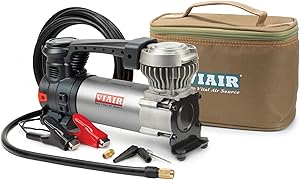
- Max Pressure: 120 PSI
- Air Flow: 1.47 CFM
- Max Tire Size: 33 inches
- Power Source: Alligator Clips
VIAIR is the gold standard for many in the off-road and RV communities, and the 88P is their entry-level heavy-duty champion. Unlike many cheap inflators that plug into a cigarette lighter and blow a fuse, the 88P uses alligator clips to draw power directly from the battery. This ensures a steady, powerful current that the gearless motor uses to inflate tires up to 33 inches. It is a maintenance-free unit that is built to last for decades, not just a few seasons.
While it doesn’t have the highest CFM on this list, it is widely regarded for its reliability and “duty cycle” honesty. It includes a brass twist-on chuck which provides a much more secure connection than clip-on versions, preventing air leakage during the high-pressure stage of inflation. It’s a compact, “set it and forget it” tool that fits into tight storage compartments. For the RVer who wants a brand they can trust and a tool that won’t fail in the middle of nowhere, the 88P is a legendary choice.
- Pros:
- Proven long-term reliability and brand reputation
- Secure brass twist-on chuck
- Permanent-magnet motor is very efficient
- Compact and includes a quality carry bag
- Cons:
- 120 PSI limit may be tight for heavy Class A rigs
- No cigarette lighter option (battery clips only)
- Slower than dual-cylinder models
7. AstroAI Heavy Duty DC Portable RV Tire Inflator

- Max Pressure: 160 PSI
- Continuous Work: 40 mins
- Cylinders/Motors: Dual Metal
- Hose/Cord Length: 16.4’ hose, 11.5’ cord
This AstroAI variant is a specialized DC-only machine that brings “TurboRise” technology to the RV market. By utilizing dual metal motors and twin cylinders, it achieves a 40-minute continuous run time. This is a critical specification for RVers; if you have six tires to fill from 80 to 100 PSI, a 15-minute duty cycle will force you to stop and wait for the machine to cool down twice. This unit lets you finish the job in one go.
The interface is fully digital and highly accurate, which is essential when you are dealing with the high-pressure sensitivities of heavy-duty tires. It offers a combined reach of nearly 28 feet when you account for the power cord and the air hose, making it one of the most accessible units for long fifth-wheels. With a 160 PSI maximum, it also has the highest ceiling on our list, ensuring it can handle the most demanding Goodyear Endurance or G-rated tires without breaking a sweat.
- Pros:
- Impressive 40-minute continuous run time
- Highest max PSI (160) for heavy-duty tires
- Accurate digital presets and auto-shutoff
- Dual power connection options (clips or plug)
- Cons:
- No AC power option for home use
- Slightly larger footprint than the single-cylinder models
- Limited to 33-inch tire diameter
How to Purchase RV Tire Inflator?
Buying an RV tire inflator isn’t the same as picking up a pump for a soccer ball. The stakes are higher, the pressures are greater, and the environment is much more demanding. To make an informed purchase, you need to look past the marketing jargon and understand the mechanical reality of air compression. Here is a deep dive into the criteria that matter.
1. Understand Your Tire’s PSI Requirements
Before you even look at a product, check your tire’s sidewall. Many RV tires, especially those on larger trailers or Class A diesel pushers, require pressures between 80 and 110 PSI. Some “heavy duty” car inflators struggle once they hit 60 PSI, slowing down to a crawl or overheating. You need a unit rated for at least 120 to 150 PSI to ensure it has the “headroom” to push air into an already high-pressure tire. If your tires require 110 PSI, a 120 PSI pump will be working at its absolute limit, whereas a 150 PSI pump will handle it comfortably.
2. Airflow: CFM vs. PSI
PSI is the pressure, but CFM (Cubic Feet per Minute) is the volume. This is where most buyers get confused. A high PSI rating means the pump can fill the tire, but a high CFM rating determines how long you’ll be standing in the rain or sun waiting for it to finish.
- Low CFM (Under 1.5): Best for topping off a few pounds or for smaller trailers.
- High CFM (2.0 – 7.0+): Essential for large RV tires (22.5 inches) or for filling a tire from flat. Dual-cylinder models usually offer the highest CFM.
3. The Duty Cycle Dilemma
Compressors generate an immense amount of heat. The “Duty Cycle” is a percentage of time a compressor can run in a set period (usually 10-20 minutes) before it needs to cool down.
- A 25% duty cycle means 5 minutes on, 15 minutes off. This is frustrating if you have four tires to fill.
- A 100% duty cycle (like the ETENWOLF VORTEX S6) means it can run continuously.
For an RV, aim for at least a 33% to 50% duty cycle at the specific pressure you need. Checking the fine print is vital, as duty cycles often drop as the pressure increases.
4. Power Source and Voltage
How will you power the unit? You have three main choices:
- 12V Cigarette Lighter: Convenient, but limited by the vehicle’s fuse (usually 15 amps). This limits the power of the motor.
- 12V Battery Clips (Alligator Clips): These connect directly to your RV or truck battery, allowing for much higher amperage and more powerful motors (like the VIAIR 88P).
- 110V AC Plug: Perfect if you are at a campsite with shore power or in your garage at home.
- Cordless (Battery): Offers the most freedom but requires you to keep the battery charged.
5. Reach and Portability
RVs are long. If you buy a pump with a 10-foot cord and a 3-foot hose, you won’t reach the back tires of a 30-foot trailer. You need a total “reach” (cord + hose) of at least 25 to 30 feet. Alternatively, a cordless model solves this problem entirely. Also, consider storage space. RV storage bays are precious real estate; look for a unit that comes with a dedicated carry bag to keep the hoses and adapters organized.
6. Digital vs. Analog Gauges
Analog gauges (the ones with a needle) are durable and don’t need batteries, but they can be hard to read accurately. Digital gauges are precise and often come with an “Auto-Shutoff” feature. This is a game-changer: you set the screen to 95 PSI, start the pump, and it stops exactly when it hits the target. This prevents over-inflation, which can be just as dangerous as under-inflation.
7. Build Quality: Metal vs. Plastic
If you are a “weekend warrior,” a high-quality plastic-housed unit might suffice. However, if you are a full-timer or travel in extreme temperatures (desert heat or mountain cold), look for a metal-bodied compressor. Metal dissipates heat much better than plastic, preventing the internal seals from melting under heavy use. Dual-cylinder units with aluminum heat sinks are the gold standard for durability.
8. Essential Accessories
Check what’s in the box. A good RV kit should include:
- Thread-on or Locking Chuck: Holding a chuck against a valve for 5 minutes is exhausting. A locking chuck lets you stand up.
- Extension Hoses: Useful for reaching inner dually tires.
- Adapters: For your bike tires, sports balls, and air mattresses.
- LED Work Light: Most tire issues happen at dawn, dusk, or in the rain. An integrated light is a life-saver.
9. Brand Reputation and Warranty
In the world of air compressors, you get what you pay for. Brands like VIAIR and AstroAI have established service histories in the RV community. Look for a warranty of at least one year. Because these devices use high-speed moving parts and high heat, cheap “no-name” versions often fail after just a few uses. Reading real-world reviews from other RV owners (who deal with the same high pressures you do) is the best way to gauge longevity.
10. Safety Features
Finally, never buy a high-output compressor without Thermal Overload Protection. This is a simple sensor that kills the power if the motor reaches a dangerous temperature. Without it, the unit can literally melt its own wiring or cause a fire. Over-current protection (fuses) is also a must to protect your vehicle’s electrical system from a surge.
By prioritizing these technical factors over the lowest price, you ensure that when you’re on the side of a highway in the middle of a trip, your inflator will actually work. It is a small investment that protects your much larger investment: your RV and your family’s safety.