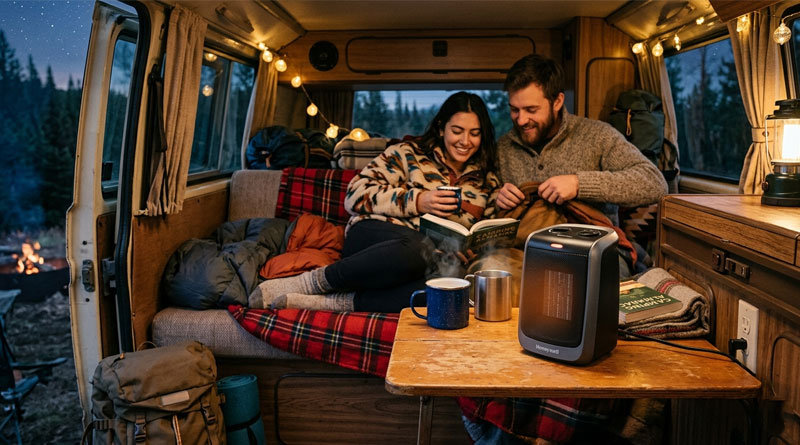
Nature is breathtaking until the temperature drops and your tent feels like a refrigerator. While a crackling campfire provides the perfect aesthetic, it rarely wins the battle against a frosty midnight chill inside your shelter. A dedicated space heater is the true MVP of cold-weather camping, turning a shivering night into a plush retreat. By balancing power sources, rigorous safety sensors, and packable designs, you can ensure your outdoor sanctuary remains toasted, safe, and ready for sunrise.
1. Dreo Space Heater 2024 Upgraded

- Power: 1500W PTC Ceramic
- Heat Delivery: Hyperamics heat funnel, 200% farther reach
- Thermostat Range: 41-95℉ with 1℉ increments
- Noise Level: 34dB
The Dreo 2024 Upgrade is a precision-engineered warmth engine for the modern camper. Utilizing a Hyperamics funnel system, it doesn’t just radiate heat; it projects it. This allows the unit to warm up a van or tent interior significantly faster than standard ceramic models. If you have access to shore power, this unit acts as a climate control hub, offering 1-degree increments for those who are particular about their sleeping temperature.
Safety is baked into the hardware with a dedicated tilt-detection sensor and an NTC chipset that prevents the unit from ever reaching dangerous internal temperatures. The brushless motor is a standout feature for light sleepers, operating at a library-quiet 34dB. It’s a sophisticated choice for those who want their portable shelter to feel exactly like a climate-controlled bedroom, wrapped in a flame-retardant, ETL-certified chassis that prioritizes your peace of mind above all else.
- Pros:
- Hyper-directional airflow reaches further
- Incredibly granular temperature settings
- Whisper-quiet brushless DC motor
- Robust tilt and overheat sensors
- Cons:
- High power draw requires 15A circuit
- Best suited for hard-floor placement
2. GiveBest Portable Electric Space Heater

- Heat Settings: 1500W / 750W / Cool Fan
- Heating Area: Up to 200 square feet
- Thermostat Range: 41℉ to 95℉
- Noise Level: Lower than 45dB
The GiveBest unit is the Swiss Army knife of campsite climate control. It’s a 2-in-1 hybrid that earns its keep in your gear bin regardless of the season. During summer treks, the “cool fan” mode provides much-needed air circulation in stuffy tents, while the 1500W heater mode tackles the autumn frost. Its compact, retro-inspired box design is surprisingly rugged, making it easy to tuck into a corner of a crowded RV or a small tent vestibule.
What makes this model a favorite is its simplicity. The manual-style thermostat dial is intuitive and reliable, cycling the PTC ceramic elements on and off to maintain a steady environment without constant manual adjustment. It covers up to 200 square feet efficiently, which is plenty for most family-sized tents. Built from flame-retardant ABS, it features the “must-have” safety duo: tip-over protection and overheat shutoff, ensuring your 2-in-1 companion doesn’t become a hazard during an adventurous night under the stars.
- Pros:
- Versatile summer/winter dual-mode
- Very lightweight for easy porting
- Intuitive thermostat cycling
- Quick-heat ceramic technology
- Cons:
- Fixed direction (no oscillation)
- Analog dials lack precise degree display
3. Dreo Atom One Portable Electric Heater

- Power: 1500W PTC Ceramic
- Oscillation: 70° wide-angle
- Thermostat Range: 41-95℉ with 1℉ increments
- Noise Level: 37.5 dB
If you find that standard heaters leave you with one hot foot and one frozen shoulder, the Dreo Atom One is your solution. Its 70° wide-angle oscillation is a game-changer for shared camping spaces, sweeping warmth across the entire interior rather than blasting a single spot. This movement, paired with Hyperamics technology, ensures that every corner of your RV or large tent reaches a uniform temperature, preventing the “cold pockets” that often plague outdoor shelters.
The “Shield360” safety system is one of the most comprehensive on the market, including a reinforced safety plug and V-0 rated fire-resistant materials. For those camping on a battery bank or mindful of their generator’s fuel, the ECO mode is a standout feature. It intelligently throttles the power based on the ambient temperature, maintaining comfort while squeezing every drop of efficiency out of your power source. It’s a high-tech, compact tower that brings “smart home” comfort to the rugged outdoors.
- Pros:
- Smooth 70° oscillation for even heat
- Energy-efficient ECO mode
- Included remote for midnight adjustments
- Compact tower footprint
- Cons:
- Vertical design can be easier to tip
- Internal fan moves a lot of air
4. Dr Infrared Heater Portable
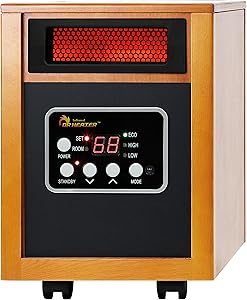
- Power: 1500-Watt (12.5 Amps)
- Heating System: Dual (Infrared Quartz + PTC)
- Heat Output: 5200 BTU (for large rooms)
- Noise Level: 39 dB
- Weight: 24 lbs
When the mercury drops into “extreme” territory, you need the heavy hitter: the Dr Infrared Heater. Unlike smaller units that only heat the air, this dual-system beast uses Infrared Quartz and PTC to warm objects directly. This is vital for camping in thin-walled RVs or tents where warm air escapes easily through the fabric. It generates a massive 5200 BTUs, providing a deep, “sun-like” heat that feels much more natural and penetrating than a standard fan heater.
While it’s the heaviest on our list at 24 lbs, the built-in caster wheels make it manageable for RV use. It’s designed for longevity, featuring a lifetime filter and a robust blower that stays remarkably quiet at 39 dB. The cherry wood finish might seem luxury-focused, but the performance is pure utility. For base camps or large trailers where you need to maintain a “living room” level of warmth for several people, this is the most powerful electric option available.
- Pros:
- Hybrid infrared tech warms bodies, not just air
- Massive 5200 BTU output
- Exceptional durability for long-term use
- Caster wheels for easy RV repositioning
- Cons:
- Quite heavy and bulky for small tents
- Requires significant storage space in transit
5. BLACK+DECKER Portable Space Heater

- Power Settings: 750W (Low) / 1500W (High)
- Weight: 2.8 lbs
- Dimensions: 7.3” x 6.3” x 9.2”
- Cord Length: 6 feet
The BLACK+DECKER Portable Heater is the epitome of “grab-and-go” warmth. Weighing in at less than three pounds, it’s designed for the minimalist camper who still wants the luxury of a warm sleeping bag. Its footprint is barely larger than a loaf of bread, allowing it to sit on a small camping crate or a tiny RV shelf without dominating the space. The 6-foot cord is generous enough to reach outlets tucked behind furniture or at the base of a tent pole.
Performance-wise, it offers two heat levels and a fan-only setting, giving you the flexibility to manage your power consumption. The low 750W setting is particularly useful for campers using smaller portable power stations that might trip on a full 1500W load. Despite its budget-friendly price point, it doesn’t skip on safety—overheat protection and an auto-tip-over switch are standard. It’s a reliable, no-nonsense heater for anyone who needs to maximize every square inch of their camping setup.
- Pros:
- Incredibly lightweight and easy to pack
- Low 750W setting is battery-bank friendly
- Trusted brand reliability
- Sturdy integrated carry handle
- Cons:
- Small fan isn’t meant for large areas
- Basic aesthetic compared to modern towers
6. Dreo 25″ Fast Portable Room Heater

- Heating Speed: 11.5 ft/s
- Oscillation: 70° wide-angle
- Noise Level: 25dB (minimum)
- Safety: Child lock, Tip-over, Overheat
The Dreo 25-inch tower is for the “glamper” who refuses to compromise on silence or speed. This heater moves air at a staggering 11.5 feet per second, meaning you can feel the warmth from across a large RV almost the moment you hit the power button. What sets it apart is the specialized airflow system that brings noise levels down to 25dB. That is quieter than a whisper, making it the premier choice for light sleepers who find the “whir” of standard fans irritating.
Technologically, this is one of the most advanced heaters on the list. It features a precise thermal sensor that works in tandem with ECO mode to maintain your target temperature with 1-degree accuracy. For camping families, the addition of a child lock provides a layer of security that smaller, simpler units lack. While its height makes it a bit of a storage challenge in a packed car, the sheer comfort of silent, oscillating warmth makes it worth the extra cargo space.
- Pros:
- Quietest operation in its class (25dB)
- High-velocity air movement
- Child lock safety feature
- Elegant digital interface
- Cons:
- Taller profile is easier to knock over
- Takes up more vertical storage space
7. Amazon Basics Ceramic Space Heater
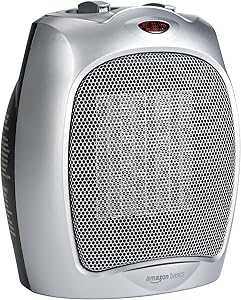
- Power Settings: 1500W / 900W / Fan Only
- Weight: 3 lbs
- Dimensions: 7.52″ x 6.34″ x 9.45″
- Noise Level: 43 dB
The Amazon Basics Ceramic Space Heater is the “old reliable” of the camping world. It’s an entry-level unit that focuses entirely on the fundamentals: getting hot and staying safe. There are no remotes to lose in the grass and no complex digital menus to navigate in the dark. Just a simple dial for the thermostat and another for the power level. This simplicity makes it a great backup heater or a primary source for weekend warriors who need a quick solution for a chilly night.
Don’t let the “Basics” name fool you regarding safety. It is fully equipped with tip-over and overheat protection, performing just as safely as models twice its price. The 900W “Low” setting is a nice middle ground for saving power without losing too much heat. It’s a workhorse—compact, effective, and small enough to throw into a backpack or a small storage bin. If you want a heater that does exactly what it says on the box without any fluff, this is it.
- Pros:
- Very budget-friendly
- Simple, durable analog controls
- Compact “cube” shape for easy packing
- Rapid ceramic heat-up
- Cons:
- No remote or timer features
- Not suitable for high-humidity environments
The Ultimate Guide to Procuring Your Camping Space Heater
Buying a space heater for the outdoors is fundamentally different from buying one for a guest bedroom. In a house, you have insulation, stable power, and fire-resistant drywall. In a tent or RV, you have thin fabric, fluctuating power, and limited ventilation. This 1,000-word deep dive will guide you through the technical, environmental, and practical nuances of purchasing the perfect heating unit for your next adventure.
1. Evaluating the Power Infrastructure
Before you even look at a heater, you must look at your power source. This is the #1 mistake campers make. Most high-quality electric space heaters run at 1500 Watts on their high setting. Mathematically, that pulls about 12.5 Amps. If your campsite only provides a 15-Amp circuit and you try to run a heater plus a coffee maker or a hair dryer, you will trip the breaker every single time.
If you are “boondocking” (camping without hookups), you need a massive battery bank. A 1500W heater will drain a 100Ah lithium battery in about 45 minutes. For off-grid users, look for heaters with a “Low” setting (750W-900W) or consider propane. If you are using a portable power station like a Jackery or EcoFlow, check the “Continuous Output” rating. If it’s rated for 1000W, a 1500W heater won’t even turn on.
2. The Propane vs. Electric Debate
This is the fork in the road for every camper. Electric heaters (like the ones reviewed above) are the “gold standard” for safety. They don’t emit carbon monoxide and they don’t have an open flame. However, they tether you to a power outlet. If you love staying at established campgrounds with RV hookups, electric is the only way to go. It’s cheaper to run and significantly quieter.
Propane heaters, on the other hand, offer total freedom. You can take them to the middle of the desert or deep into a national forest. But they come with a “safety tax.” You must ensure proper ventilation to prevent Carbon Monoxide (CO) poisoning. Even if the heater has an Oxygen Depletion Sensor (ODS), never trust your life to a single sensor. If you buy a propane unit, you must also buy a standalone, battery-operated CO detector to keep inside your tent.
3. Understanding Heating Technology (BTUs vs. Watts)
When shopping, you’ll see two different measurements of heat: Watts for electric and BTUs for propane.
- Ceramic PTC: Most modern portable heaters use Positive Temperature Coefficient (PTC) ceramic. They are efficient and don’t “glow red,” making them safer around fabrics.
- Infrared: This is great for drafty RVs. Infrared waves don’t care about the wind; they warm your skin directly. If you camp in a tent where the wind blows through the mesh, a ceramic fan heater will lose all its heat to the breeze. An infrared heater will keep you warm anyway.
- BTU Calculation: If you are looking at propane, a 4,000 to 9,000 BTU heater is standard for a 2-4 person tent. For a large RV, you may need 12,000+ BTUs.
4. Critical Safety Check-List
Because you are in a small, flammable space, safety features are non-negotiable.
- Auto Tip-Over: Tents have uneven floors. A sleeping bag could easily catch the edge of a heater and knock it over. Without this sensor, the heater will keep running against the fabric until it ignites. Never buy a camping heater without this.
- Overheat Shutoff: If a piece of clothing falls on the heater, the internal temperature will spike. This sensor kills the power before the plastic melts or a fire starts.
- V0 Fire Rating: This is a material certification. It means the plastic shell of the heater is self-extinguishing. Even if an internal component fails, the heater won’t become a torch.
5. Portability and “Cram-ability”
Space is the ultimate currency in camping. A 25-inch tower heater might feel great in a living room, but can you fit it in your trunk next to the cooler, the tent, and the sleeping bags? Look for heaters with “recessed” or “integrated” handles. Folding handles or sticks that poke out are prone to breaking during transit. If you are a backpacker, you likely won’t carry a space heater at all, but for car campers, “square” designs (like the Amazon Basics or GiveBest) are much easier to pack because they don’t leave “dead space” around them in your gear bin.
6. The Noise Factor
In the silence of the woods, a 50dB fan sounds like a jet engine. If you are a light sleeper, pay attention to the decibel ratings.
- 30dB-35dB: Quiet library level. You can sleep through this easily.
- 40dB-45dB: Standard white noise. Some people find this helpful for blocking out campsite noises (like a neighbor’s generator).
- 50dB+: Distracting. You’ll have to turn the TV or your conversation volume up.
7. Digital vs. Analog Controls
In 2026, many heaters have touchscreens and Wi-Fi. Ask yourself: Do you really need that? In a camping environment, Analog dials are often better. They are more durable and can be operated while wearing gloves. Digital screens are nice for precision, but they can be hard to read in direct sunlight and are more prone to glitching if they get damp or cold. However, Remotes are a true luxury—being able to turn the heat up from inside your sleeping bag at 3:00 AM without touching the cold floor is worth the extra $10.
8. Determining Your “Warmth Zone”
Are you trying to heat the whole tent, or just your feet? If you’re solo, a small 500W-750W personal heater is better. It uses less power and provides targeted warmth. If you have a family of four in a “cabin-style” tent, you need an oscillating tower or a powerful infrared unit. Oscillation is the key here; if a heater sits still, the person right in front of it will be sweating while the people in the corners are freezing.
9. Maintenance and Longevity
Camping is dirty. Dust, dog hair, and pine needles will get into your heater’s intake. Look for models with removable, washable filters. If the intake gets clogged, the heater will overheat and shut off constantly. A unit that is easy to wipe down and has a protected heating element will last you many seasons, whereas a cheap, open-coil heater will likely burn out after one dusty trip.
10. Final Purchase Strategy
Always buy your heater before the season starts. Prices for space heaters spike in October and November. When you receive your heater, do a “test run” at home first. Plug it into an outlet that shares a circuit with other items to see if it trips your home breaker. If it does, you know you’ll have to be very careful at the campsite. Check for any “new heater smell” (off-gassing) and run it for an hour in a ventilated room to burn off any manufacturing oils before you’re trapped in a small tent with those fumes.
By prioritizing Safety Sensors and Power Compatibility over flashy aesthetics, you’ll find a heater that doesn’t just look good on a shelf, but actually keeps you alive and comfortable when the mountain air turns biting. Happy (and warm) trails!